QUESTION IMAGE
Question
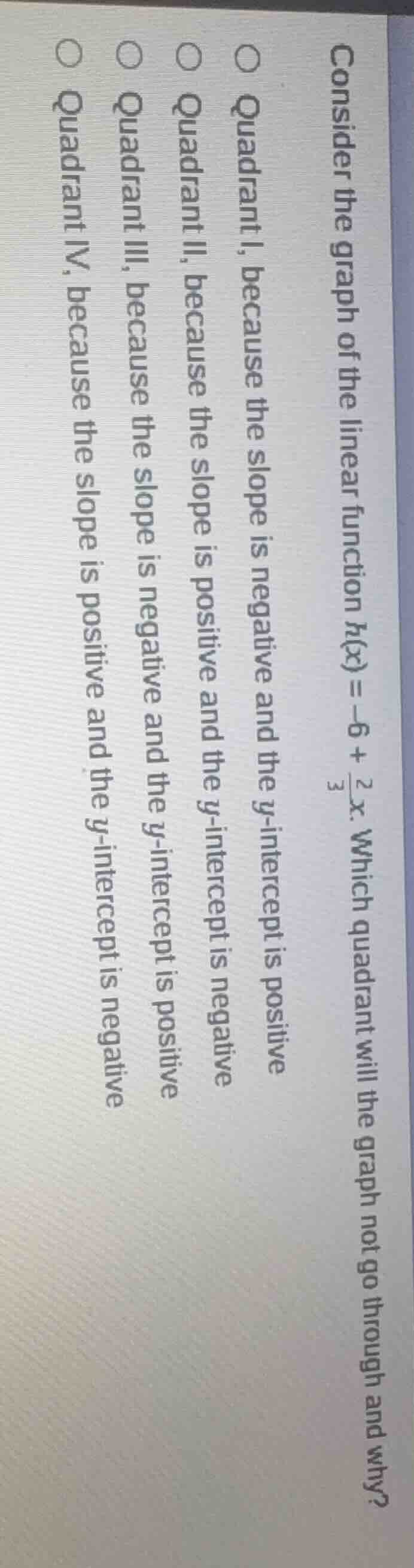
consider the graph of the linear function ( h(x) = -6 + \frac{2}{3}x ). which quadrant will the graph not go through and why?
- quadrant i, because the slope is negative and the y - intercept is positive
- quadrant ii, because the slope is positive and the y - intercept is negative
- quadrant iii, because the slope is negative and the y - intercept is positive
- quadrant iv, because the slope is positive and the y - intercept is negative
Step1: Identify slope and y-intercept
The linear function is \( h(x)=-6 + \frac{2}{3}x \), which can be written in slope - intercept form \( y = mx + b \) (where \( m \) is the slope and \( b \) is the y - intercept) as \( y=\frac{2}{3}x-6 \). So, the slope \( m=\frac{2}{3}\) (positive) and the y - intercept \( b = - 6\) (negative).
Step2: Analyze the graph based on slope and y - intercept
- A positive slope means the line rises from left to right.
- A negative y - intercept means the line crosses the y - axis at \( (0,-6) \).
Let's consider the quadrants:
- Quadrant I: \( x>0,y > 0 \). Since the slope is positive and y - intercept is negative, when \( x \) is large enough (e.g., \( x = 9 \), then \( y=\frac{2}{3}\times9-6=6 - 6 = 0\); when \( x = 12\), \( y=\frac{2}{3}\times12-6 = 8 - 6=2>0\)), the line will enter Quadrant I.
- Quadrant II: \( x<0,y > 0 \). If \( x<0 \), then \( y=\frac{2}{3}x-6\). Since \( x<0 \), \( \frac{2}{3}x<0 \), and subtracting 6 (a negative number operation: \( \text{negative}-\text{positive}=\text{negative} \)) will make \( y<0 \). So the line will not enter Quadrant II.
- Quadrant III: \( x<0,y < 0 \). When \( x<0 \), \( \frac{2}{3}x<0 \), and \( y=\frac{2}{3}x - 6\) (a negative number minus 6 is more negative), so the line will pass through Quadrant III.
- Quadrant IV: \( x>0,y < 0 \). When \( x \) is small (e.g., \( x = 0\), \( y=-6\); when \( x = 3\), \( y=\frac{2}{3}\times3-6=2 - 6=-4\)), the line will pass through Quadrant IV.
Since the slope is positive (\( m=\frac{2}{3}>0 \)) and the y - intercept is negative (\( b=-6 < 0\)), the line will not go through Quadrant II. The option that says "Quadrant II, because the slope is positive and the y - intercept is negative" is incorrect? Wait, no, the question is which quadrant the graph will not go through. Wait, let's re - check:
Wait, let's take the slope and y - intercept again. The slope is positive (\( m=\frac{2}{3}\)) and y - intercept is negative (\( b=-6\)).
The line \( y = \frac{2}{3}x-6 \):
- When \( x = 0\), \( y=-6\) (on the y - axis, below the origin).
- As \( x \) increases (moves to the right), \( y \) increases (since slope is positive). So the line starts in Quadrant IV (when \( x>0,y<0 \) for small \( x \)), goes through Quadrant III (when \( x < 0,y<0 \)) and then into Quadrant I (when \( x>0,y > 0 \) for large \( x \)). It never goes into Quadrant II because for \( x<0 \), \( y=\frac{2}{3}x-6\). Since \( x<0 \), \( \frac{2}{3}x<0 \), and \( y=\frac{2}{3}x - 6<0\) (because a negative number minus 6 is still negative). But wait, the options:
Wait, the options are:
- Quadrant I, because the slope is negative and the y - intercept is positive (wrong, slope is positive, y - intercept is negative)
- Quadrant II, because the slope is positive and the y - intercept is negative (this is the correct reason for not going through Quadrant II)
- Quadrant III, because the slope is negative and the y - intercept is positive (wrong, slope is positive, y - intercept is negative)
- Quadrant IV, because the slope is positive and the y - intercept is negative (wrong, the line does go through Quadrant IV)

Snap & solve any problem in the app
Get step-by-step solutions on Sovi AI
Photo-based solutions with guided steps
Explore more problems and detailed explanations
Quadrant II, because the slope is positive and the y - intercept is negative