QUESTION IMAGE
Question
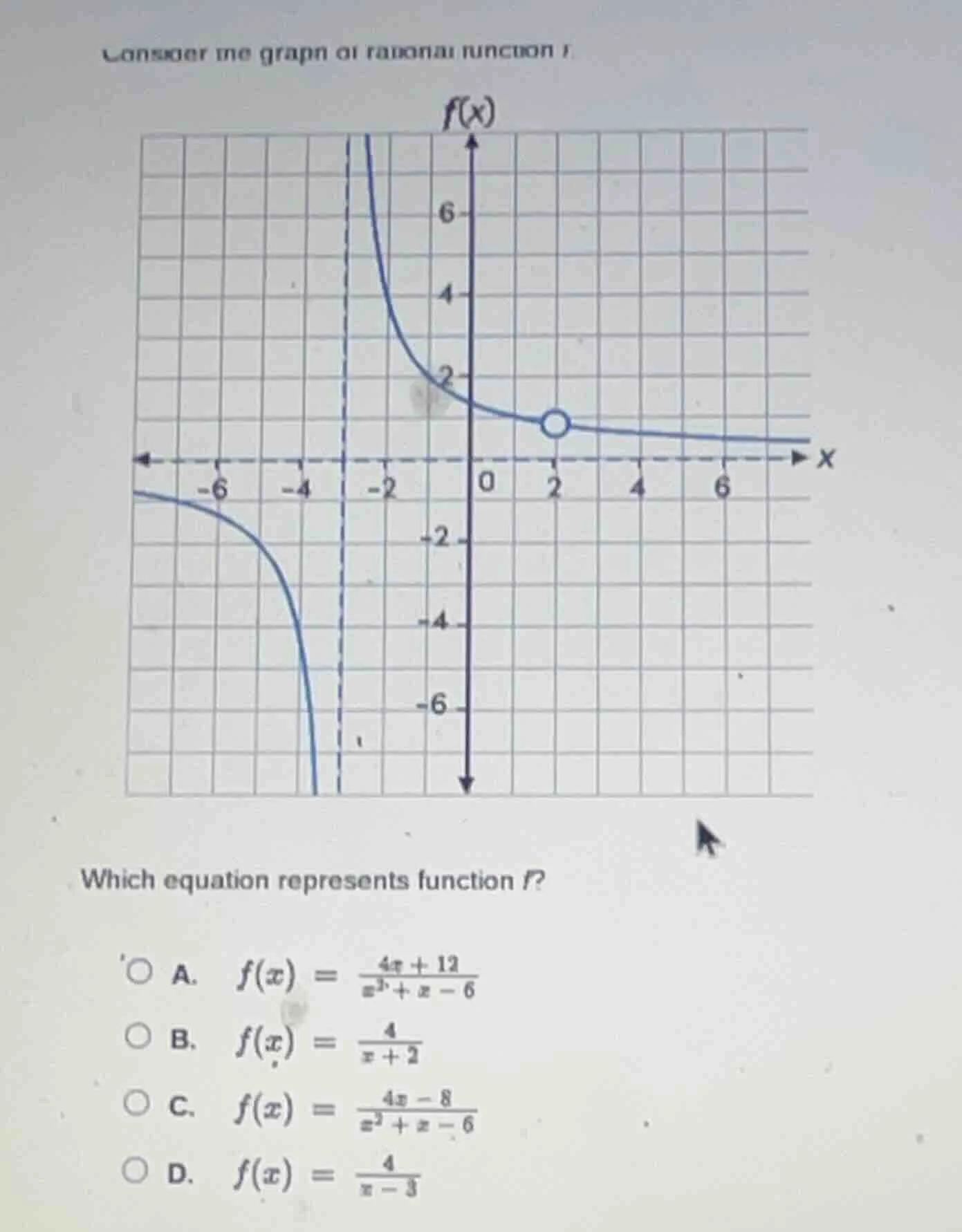
consider the graph of rational function f. which equation represents function f? a. $f(x) = \frac{4x + 12}{x^2 + x - 6}$ b. $f(x) = \frac{4}{x + 2}$ c. $f(x) = \frac{4x - 8}{x^2 + x - 6}$ d. $f(x) = \frac{4}{x - 3}$
Step1: Identify vertical asymptote
From the graph, the vertical asymptote is $x=-3$. For a rational function, vertical asymptotes occur where the denominator is zero (and numerator is not zero at that point). Let's check denominators:
- Option A: $x^2+x-6=(x+3)(x-2)$, zero at $x=-3,2$
- Option B: $x+2$, zero at $x=-2$
- Option C: $x^2+x-6=(x+3)(x-2)$, zero at $x=-3,2$
- Option D: $x-3$, zero at $x=3$
Eliminate B and D, since their asymptotes don't match.
Step2: Identify hole location
The graph has a hole at $x=2$ (the open circle). A hole occurs when a factor cancels in numerator and denominator.
- Option A: Numerator $4x+12=4(x+3)$, no $(x-2)$ factor, so no cancellation at $x=2$
- Option C: Numerator $4x-8=4(x-2)$, denominator has $(x-2)$, so this factor cancels, creating a hole at $x=2$
Step3: Verify simplified function
After canceling $(x-2)$ in Option C, we get $f(x)=\frac{4}{x+3}$, which matches the shape of the graph (decaying curve on both sides of $x=-3$, approaching 0 as $x\to\pm\infty$).

Snap & solve any problem in the app
Get step-by-step solutions on Sovi AI
Photo-based solutions with guided steps
Explore more problems and detailed explanations
C. $f(x) = \frac{4x - 8}{x^2 + x - 6}$