QUESTION IMAGE
Question
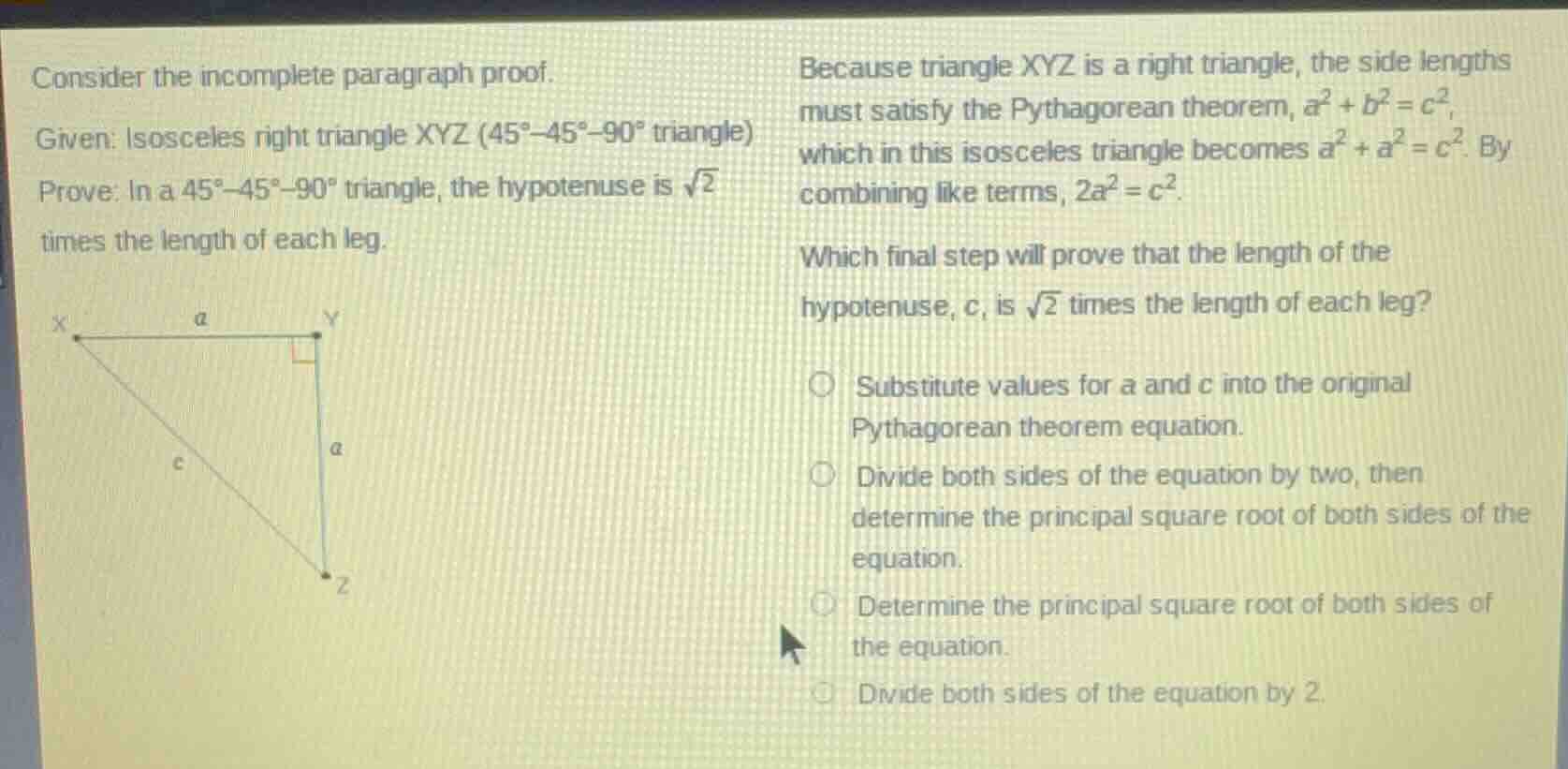
consider the incomplete paragraph proof.
given: isosceles right triangle xyz (45°–45°–90° triangle)
prove: in a 45°–45°–90° triangle, the hypotenuse is \\(\sqrt{2}\\) times the length of each leg.
because triangle xyz is a right triangle, the side lengths must satisfy the pythagorean theorem, \\(a^2 + b^2 = c^2\\), which in this isosceles triangle becomes \\(a^2 + a^2 = c^2\\). by combining like terms, \\(2a^2 = c^2\\).
which final step will prove that the length of the hypotenuse, c, is \\(\sqrt{2}\\) times the length of each leg?
- substitute values for a and c into the original pythagorean theorem equation.
- divide both sides of the equation by two, then determine the principal square root of both sides of the equation.
- determine the principal square root of both sides of the equation.
- divide both sides of the equation by 2.
Step1: Identify target relation
We need to derive $c = a\sqrt{2}$ from $2a^2 = c^2$.
Step2: Isolate $a^2$ term
Divide both sides of $2a^2 = c^2$ by 2:
$\frac{2a^2}{2} = \frac{c^2}{2}$
Simplify to get $a^2 = \frac{c^2}{2}$
Step3: Take principal square roots
Take principal square root of both sides:
$\sqrt{a^2} = \sqrt{\frac{c^2}{2}}$
Simplify to $a = \frac{c}{\sqrt{2}}$, then rearrange to $c = a\sqrt{2}$.

Snap & solve any problem in the app
Get step-by-step solutions on Sovi AI
Photo-based solutions with guided steps
Explore more problems and detailed explanations
Divide both sides of the equation by two, then determine the principal square root of both sides of the equation.