QUESTION IMAGE
Question
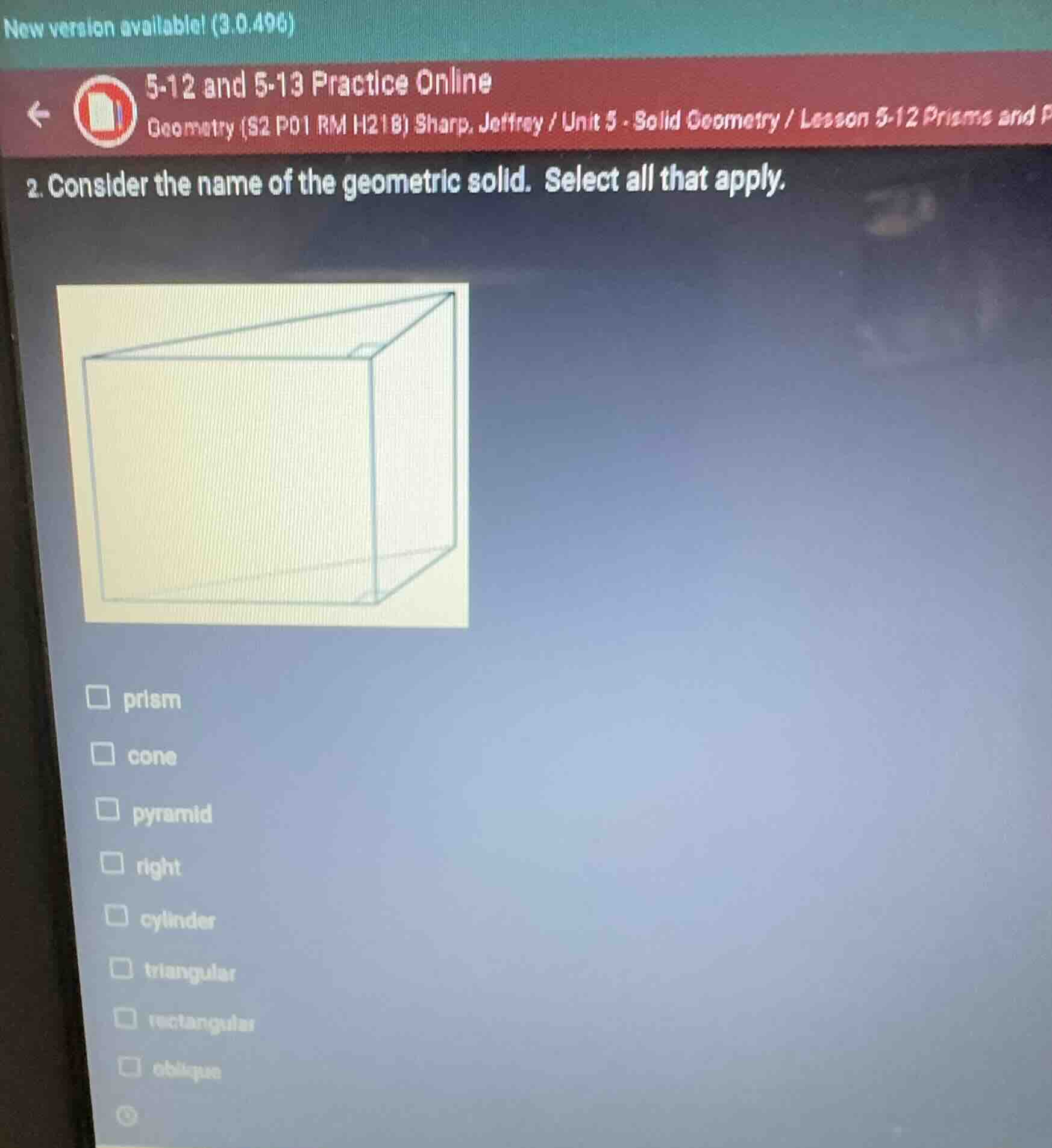
- consider the name of the geometric solid. select all that apply. image of a geometric solid options: prism, cone, pyramid, right, cylinder, triangular, rectangular, oblique
Brief Explanations
- Prism: A prism has two congruent polygonal bases connected by rectangular (or parallelogram) faces. The given solid has two triangular bases (wait, no, looking at the diagram—wait, actually, the front face? Wait, no, the diagram shows a solid with a triangular base? Wait, no, maybe it's a triangular prism? Wait, no, the options include "triangular", "rectangular", "prism", "oblique", "right". Wait, let's analyze each option:
- Prism: Yes, because it has two congruent bases (triangular, maybe) and lateral faces. So it's a prism.
- Cone: No, a cone has a circular base and a single vertex. This has two bases.
- Pyramid: No, a pyramid has one base and triangular faces meeting at a vertex. This has two bases.
- Right: Wait, no—wait, the diagram looks like an oblique prism? Wait, no, maybe it's a triangular prism, and also oblique? Wait, no, let's check the options. Wait, the solid: the top edge is slanted, so it's an oblique prism. Also, the base is triangular? Wait, the front face—wait, the diagram shows a solid with a triangular base (the right face is a rectangle? No, wait, the diagram: the base is a triangle, and the lateral faces—wait, maybe it's a triangular prism, oblique, and prism. Also, "triangular" because the base is a triangle, "prism" because it's a prism, "oblique" because the lateral edges are not perpendicular to the base (since the top is slanted), and maybe "prism" is correct, "triangular" (if the base is triangle), "oblique" (since it's slanted), and "prism" is correct. Wait, let's re-express:
- Prism: Correct, as it has two congruent bases (triangular) and lateral faces.
- Triangular: Correct, if the base is a triangle.
- Oblique: Correct, because the lateral edges are not perpendicular to the base (the top edge is slanted, so the prism is oblique, not right).
- Wait, but let's check the options again. The options are: prism, cone, pyramid, right, cylinder, triangular, rectangular, oblique.
- So:
- Prism: Yes, it's a prism (two bases, lateral faces).
- Triangular: If the base is a triangle (the right face looks like a triangle? Wait, the diagram: the front face is a rectangle, but the top is slanted. Wait, maybe the base is a triangle, so it's a triangular prism. So "triangular" is correct.
- Oblique: Because the lateral edges (the edges connecting the corresponding vertices of the two bases) are not perpendicular to the base, so it's an oblique prism (not a right prism, since right prism has lateral edges perpendicular to the base).
- Prism is correct.
- Triangular is correct (if the base is a triangle).
- Oblique is correct (since it's slanted, not right).
- Right: No, because it's slanted, so not right.
- Rectangular: No, because the base is triangular, not rectangular.
- Cylinder: No, cylinder has circular bases.
- Pyramid: No, pyramid has one base.
- Cone: No, cone has one base.
So the correct options are prism, triangular, oblique. Wait, but let's confirm:
- A prism is defined as a polyhedron with two congruent polygonal bases connected by parallelogram faces. If the bases are triangles, it's a triangular prism. If the lateral edges are not perpendicular to the bases, it's an oblique prism. So:
- Prism: Yes.
- Triangular: Yes (base is triangle).
- Oblique: Yes (lateral edges not perpendicular to base).
- The other options: cone (no), pyramid (no), right (no, because it's oblique), cylinder (no), rectangular (no, base…

Snap & solve any problem in the app
Get step-by-step solutions on Sovi AI
Photo-based solutions with guided steps
Explore more problems and detailed explanations
The correct options are:
- prism
- triangular
- oblique