QUESTION IMAGE
Question
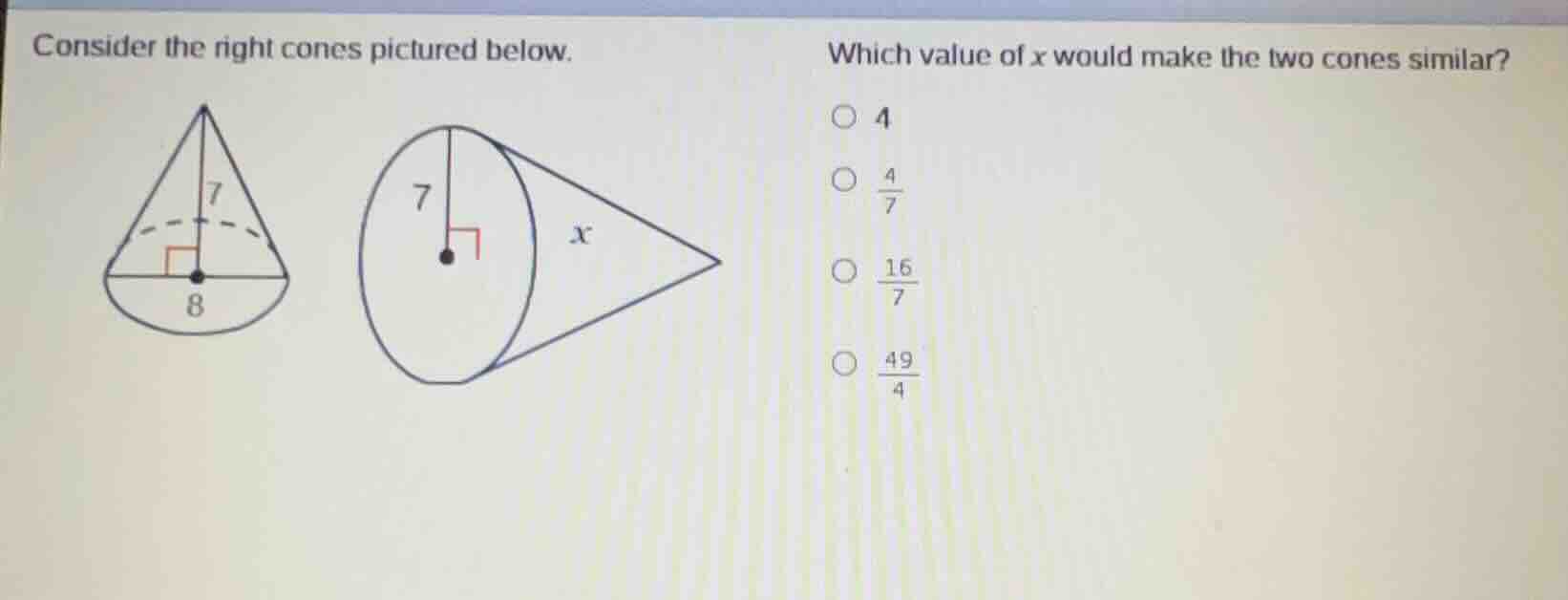
consider the right cones pictured below. which value of x would make the two cones similar? 4 \\(\frac{4}{7}\\) \\(\frac{16}{7}\\) \\(\frac{49}{4}\\)
Step1: Recall similarity of cones
For two right cones to be similar, the ratios of their corresponding linear dimensions (radius and height, or slant height) must be equal. First, find the radius of the first cone: the diameter is 8, so radius \( r_1=\frac{8}{2} = 4\), height \( h_1 = 7\). The second cone has radius \( r_2=7\) and slant height (or the corresponding linear part) \( x\), and its height should correspond to the first cone's height? Wait, no, actually, for similar cones, the ratio of radius to height (or radius to slant height, depending on the corresponding parts) should be equal. Wait, the first cone: radius 4, height 7. The second cone: radius 7, and the slant height (or the lateral edge) \( x\)? Wait, no, maybe the first cone's radius is 4 (since diameter 8), height 7. The second cone's radius is 7, and we need the ratio of radius to height (or the corresponding linear measure) to be equal. Wait, actually, for similar solids, the ratio of corresponding linear measurements is equal. So \(\frac{r_1}{h_1}=\frac{r_2}{x}\)? Wait, no, maybe the first cone: radius \( r_1 = 4\), height \( h_1 = 7\). The second cone: radius \( r_2 = 7\), and the height (or the slant height?) Wait, the second cone's diagram: the radius is 7 (the line from center to edge is 7, so radius 7), and the slant height (the side \( x\)). Wait, no, the first cone: base diameter 8, so radius 4, height 7. The second cone: base radius 7, and we need the ratio of radius to height (or radius to slant height) to be equal. Wait, actually, for similar cones, the ratio of radius to height should be equal. So \(\frac{r_1}{h_1}=\frac{r_2}{x}\)? Wait, no, maybe the first cone's radius is 4, height 7. The second cone's radius is 7, and the height (or the corresponding linear part) is \( x\)? Wait, no, let's set up the proportion: \(\frac{4}{7}=\frac{7}{x}\)? Wait, no, that would be if the ratios are equal. Wait, cross - multiply: \(4x = 7\times7\)? No, that would be wrong. Wait, maybe I mixed up. Wait, the first cone: radius \( r_1 = 4\) (diameter 8), height \( h_1 = 7\). The second cone: radius \( r_2 = 7\), and the slant height (or the lateral edge) \( x\). Wait, no, actually, for similar cones, the ratio of radius to height (or radius to slant height) should be equal. Wait, let's think again. The first cone: radius 4, height 7. The second cone: radius 7, and we need the ratio of radius to height (or the corresponding linear measure) to be equal. So \(\frac{r_1}{h_1}=\frac{r_2}{x}\)? Wait, no, maybe the first cone's radius is 4, height 7, and the second cone's radius is 7, and the height (or the slant height) is \( x\). So \(\frac{4}{7}=\frac{7}{x}\)? Solving for \( x\): \(4x=49\), so \(x = \frac{49}{4}\)? Wait, no, that's one of the options. Wait, let's check the proportion again.
Wait, the first cone: base radius \( r_1=\frac{8}{2}=4\), height \( h_1 = 7\). The second cone: base radius \( r_2 = 7\), and the slant height (or the lateral side) \( x\). For similar cones, the ratio of radius to height (or radius to slant height) should be equal. So \(\frac{r_1}{h_1}=\frac{r_2}{x}\)? Wait, no, maybe it's \(\frac{h_1}{r_1}=\frac{x}{r_2}\). Let's try that. \(\frac{7}{4}=\frac{x}{7}\). Then cross - multiply: \(4x = 49\), so \(x=\frac{49}{4}\). Yes, that makes sense. So the proportion is \(\frac{h_1}{r_1}=\frac{x}{r_2}\), because the height of the first cone corresponds to the slant height (or the lateral side) of the second cone, and the radius of the first cone corresponds to the radius of the second cone. So \(\frac{7}{4}=\frac{x}{7}\), then \(x=\frac{7\times7}{4}…

Snap & solve any problem in the app
Get step-by-step solutions on Sovi AI
Photo-based solutions with guided steps
Explore more problems and detailed explanations
\(\frac{49}{4}\)