QUESTION IMAGE
Question
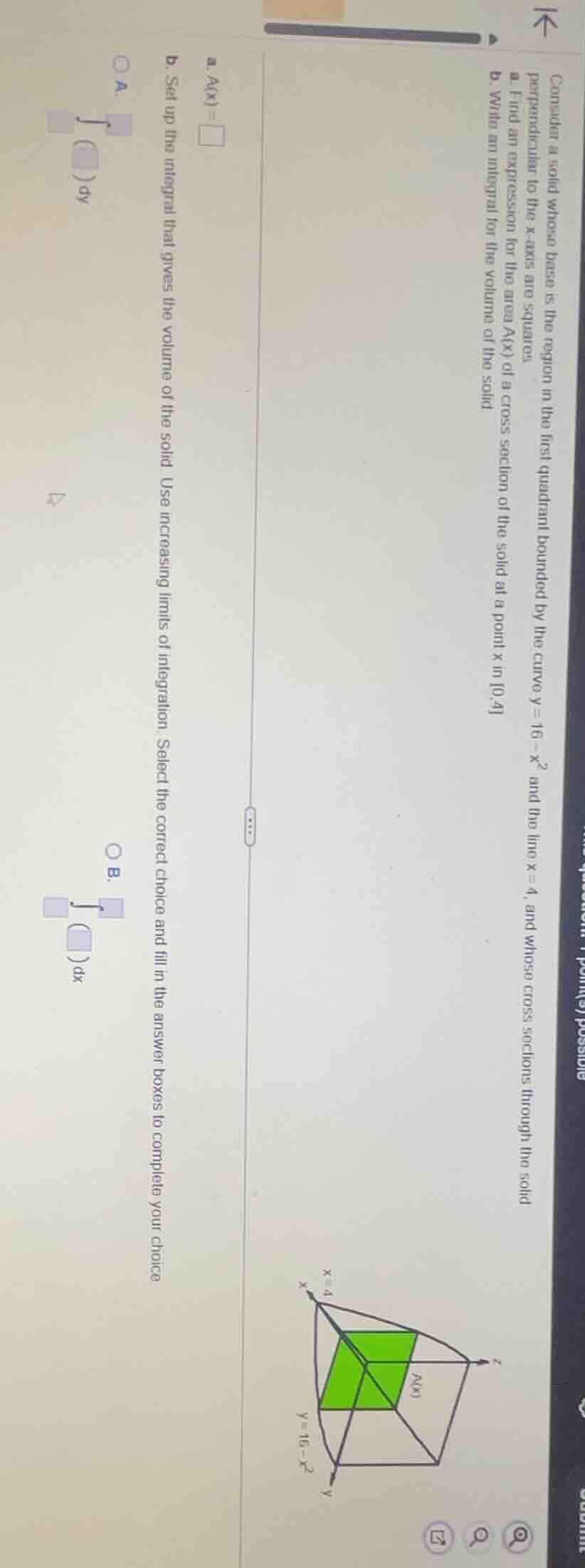
consider a solid whose base is the region in the first quadrant bounded by the curve ( y = 16 - x^2 ) and the line ( x = 4 ), and whose cross - sections through the solid perpendicular to the x - axis are squares.
a. find an expression for the area ( a(x) ) of a cross - section of the solid at a point ( x ) in (0,4)
b. write an integral for the volume of the solid
a. ( a(x)=square )
b. set up the integral that gives the volume of the solid. use increasing limits of integration. select the correct choice and fill in the answer boxes to complete your choice.
a. ( int_{}^{} (square) dy )
b. ( int_{}^{} (square) dx )
Part a: Find \( A(x) \)
Step 1: Understand the cross - section
The cross - sections are squares and they are perpendicular to the \( x \) - axis. The side length of the square at a given \( x \) is equal to the \( y \) - value of the function \( y = 16 - x^{2}\) (since the base of the solid is in the first quadrant bounded by \( y=16 - x^{2}\), \( x = 4\) and the axes). For a square, the area \( A=s^{2}\), where \( s\) is the side length. Here, \( s=y = 16 - x^{2}\).
Step 2: Calculate the area of the square
Using the formula for the area of a square \( A=s^{2}\), with \( s=16 - x^{2}\), we get \( A(x)=(16 - x^{2})^{2}\). We can expand this as \(A(x)=256-32x^{2}+x^{4}\), but the factored form \( (16 - x^{2})^{2}\) is also correct.
Step 1: Recall the volume formula for solids with known cross - sectional area
The volume \( V\) of a solid with cross - sectional area \( A(x)\) from \( x = a\) to \( x = b\) is given by the integral \( V=\int_{a}^{b}A(x)dx\).
Step 2: Determine the limits of integration
The region is in the first quadrant and \( x\in[0,4]\) (as given in the problem). The cross - sectional area function is \( A(x)=(16 - x^{2})^{2}\) and we integrate with respect to \( x\) (since the cross - sections are perpendicular to the \( x \) - axis). So the integral for the volume is \( V=\int_{0}^{4}(16 - x^{2})^{2}dx\). Also, looking at the options, option B is of the form \(\int_{}^{}()dx\) which matches our setup (the limits will be from 0 to 4 and the integrand is \((16 - x^{2})^{2}\)).

Snap & solve any problem in the app
Get step-by-step solutions on Sovi AI
Photo-based solutions with guided steps
Explore more problems and detailed explanations
\( A(x)=(16 - x^{2})^{2}\) (or \(A(x)=x^{4}-32x^{2} + 256\))