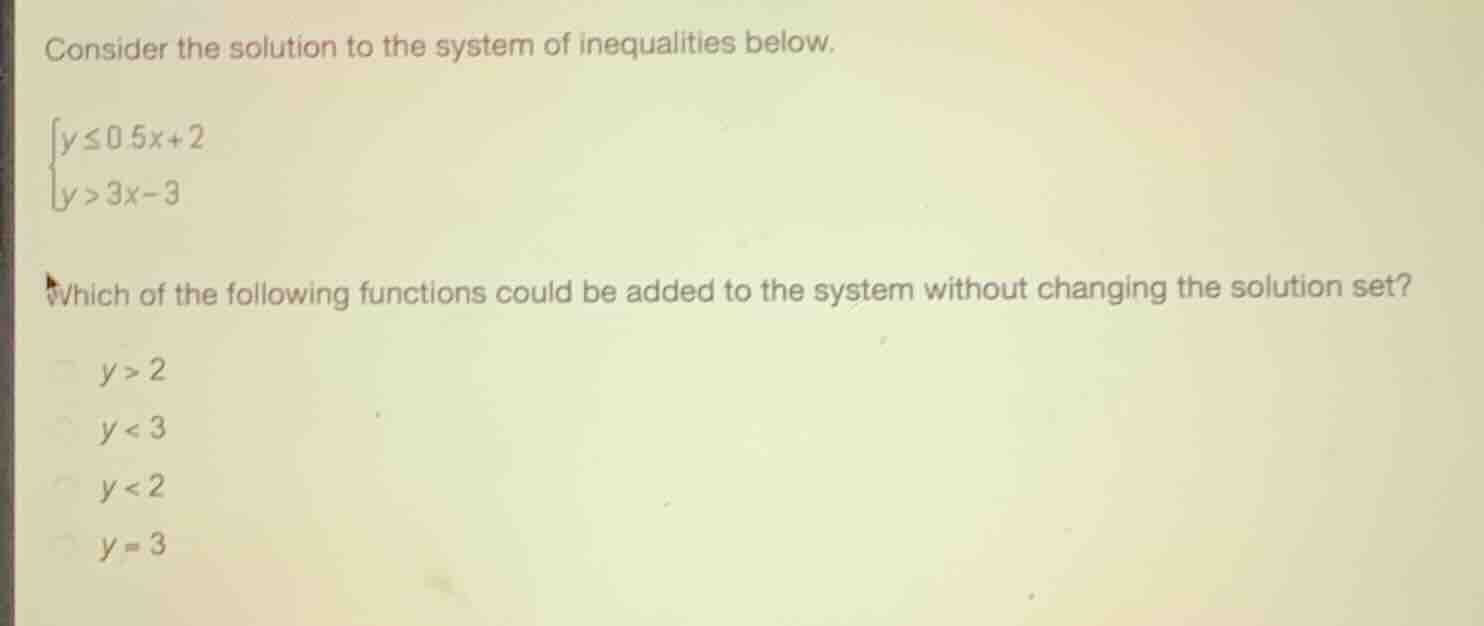
Step1: Find intersection of the two lines
To find the intersection of \( y = 0.5x + 2 \) and \( y=3x - 3 \), set them equal:
\( 0.5x + 2=3x - 3 \)
Subtract \( 0.5x \) from both sides: \( 2 = 2.5x-3 \)
Add 3 to both sides: \( 5 = 2.5x \)
Divide by 2.5: \( x = 2 \)
Substitute \( x = 2 \) into \( y = 0.5x + 2 \): \( y=0.5(2)+2=1 + 2=3 \)? Wait, no, \( 0.5\times2 = 1 \), \( 1+2=3 \)? Wait, but let's check with \( y = 3x-3 \): \( 3\times2-3=6 - 3=3 \). So the intersection point is \( (2,3) \).
Now, analyze the regions. The first inequality \( y\leq0.5x + 2 \) is the region below or on the line with slope 0.5 and y-intercept 2. The second inequality \( y>3x - 3 \) is the region above the line with slope 3 and y-intercept - 3.
Let's find the range of \( y \) values in the solution set. Let's take a test point in the solution region. For example, when \( x = 0 \), from \( y\leq0.5(0)+2=2 \) and \( y>3(0)-3=- 3 \), so \( - 33 \) and \( y\leq3 \) at \( x = 2 \) has no solution? Wait, no, the first inequality is \( y\leq0.5x + 2 \), at \( x = 2 \), \( y\leq3 \), the second is \( y>3x - 3=3 \), so at \( x = 2 \), \( y>3 \) and \( y\leq3 \) is impossible, so the solution set is where the two regions overlap, and the maximum \( y \) value in the solution set: let's see the line \( y = 0.5x + 2 \) and \( y=3x - 3 \) intersect at \( (2,3) \), but since \( y>3x - 3 \) (strict inequality) and \( y\leq0.5x + 2 \) (non - strict), the point \( (2,3) \) is not in the solution set (because \( y>3 \) at \( x = 2 \) would require \( y>3 \), but \( y\leq3 \) at \( x = 2 \)). Wait, maybe I made a mistake in calculation. Wait, \( 0.5x+2 \) and \( 3x - 3 \): solving \( 0.5x+2=3x - 3 \), \( 2 + 3=3x-0.5x \), \( 5 = 2.5x \), \( x = 2 \), then \( y=0.5*2 + 2=3 \), so the two lines intersect at \( (2,3) \). Now, for \( x<2 \), let's take \( x = 0 \), \( 0.5*0 + 2=2 \), \( 3*0-3=-3 \), so the region \( y> - 3 \) and \( y\leq2 \) (when \( x = 0 \)) is part of the solution. For \( x \) values less than 2, the upper bound of \( y \) from \( y\leq0.5x + 2 \) is less than 3 (since when \( x = 2 \), it's 3, and as \( x \) decreases, \( 0.5x + 2 \) decreases). The lower bound from \( y>3x - 3 \) increases as \( x \) increases. So the solution set has \( y<3 \)? Wait, no, when \( x \) is less than 2, \( 0.5x + 2<3 \), so \( y\leq0.5x + 2<3 \), and \( y>3x - 3 \). So the maximum \( y \) in the solution set is less than 3? Wait, no, let's check the line \( y = 0.5x + 2 \), as \( x \) increases, \( y \) increases, but the line \( y=3x - 3 \) also increases, and they intersect at \( (2,3) \). For \( x>2 \), \( 3x - 3>0.5x + 2 \) (since the slope of \( y = 3x-3 \) is greater than that of \( y = 0.5x + 2 \)), so the regions \( y\leq0.5x + 2 \) and \( y>3x - 3 \) do not overlap for \( x>2 \). For \( x = 2 \), as we saw, \( y>3 \) and \( y\leq3 \) is impossible. For \( x<2 \), \( 0.5x + 2>3x - 3 \) (since at \( x = 2 \) they are equal, and for \( x<2 \), the line with smaller slope \( 0.5x + 2 \) is above \( 3x - 3 \)). So in the solution set (for \( x<2 \)), \( y \) is bounded above by \( y\leq0.5x + 2 \) (which is less than 3 when \( x<2 \)) and below by \( y>3x - 3 \). So the \( y \) values in the solution set are all less than 3 (because the upper bound \( y = 0.5x + 2 \) is less than 3 for \( x<2 \), and at \( x = 2 \), there's no solution). S…