QUESTION IMAGE
Question
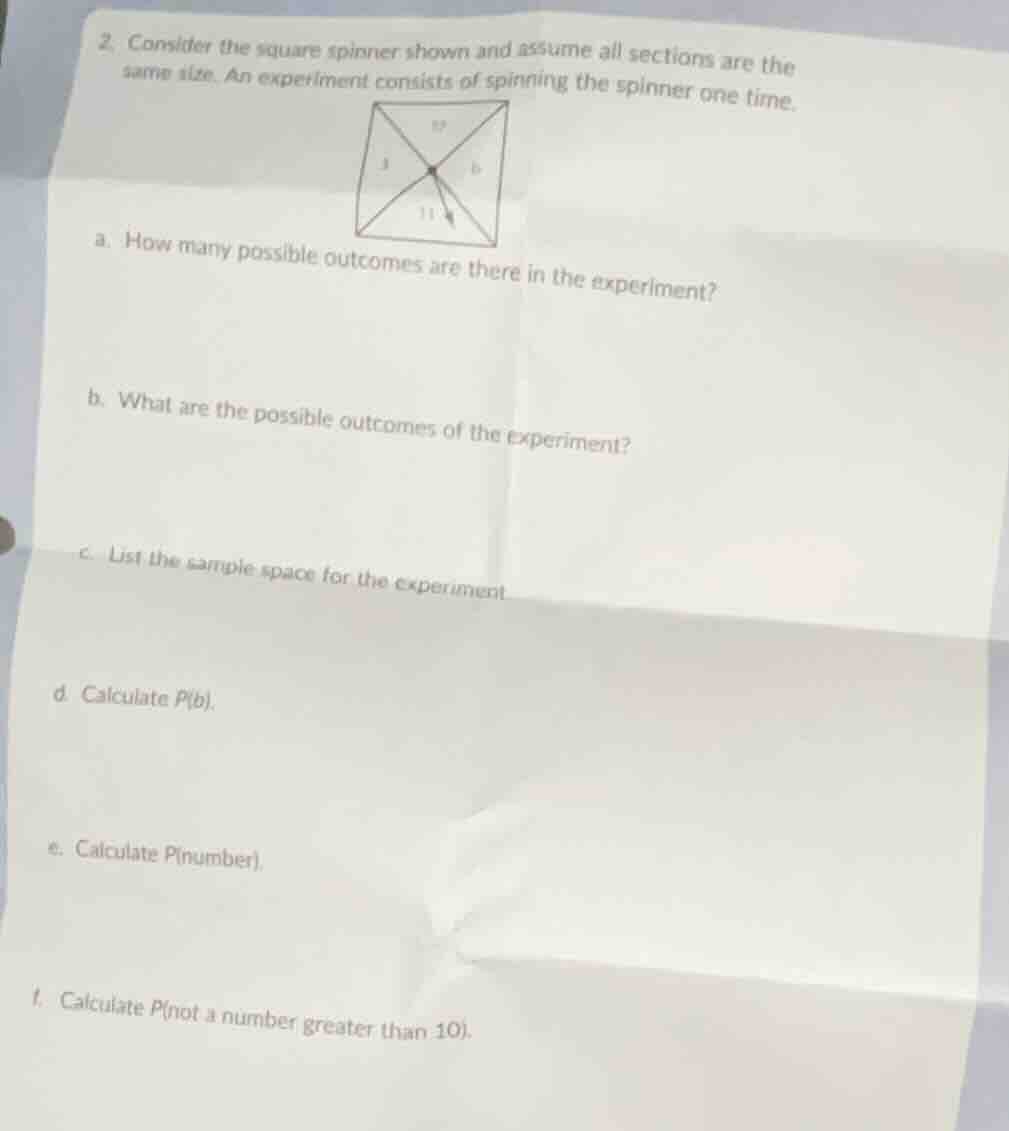
- consider the square spinner shown and assume all sections are the same size. an experiment consists of spinning the spinner one time.
a. how many possible outcomes are there in the experiment?
b. what are the possible outcomes of the experiment?
c. list the sample space for the experiment
d. calculate p(b).
e. calculate p(number).
f. calculate p(not a number greater than 10).
Step1: Count equal sections
The spinner has 4 equal sections.
Step2: Identify distinct outcomes
The sections are labeled 3, 17, b, 11.
Step3: Define sample space
Sample space = all unique outcomes.
Step4: Calculate P(b)
Probability = $\frac{\text{Number of favorable outcomes}}{\text{Total outcomes}}$ = $\frac{1}{4}$
Step5: Calculate P(number)
Count numeric outcomes: 3,17,11 (3 total). Probability = $\frac{3}{4}$
Step6: Calculate P(not >10)
Numbers >10: 17,11 (2 outcomes). Outcomes not >10: 3, b (2 total). Probability = $\frac{2}{4}$ = $\frac{1}{2}$

Snap & solve any problem in the app
Get step-by-step solutions on Sovi AI
Photo-based solutions with guided steps
Explore more problems and detailed explanations
a. 4
b. 3, 17, b, 11
c. $\{3, 17, b, 11\}$
d. $\frac{1}{4}$
e. $\frac{3}{4}$
f. $\frac{1}{2}$