QUESTION IMAGE
Question
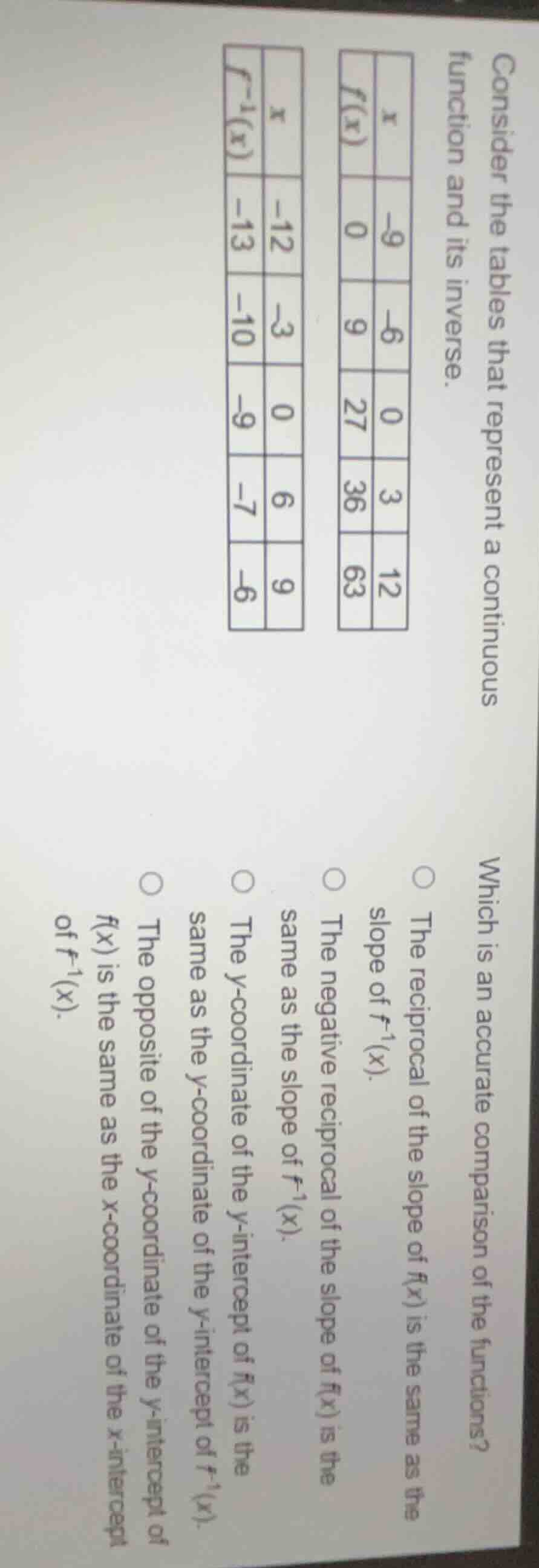
consider the tables that represent a continuous function and its inverse.
| x | f(x) |
|---|---|
| -6 | 9 |
| 0 | 27 |
| 3 | 36 |
| 12 | 63 |
| x | $f^{-1}(x)$ |
|---|---|
| -3 | -10 |
| 0 | -9 |
| 6 | -7 |
| 9 | -6 |
which is an accurate comparison of the functions?
- the reciprocal of the slope of $f(x)$ is the same as the slope of $f^{-1}(x)$.
- the negative reciprocal of the slope of $f(x)$ is the same as the slope of $f^{-1}(x)$.
- the $y$-coordinate of the $y$-intercept of $f(x)$ is the same as the $y$-coordinate of the $y$-intercept of $f^{-1}(x)$.
- the opposite of the $y$-coordinate of the $y$-intercept of $f(x)$ is the same as the $x$-coordinate of the $x$-intercept of $f^{-1}(x)$. (note: the original ocr had some formatting issues; this is a corrected interpretation of the options.)
To solve this, we analyze the relationship between a function \( f(x) \) and its inverse \( f^{-1}(x) \):
Step 1: Recall Properties of Inverse Functions
For a linear function \( f(x) = mx + b \) (where \( m \) is the slope and \( b \) is the \( y \)-intercept), its inverse \( f^{-1}(x) \) is found by swapping \( x \) and \( y \) and solving for \( y \). This gives \( f^{-1}(x) = \frac{1}{m}x - \frac{b}{m} \), so:
- The slope of \( f^{-1}(x) \) is \( \frac{1}{m} \) (the reciprocal of the slope of \( f(x) \)).
- The \( y \)-intercept of \( f(x) \) is \( b \), and the \( x \)-intercept of \( f^{-1}(x) \) is \( b \) (since swapping \( x \) and \( y \) in \( y = mx + b \) gives \( x = my + b \), so when \( y = 0 \), \( x = b \)).
Step 2: Analyze the Options
- Option 1: "The reciprocal of the slope of \( f(x) \) is the same as the slope of \( f^{-1}(x) \)."
From the inverse function formula, if \( f(x) \) has slope \( m \), \( f^{-1}(x) \) has slope \( \frac{1}{m} \) (the reciprocal). This matches.
- Option 2: "The negative reciprocal of the slope of \( f(x) \) is the same as the slope of \( f^{-1}(x) \)."
The slope of \( f^{-1}(x) \) is the reciprocal (not negative reciprocal) of \( f(x) \)’s slope. Eliminate.
- Option 3: "The \( y \)-coordinate of the \( y \)-intercept of \( f(x) \) is the same as the \( y \)-coordinate of the \( y \)-intercept of \( f^{-1}(x) \)."
The \( y \)-intercept of \( f(x) \) is \( b \) (from \( y = mx + b \)). For \( f^{-1}(x) = \frac{1}{m}x - \frac{b}{m} \), the \( y \)-intercept is \( -\frac{b}{m} \), which is not the same as \( b \) (unless \( m = -1 \), which is not general). Eliminate.
- Option 4: "The opposite of the \( y \)-coordinate of the \( y \)-intercept of \( f(x) \) is the same as the \( x \)-coordinate of the \( x \)-intercept of \( f^{-1}(x) \)."
The \( x \)-intercept of \( f^{-1}(x) \) is \( b \) (from \( x = my + b \), \( y = 0 \) gives \( x = b \)), and the \( y \)-intercept of \( f(x) \) is \( b \). The "opposite" of \( b \) is \( -b \), which is not equal to \( b \) (unless \( b = 0 \)). Eliminate.

Snap & solve any problem in the app
Get step-by-step solutions on Sovi AI
Photo-based solutions with guided steps
Explore more problems and detailed explanations
The correct option is: "The reciprocal of the slope of \( f(x) \) is the same as the slope of \( f^{-1}(x) \)." (Assuming the first option is labeled, e.g., A, with this text.)