QUESTION IMAGE
Question
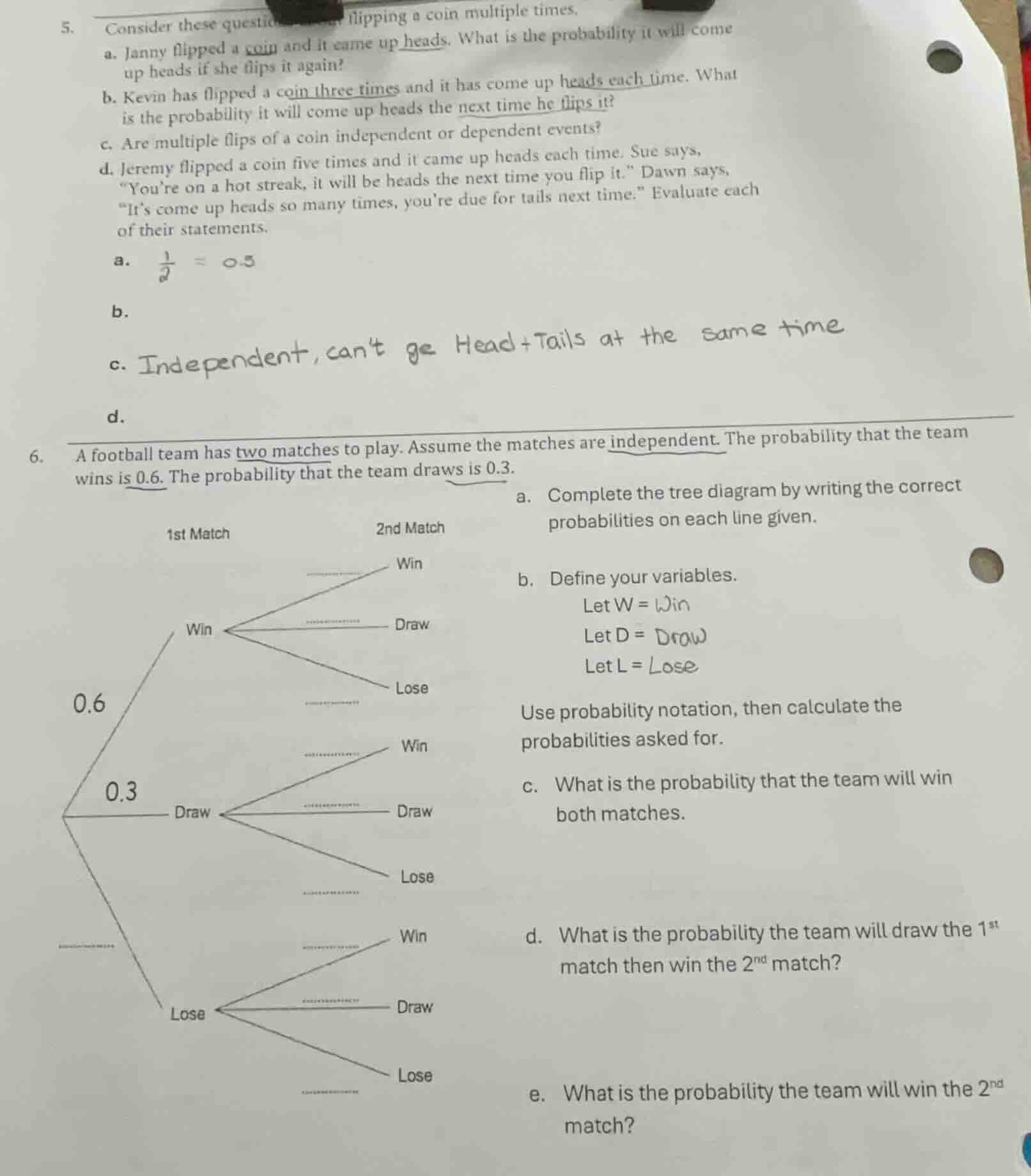
- consider these questions about flipping a coin multiple times.
a. janny flipped a coin and it came up heads. what is the probability it will come up heads if she flips it again?
b. kevin has flipped a coin three times and it has come up heads each time. what is the probability it will come up heads the next time he flips it?
c. are multiple flips of a coin independent or dependent events?
d. jeremy flipped a coin five times and it came up heads each time. sue says, \youre on a hot streak, it will be heads the next time you flip it.\ dawn says, \its come up heads so many times, youre due for tails next time.\ evaluate each of their statements.
a. \\(\frac{1}{2} = 0.5\\)
b.
c. independent, cant get head+tails at the same time
d.
- a football team has two matches to play. assume the matches are independent. the probability that the team wins is 0.6. the probability that the team draws is 0.3.
a. complete the tree diagram by writing the correct probabilities on each line given.
b. define your variables.
let w = win
let d = draw
let l = lose
use probability notation, then calculate the probabilities asked for.
c. what is the probability that the team will win both matches?
d. what is the probability the team will draw the 1st match then win the 2nd match?
e. what is the probability the team will win the 2nd match?
For Question 5:
Step1: Coin flip probability is independent
A fair coin has 2 outcomes, so $P(\text{Heads}) = \frac{1}{2} = 0.5$. Past flips do not affect future ones.
Step2: Classify coin flip events
Each flip does not depend on prior results, so events are independent.
Step3: Evaluate streak claims
Both claims are wrong because each flip is independent; past results don't change the 0.5 probability of heads/tails.
Step1: Calculate lose probability
First, find $P(L)$: since total probability = 1, $P(L) = 1 - P(W) - P(D) = 1 - 0.6 - 0.3 = 0.1$.
Step2: Fill tree diagram probabilities
All second match branches have the same probabilities as the first: Win = 0.6, Draw = 0.3, Lose = 0.1 (matches are independent).
Step3: Define variables (given)
Let $W = \text{Win}$, $D = \text{Draw}$, $L = \text{Lose}$
Step4: Calculate win both matches
Multiply independent win probabilities: $P(W \cap W) = P(W) \times P(W)$
<Expression>
$0.6 \times 0.6 = 0.36$
</Expression>
Step5: Calculate draw then win
Multiply draw and win probabilities: $P(D \cap W) = P(D) \times P(W)$
<Expression>
$0.3 \times 0.6 = 0.18$
</Expression>
Step6: Calculate win 2nd match
Sum all paths leading to 2nd match win:
<Expression>
$P(W \cap W) + P(D \cap W) + P(L \cap W) = (0.6 \times 0.6) + (0.3 \times 0.6) + (0.1 \times 0.6) = 0.6(0.6+0.3+0.1) = 0.6 \times 1 = 0.6$
</Expression>

Snap & solve any problem in the app
Get step-by-step solutions on Sovi AI
Photo-based solutions with guided steps
Explore more problems and detailed explanations
a. $\frac{1}{2}$ or $0.5$
b. $\frac{1}{2}$ or $0.5$
c. Independent events
d. Both Sue and Dawn are incorrect. Coin flips are independent events, so the probability of heads on the next flip is still $\frac{1}{2}$, regardless of previous results.
---