QUESTION IMAGE
Question
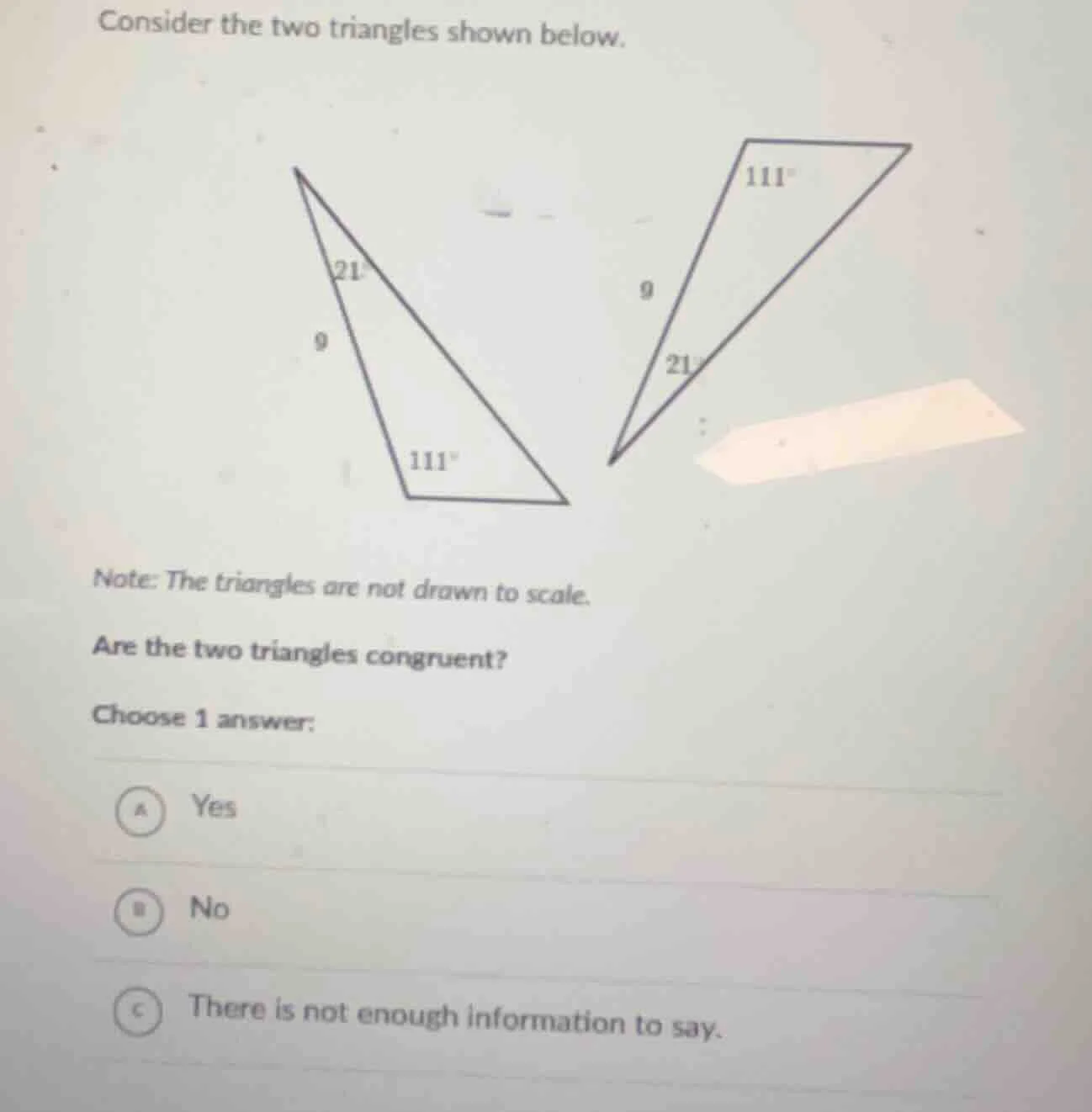
consider the two triangles shown below. note: the triangles are not drawn to scale. are the two triangles congruent? choose 1 answer: a yes b no c there is not enough information to say.
Step1: Identify congruence criteria
We can use the ASA (Angle - Side - Angle) or SAS (Side - Angle - Side) congruence criteria. Let's check the given angles and side.
In both triangles, we have a side of length 9, an angle of \(21^{\circ}\), and an angle of \(111^{\circ}\). Let's verify the arrangement.
For the first triangle: we have a side of length 9, then an angle of \(21^{\circ}\), and then an angle of \(111^{\circ}\).
For the second triangle: when we consider the orientation, we also have a side of length 9, an angle of \(21^{\circ}\), and an angle of \(111^{\circ}\). The side of length 9 is between the \(21^{\circ}\) angle and the \(111^{\circ}\) angle in both triangles (by the order of the angles and the side). So, by the ASA (Angle - Side - Angle) congruence criterion, if two angles and the included side of one triangle are equal to two angles and the included side of another triangle, the triangles are congruent.
Step2: Apply ASA criterion
The included side between the \(21^{\circ}\) angle and the \(111^{\circ}\) angle is of length 9 in both triangles. The two angles (\(21^{\circ}\) and \(111^{\circ}\)) and the included side (length 9) are equal in both triangles. So, by ASA congruence, the two triangles are congruent.

Snap & solve any problem in the app
Get step-by-step solutions on Sovi AI
Photo-based solutions with guided steps
Explore more problems and detailed explanations
A. Yes