QUESTION IMAGE
Question
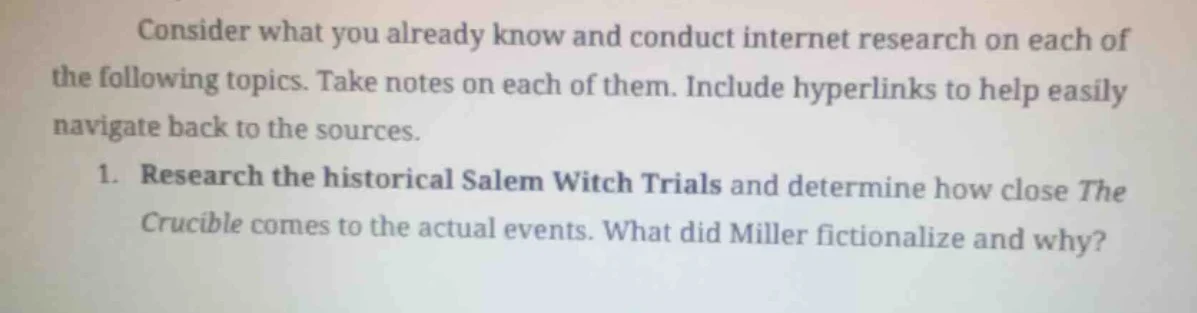
consider what you already know and conduct internet research on each of the following topics. take notes on each of them. include hyperlinks to help easily navigate back to the sources.
- research the historical salem witch trials and determine how close the crucible comes to the actual events. what did miller fictionalize and why?
Response
1. Research on the Historical Salem Witch Trials and "The Crucible" Comparison
Brief Explanations
- Salem Witch Trials (Historical): In 1692 - 1693, Salem, MA, saw mass hysteria over alleged witchcraft. Over 200 were accused, 30 convicted, 19 hanged, others died in custody. Triggered by teenage girls' strange behavior, religious extremism, and social tensions (e.g., property disputes). Source: Salem Witch Trials - History.com
- "The Crucible" (Arthur Miller): A play using Salem trials as an allegory for 1950s McCarthyism (anti - communist witch - hunts). Miller fictionalized:
- Character Relationships: In real life, John Proctor was older, and his relationship with Abigail Williams (who was around 11 - 12, not a lover) was misrepresented. Miller made Abigail older (17) and their affair central to create dramatic tension and explore guilt/repentance.
- Trial Process: Real trials had more legal procedures (e.g., spectral evidence debate), but Miller simplified to focus on moral courage vs. conformity.
- Motivations: Real accusations had roots in social envy, land grabs; Miller emphasized ideological (McCarthyism parallel) and moral themes. He fictionalized to draw parallels between 17th - century mass hysteria and 20th - century political witch - hunts, criticizing McCarthyism. Source: The Crucible - SparkNotes

Snap & solve any problem in the app
Get step-by-step solutions on Sovi AI
Photo-based solutions with guided steps
Explore more problems and detailed explanations
(Notes Summary):
- Salem Witch Trials (1692 - 1693):
- Context: Colonial Massachusetts, Puritan society, fear of Satan/witchcraft.
- Events: Started with girls' (e.g., Betty Parris, Abigail Williams) "afflictions" (fits, strange speech). Led to accusations, trials (including spectral evidence: testimony of seeing spirits), executions (19 hanged, 1 pressed to death).
- Causes: Religious fanaticism, social rivalries, ergot poisoning (theory for girls' symptoms), British - colonial power shifts.
- "The Crucible" vs. Reality:
- Fictionalized Elements:
- Abigail - Proctor Relationship: Real Abigail (11 - 12) not Proctor's lover; Miller aged her, created affair to drive plot (guilt, betrayal).
- Character Merging: Some characters (e.g., Mary Warren) combined traits of real - life figures.
- Trial Drama: Simplified legal processes to highlight moral dilemmas (e.g., Proctor's confession/recantation).
- Why Fictionalize?: To critique McCarthyism (1950s, where people were blacklisted for alleged communism). By mirroring Salem's mass hysteria with 1950s political paranoia, Miller showed how fear/scapegoating destroy justice. Also, to explore universal themes: guilt, courage, the danger of groupthink.
- Accuracy in Themes: Miller accurately captured the mass hysteria, scapegoating, and religious extremism of Salem. But character details and trial procedures were altered for artistic and allegorical purposes.