QUESTION IMAGE
Question
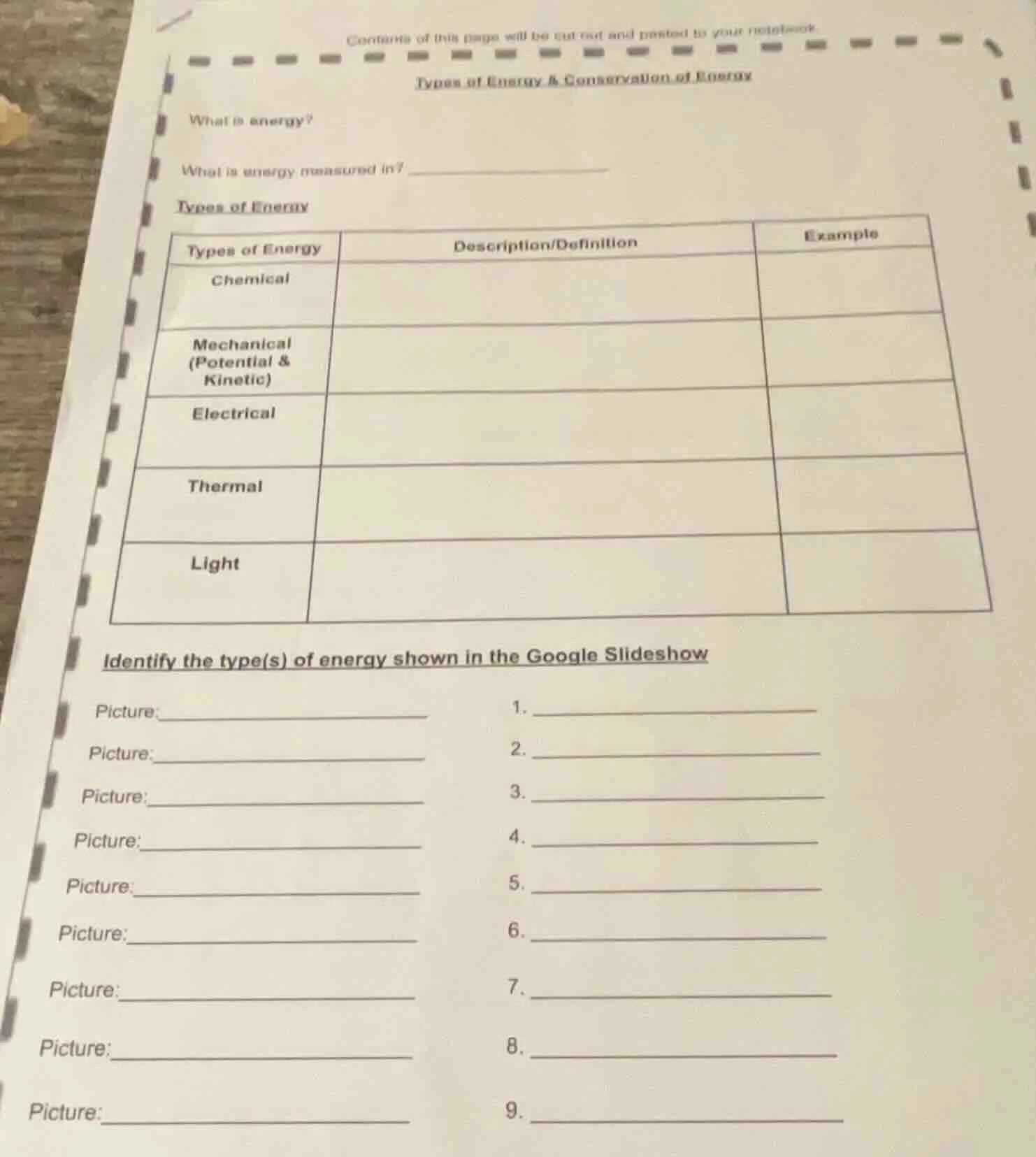
contents of this page will be cut out and pasted to your notebook
types of energy & conservation of energy
what is energy?
what is energy measured in? _______________
types of energy
identify the type(s) of energy shown in the google slideshow
picture:___________________ 1. ___________________
picture:___________________ 2. ___________________
picture:___________________ 3. ___________________
picture:___________________ 4. ___________________
picture:___________________ 5. ___________________
picture:___________________ 6. ___________________
picture:___________________ 7. ___________________
picture:___________________ 8. ___________________
picture:___________________ 9. ___________________
To solve this worksheet on types of energy, we first recall the definitions and examples of each energy type:
1. Chemical Energy
- Description: Energy stored in the bonds of chemical compounds (atoms and molecules). Released during chemical reactions (e.g., combustion, digestion).
- Example: Energy in food (e.g., glucose), batteries, or fossil fuels (coal, gasoline).
2. Mechanical Energy (Potential + Kinetic)
- Potential Energy: Stored energy due to position or configuration (e.g., gravitational potential energy, elastic potential energy).
- Kinetic Energy: Energy of motion (depends on mass and velocity: \( KE = \frac{1}{2}mv^2 \)).
- Example (Potential): A book on a shelf, a stretched spring.
- Example (Kinetic): A moving car, a falling apple.
3. Electrical Energy
- Description: Energy associated with the flow of electric charge (electrons) through a conductor.
- Example: Energy in a lightbulb (when powered), a laptop charger, or a lightning strike.
4. Thermal Energy
- Description: Energy related to the temperature of an object; due to the motion of its atoms/molecules (heat energy).
- Example: Heat from a fire, a hot cup of coffee, or the warmth of the sun.
5. Light Energy
- Description: Energy carried by electromagnetic waves (visible light, UV, infrared, etc.).
- Example: Sunlight, a lightbulb, or a laser beam.
Energy Measurement
Energy is measured in Joules (J) (SI unit). Other units include calories (for heat) or kilowatt - hours (kWh) for electrical energy.
Identifying Energy in Pictures (General Approach)
For each picture, observe the context:
- If it involves chemicals (e.g., food, fuel) → Chemical.
- If it involves motion or position (e.g., a ball rolling, a dam) → Mechanical (Kinetic/Potential).
- If it involves electricity (e.g., wires, devices) → Electrical.
- If it involves heat (e.g., a flame, hot object) → Thermal.
- If it involves light (e.g., a lamp, the sun) → Light.
Example Completion (Sample Answers)
| Types of Energy | Description/Definition | Example |
|---|---|---|
| Mechanical (Potential & Kinetic) | Potential: Stored energy (position/shape); Kinetic: Energy of motion. | Potential: A rock on a cliff; Kinetic: A running dog |
| Electrical | Energy from moving electric charges (electrons). | Energy in a smartphone charger |
| Thermal | Energy from the motion of atoms/molecules (heat). | Heat from a campfire |
| Light | Energy from electromagnetic waves (visible/invisible). | Light from a flashlight |
For the “Identify the type(s) of energy in the Google Slideshow” section, apply the above logic to each picture (e.g., if a picture shows a battery, label “Chemical + Electrical”; if a picture shows a falling ball, label “Mechanical (Kinetic)”).
Final Answers (Key Takeaways)
- Energy is measured in Joules (J).
- Use the definitions and examples above to fill in the table and identify energy types in pictures.
If you have specific pictures, share their details (e.…

Snap & solve any problem in the app
Get step-by-step solutions on Sovi AI
Photo-based solutions with guided steps
Explore more problems and detailed explanations
To solve this worksheet on types of energy, we first recall the definitions and examples of each energy type:
1. Chemical Energy
- Description: Energy stored in the bonds of chemical compounds (atoms and molecules). Released during chemical reactions (e.g., combustion, digestion).
- Example: Energy in food (e.g., glucose), batteries, or fossil fuels (coal, gasoline).
2. Mechanical Energy (Potential + Kinetic)
- Potential Energy: Stored energy due to position or configuration (e.g., gravitational potential energy, elastic potential energy).
- Kinetic Energy: Energy of motion (depends on mass and velocity: \( KE = \frac{1}{2}mv^2 \)).
- Example (Potential): A book on a shelf, a stretched spring.
- Example (Kinetic): A moving car, a falling apple.
3. Electrical Energy
- Description: Energy associated with the flow of electric charge (electrons) through a conductor.
- Example: Energy in a lightbulb (when powered), a laptop charger, or a lightning strike.
4. Thermal Energy
- Description: Energy related to the temperature of an object; due to the motion of its atoms/molecules (heat energy).
- Example: Heat from a fire, a hot cup of coffee, or the warmth of the sun.
5. Light Energy
- Description: Energy carried by electromagnetic waves (visible light, UV, infrared, etc.).
- Example: Sunlight, a lightbulb, or a laser beam.
Energy Measurement
Energy is measured in Joules (J) (SI unit). Other units include calories (for heat) or kilowatt - hours (kWh) for electrical energy.
Identifying Energy in Pictures (General Approach)
For each picture, observe the context:
- If it involves chemicals (e.g., food, fuel) → Chemical.
- If it involves motion or position (e.g., a ball rolling, a dam) → Mechanical (Kinetic/Potential).
- If it involves electricity (e.g., wires, devices) → Electrical.
- If it involves heat (e.g., a flame, hot object) → Thermal.
- If it involves light (e.g., a lamp, the sun) → Light.
Example Completion (Sample Answers)
| Types of Energy | Description/Definition | Example |
|---|---|---|
| Mechanical (Potential & Kinetic) | Potential: Stored energy (position/shape); Kinetic: Energy of motion. | Potential: A rock on a cliff; Kinetic: A running dog |
| Electrical | Energy from moving electric charges (electrons). | Energy in a smartphone charger |
| Thermal | Energy from the motion of atoms/molecules (heat). | Heat from a campfire |
| Light | Energy from electromagnetic waves (visible/invisible). | Light from a flashlight |
For the “Identify the type(s) of energy in the Google Slideshow” section, apply the above logic to each picture (e.g., if a picture shows a battery, label “Chemical + Electrical”; if a picture shows a falling ball, label “Mechanical (Kinetic)”).
Final Answers (Key Takeaways)
- Energy is measured in Joules (J).
- Use the definitions and examples above to fill in the table and identify energy types in pictures.
If you have specific pictures, share their details (e.g., “Picture 1: A battery”) for precise identification!