QUESTION IMAGE
Question
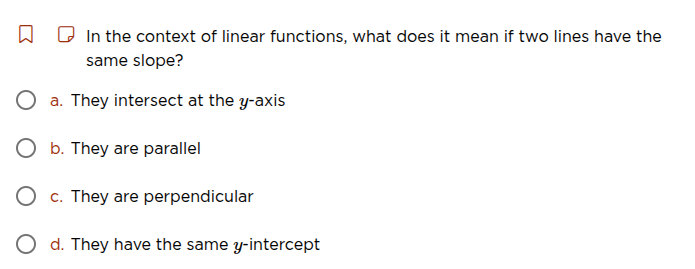
in the context of linear functions, what does it mean if two lines have the same slope?
a. they intersect at the y-axis
b. they are parallel
c. they are perpendicular
d. they have the same y-intercept
To determine the meaning of two linear functions having the same slope, we analyze each option:
- Option a: Intersecting at the \( y \)-axis means they have the same \( y \)-intercept (\( b \) in \( y = mx + b \)), not related to slope (\( m \)). So a is incorrect.
- Option b: In the slope - intercept form of a line \( y=mx + b \), the slope \( m \) determines the steepness and direction of the line. If two lines have the same slope (\( m_1=m_2 \)) and different \( y \)-intercepts (\( b_1
eq b_2 \)), they will never intersect and are parallel. If they have the same slope and same \( y \)-intercept, they are coincident (the same line). But in the context of linear functions, having the same slope implies they are parallel (including coincident as a special case of parallel lines in some definitions).
- Option c: Two lines are perpendicular if the product of their slopes is \( - 1\) (i.e., \( m_1\times m_2=-1 \)), not when they have the same slope. So c is incorrect.
- Option d: Having the same \( y \)-intercept means \( b_1 = b_2 \) in \( y=mx + b \), which is not related to having the same slope. So d is incorrect.

Snap & solve any problem in the app
Get step-by-step solutions on Sovi AI
Photo-based solutions with guided steps
Explore more problems and detailed explanations
b. They are parallel