QUESTION IMAGE
Question
continental drift
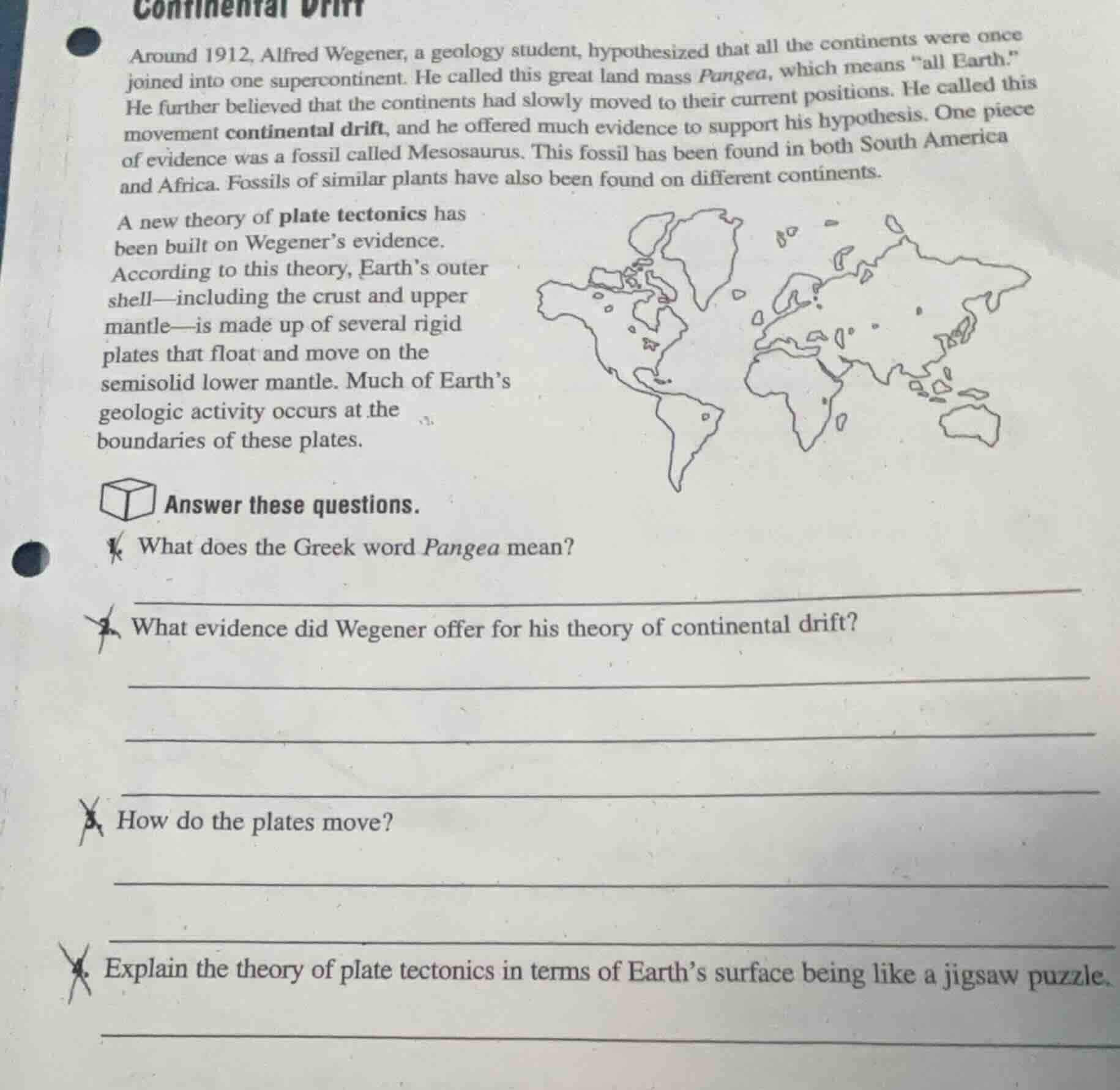
around 1912, alfred wegener, a geology student, hypothesized that all the continents were once joined into one supercontinent. he called this great land mass pangea, which means \all earth.\ he further believed that the continents had slowly moved to their current positions. he called this movement continental drift, and he offered much evidence to support his hypothesis. one piece of evidence was a fossil called mesosaurus. this fossil has been found in both south america and africa. fossils of similar plants have also been found on different continents.
a new theory of plate tectonics has been built on wegener’s evidence.
according to this theory, earth’s outer shell—including the crust and upper mantle—is made up of several rigid plates that float and move on the semisolid lower mantle. much of earth’s geologic activity occurs at the boundaries of these plates.
answer these questions.
- what does the greek word pangea mean?
- what evidence did wegener offer for his theory of continental drift?
- how do the plates move?
- explain the theory of plate tectonics in terms of earth’s surface being like a jigsaw puzzle.
Question 1: What does the Greek word Pangea mean?
From the text: "He called this great land mass Pangea, which means 'all Earth'." So we can directly get the meaning.
The text says: "One piece of evidence was a fossil called Mesosaurus. This fossil has been found in both South America and Africa. Fossils of similar plants have also been found on different continents." We extract this evidence.
According to the text: "Earth’s outer shell—including the crust and upper mantle—is made up of several rigid plates that float and move on the semisolid lower mantle." We get the movement way from this sentence.

Snap & solve any problem in the app
Get step-by-step solutions on Sovi AI
Photo-based solutions with guided steps
Explore more problems and detailed explanations
"all Earth"