QUESTION IMAGE
Question
continued:
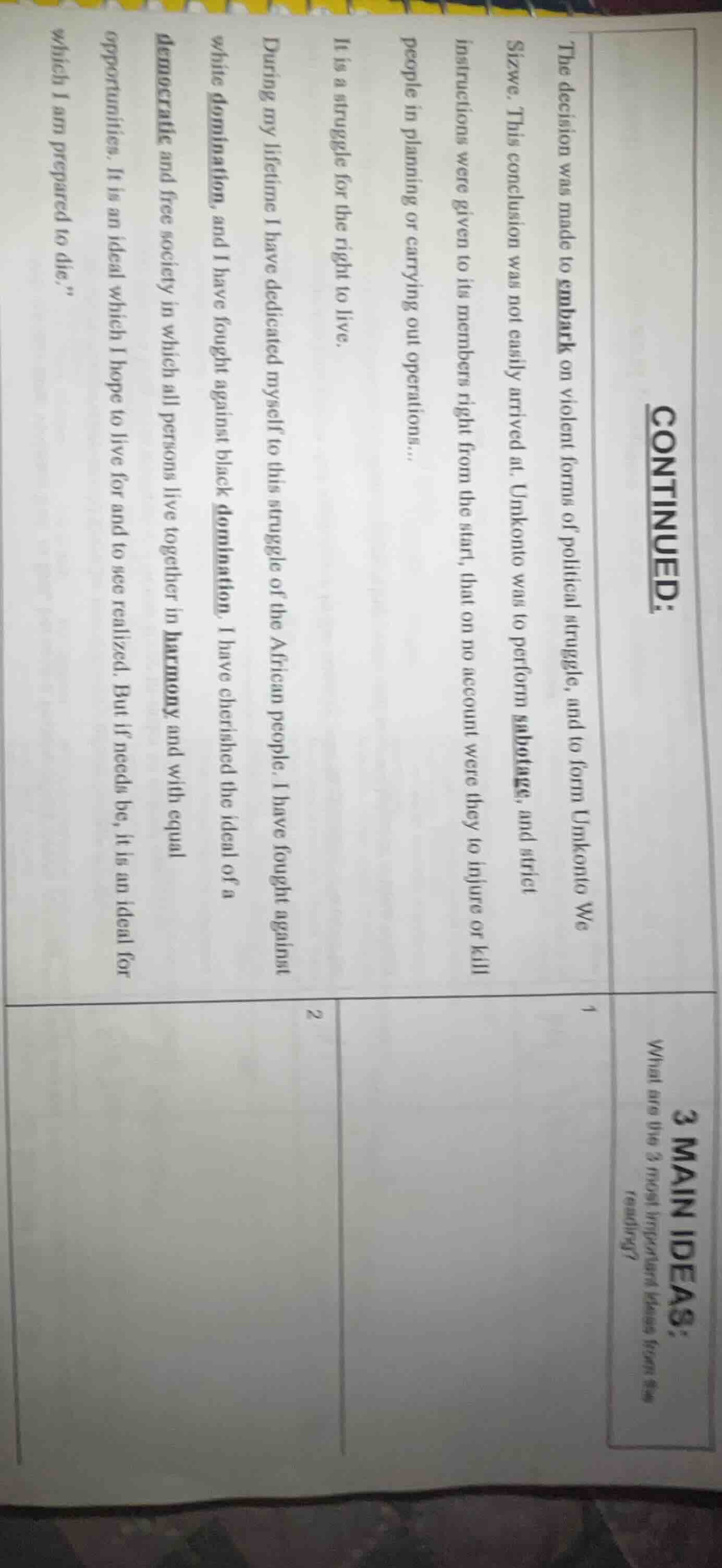
1 the decision was made to embark on violent forms of political struggle, and to form umkonto we sizwe. this conclusion was not easily arrived at. umkonto was to perform sabotage, and strict instructions were given to its members right from the start, that on no account were they to injure or kill people in planning or carrying out operations...
it is a struggle for the right to live.
2 during my lifetime i have dedicated myself to this struggle of the african people. i have fought against white domination, and i have fought against black domination. i have cherished the ideal of a democratic and free society in which all persons live together in harmony and with equal opportunities. it is an ideal which i hope to live for and to see realized. but if needs be, it is an ideal for which i am prepared to die.\
3 main ideas:
what are the 3 most important ideas from the reading?
- Identified the formal shift to violent political struggle via Umkhonto we Sizwe, with strict sabotage-only rules to avoid harming people.
- Highlighted the core framing of the fight as a struggle for the fundamental right to live for the African people.
- Extracted the long-stated ideal of a democratic, equal, harmonious multiracial society, for which the speaker is willing to live or die.

Snap & solve any problem in the app
Get step-by-step solutions on Sovi AI
Photo-based solutions with guided steps
Explore more problems and detailed explanations
- The decision was made to launch Umkhonto we Sizwe for violent political struggle, with strict instructions to only carry out sabotage and never injure or kill people.
- The speaker frames their work as a struggle for the African people's right to live, fighting against both white and black domination.
- The speaker's lifelong ideal is a democratic, free society where all people live in harmony with equal opportunities, an ideal they are prepared to die for if necessary.