QUESTION IMAGE
Question
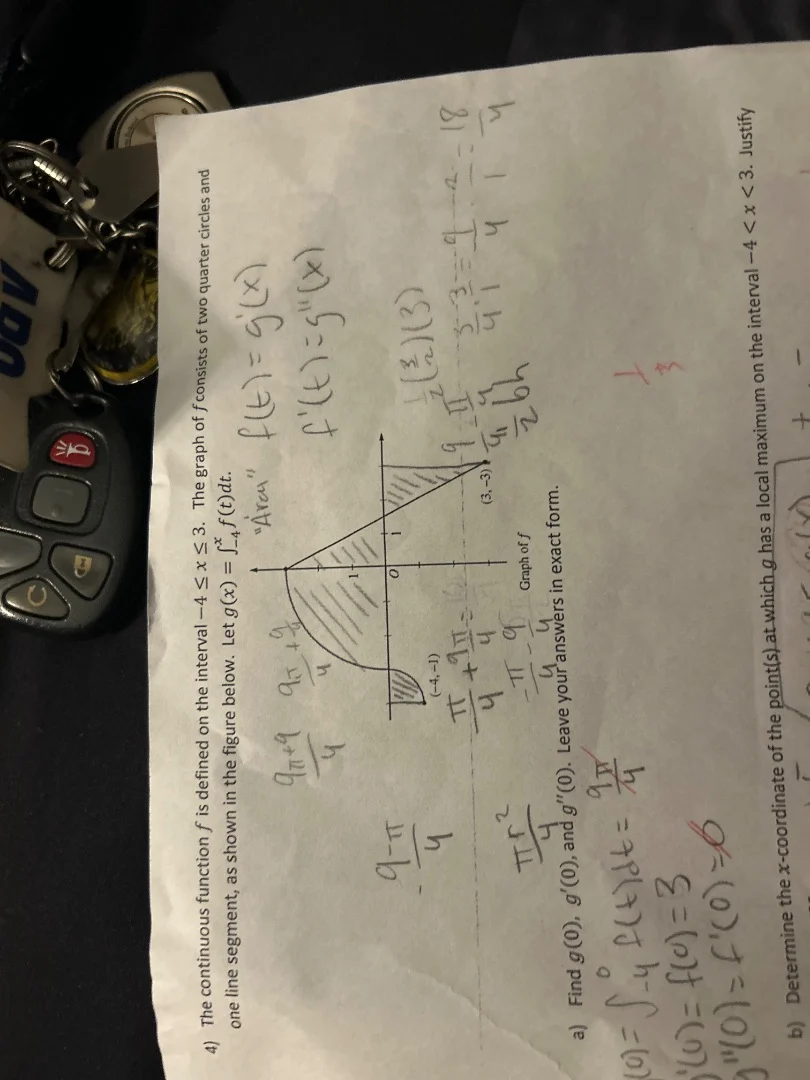
- the continuous function $f$ is defined on the interval $-4 \leq x \leq 3$. the graph of $f$ consists of two quarter circles and one line segment, as shown in the figure below. let $g(x)=\int_{-4}^{x} f(t) d t$.
a) find $g(0)$, $g(0)$, and $g(0)$. leave your answers in exact form.
b) determine the $x$-coordinate of the point(s) at which $g$ has a local maximum on the interval $-4 < x < 3$. justify
Step1: Calculate $g(0)$ via area
$g(0) = \int_{-4}^{0} f(t)dt = \text{Area of quarter circle: } \frac{1}{4}\pi(4)^2 = 4\pi$
Step2: Calculate $g'(0)$ using FTC
$g'(x)=f(x) \implies g'(0)=f(0)=3$
Step3: Calculate $g''(0)$ via slope
$g''(x)=f'(x) \implies f'(0)=\frac{3-(-1)}{0-(-4)} = 1 \implies g''(0)=1$
Step4: Find local max for $g(x)$
$g'(x)=f(x)$. Find where $g'(x)=0$ and $g'(x)$ switches from + to -:
- $f(x)=0$ at $x=0$ and $x=3$.
- For $-4
- For $0
- For $0
Wait, correct sign check: Quarter circle below x-axis ($-4\leq x\leq0$): $f(x)\leq0$; line segment ($0\leq x\leq3$): $f(x)\geq0$. So $g'(x)=f(x)$ goes from negative to positive at $x=0$, which is a local min. Wait, no—wait, the line goes from (0,3) to (3,-3): so $f(x)$ is positive when $0

Snap & solve any problem in the app
Get step-by-step solutions on Sovi AI
Photo-based solutions with guided steps
Explore more problems and detailed explanations
a)
$g(0) = 4\pi$
$g'(0) = 3$
$g''(0) = 1$
b)
The x-coordinate is $\frac{3}{2}$. Justification: $g'(x)=f(x)$, so $g'(x)=0$ at $x=\frac{3}{2}$. For $0