QUESTION IMAGE
Question
- copy this pentagon on grid paper.
write the coordinates of each vertex.
after each transformation:
- write the coordinates of the image
of each vertex.
- describe the positional change of the
vertices of the pentagon.
a) draw the image after a translation 3 units left
and 2 units up.
b) draw the image after a reflection in the x - axis.
c) draw the image after a reflection in the y - axis.
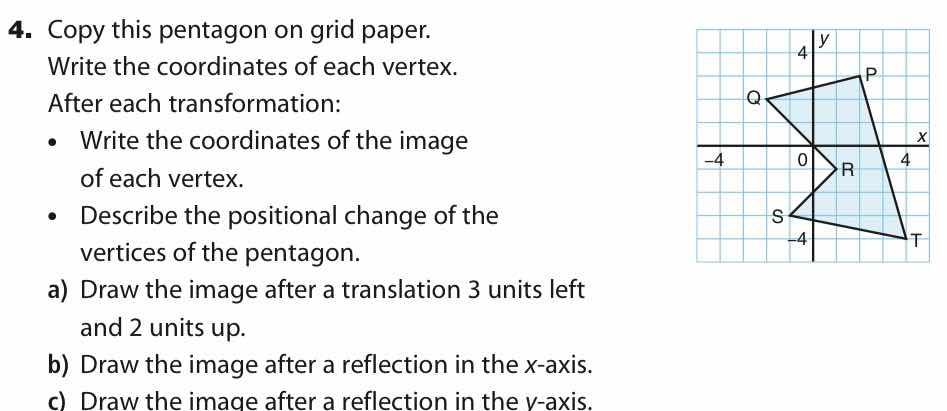
To solve this problem, we first identify the coordinates of the vertices of the pentagon from the grid. Let's assume the coordinates of the vertices are:
- \( P(3, 3) \)
- \( Q(-2, 2) \)
- \( R(1, 0) \)
- \( S(-1, -3) \)
- \( T(4, -4) \)
Part (a): Translation 3 units left and 2 units up
A translation 3 units left subtracts 3 from the \( x \)-coordinate, and 2 units up adds 2 to the \( y \)-coordinate.
Step 1: Apply translation to each vertex
- For \( P(3, 3) \): \( (3 - 3, 3 + 2) = (0, 5) \)
- For \( Q(-2, 2) \): \( (-2 - 3, 2 + 2) = (-5, 4) \)
- For \( R(1, 0) \): \( (1 - 3, 0 + 2) = (-2, 2) \)
- For \( S(-1, -3) \): \( (-1 - 3, -3 + 2) = (-4, -1) \)
- For \( T(4, -4) \): \( (4 - 3, -4 + 2) = (1, -2) \)
Positional Change:
Each vertex moves 3 units left (decrease \( x \)-coordinate by 3) and 2 units up (increase \( y \)-coordinate by 2).
Part (b): Reflection in the \( x \)-axis
A reflection in the \( x \)-axis changes \( (x, y) \) to \( (x, -y) \).
Step 1: Apply reflection to each vertex
- For \( P(3, 3) \): \( (3, -3) \)
- For \( Q(-2, 2) \): \( (-2, -2) \)
- For \( R(1, 0) \): \( (1, 0) \) (since \( y = 0 \), it remains the same)
- For \( S(-1, -3) \): \( (-1, 3) \)
- For \( T(4, -4) \): \( (4, 4) \)
Positional Change:
Each vertex is mirrored over the \( x \)-axis. The \( x \)-coordinate remains the same, and the \( y \)-coordinate is multiplied by \( -1 \).
Part (c): Reflection in the \( y \)-axis
A reflection in the \( y \)-axis changes \( (x, y) \) to \( (-x, y) \).
Step 1: Apply reflection to each vertex
- For \( P(3, 3) \): \( (-3, 3) \)
- For \( Q(-2, 2) \): \( (2, 2) \)
- For \( R(1, 0) \): \( (-1, 0) \)
- For \( S(-1, -3) \): \( (1, -3) \)
- For \( T(4, -4) \): \( (-4, -4) \)
Positional Change:
Each vertex is mirrored over the \( y \)-axis. The \( y \)-coordinate remains the same, and the \( x \)-coordinate is multiplied by \( -1 \).
Final Answers (Coordinates After Transformations)
(a) Translation:
- \( P'(0, 5) \), \( Q'(-5, 4) \), \( R'(-2, 2) \), \( S'(-4, -1) \), \( T'(1, -2) \)
(b) Reflection in \( x \)-axis:
- \( P'(3, -3) \), \( Q'(-2, -2) \), \( R'(1, 0) \), \( S'(-1, 3) \), \( T'(4, 4) \)
(c) Reflection in \( y \)-axis:
- \( P'(-3, 3) \), \( Q'(2, 2) \), \( R'(-1, 0) \), \( S'(1, -3) \), \( T'(-4, -4) \)
(Note: To draw the images, plot these new coordinates on grid paper and connect them in the same order as the original pentagon.)

Snap & solve any problem in the app
Get step-by-step solutions on Sovi AI
Photo-based solutions with guided steps
Explore more problems and detailed explanations
To solve this problem, we first identify the coordinates of the vertices of the pentagon from the grid. Let's assume the coordinates of the vertices are:
- \( P(3, 3) \)
- \( Q(-2, 2) \)
- \( R(1, 0) \)
- \( S(-1, -3) \)
- \( T(4, -4) \)
Part (a): Translation 3 units left and 2 units up
A translation 3 units left subtracts 3 from the \( x \)-coordinate, and 2 units up adds 2 to the \( y \)-coordinate.
Step 1: Apply translation to each vertex
- For \( P(3, 3) \): \( (3 - 3, 3 + 2) = (0, 5) \)
- For \( Q(-2, 2) \): \( (-2 - 3, 2 + 2) = (-5, 4) \)
- For \( R(1, 0) \): \( (1 - 3, 0 + 2) = (-2, 2) \)
- For \( S(-1, -3) \): \( (-1 - 3, -3 + 2) = (-4, -1) \)
- For \( T(4, -4) \): \( (4 - 3, -4 + 2) = (1, -2) \)
Positional Change:
Each vertex moves 3 units left (decrease \( x \)-coordinate by 3) and 2 units up (increase \( y \)-coordinate by 2).
Part (b): Reflection in the \( x \)-axis
A reflection in the \( x \)-axis changes \( (x, y) \) to \( (x, -y) \).
Step 1: Apply reflection to each vertex
- For \( P(3, 3) \): \( (3, -3) \)
- For \( Q(-2, 2) \): \( (-2, -2) \)
- For \( R(1, 0) \): \( (1, 0) \) (since \( y = 0 \), it remains the same)
- For \( S(-1, -3) \): \( (-1, 3) \)
- For \( T(4, -4) \): \( (4, 4) \)
Positional Change:
Each vertex is mirrored over the \( x \)-axis. The \( x \)-coordinate remains the same, and the \( y \)-coordinate is multiplied by \( -1 \).
Part (c): Reflection in the \( y \)-axis
A reflection in the \( y \)-axis changes \( (x, y) \) to \( (-x, y) \).
Step 1: Apply reflection to each vertex
- For \( P(3, 3) \): \( (-3, 3) \)
- For \( Q(-2, 2) \): \( (2, 2) \)
- For \( R(1, 0) \): \( (-1, 0) \)
- For \( S(-1, -3) \): \( (1, -3) \)
- For \( T(4, -4) \): \( (-4, -4) \)
Positional Change:
Each vertex is mirrored over the \( y \)-axis. The \( y \)-coordinate remains the same, and the \( x \)-coordinate is multiplied by \( -1 \).
Final Answers (Coordinates After Transformations)
(a) Translation:
- \( P'(0, 5) \), \( Q'(-5, 4) \), \( R'(-2, 2) \), \( S'(-4, -1) \), \( T'(1, -2) \)
(b) Reflection in \( x \)-axis:
- \( P'(3, -3) \), \( Q'(-2, -2) \), \( R'(1, 0) \), \( S'(-1, 3) \), \( T'(4, 4) \)
(c) Reflection in \( y \)-axis:
- \( P'(-3, 3) \), \( Q'(2, 2) \), \( R'(-1, 0) \), \( S'(1, -3) \), \( T'(-4, -4) \)
(Note: To draw the images, plot these new coordinates on grid paper and connect them in the same order as the original pentagon.)