QUESTION IMAGE
Question
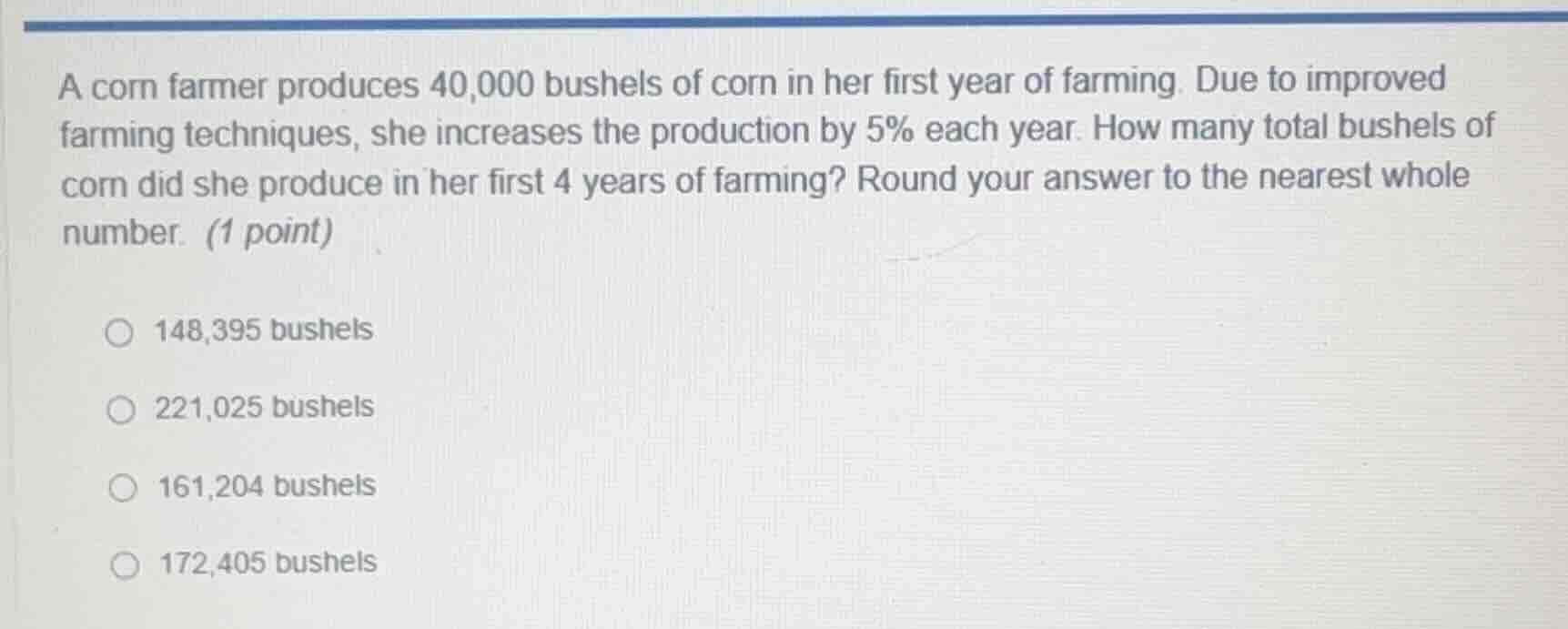
a corn farmer produces 40,000 bushels of corn in her first year of farming. due to improved farming techniques, she increases the production by 5% each year. how many total bushels of corn did she produce in her first 4 years of farming? round your answer to the nearest whole number. (1 point)
148,395 bushels
221,025 bushels
161,204 bushels
172,405 bushels
Step1: Identify the series type
This is a geometric series problem where the first term \( a = 40000 \), common ratio \( r = 1 + 0.05=1.05 \), and number of terms \( n = 4 \). The formula for the sum of a geometric series is \( S_n=\frac{a(r^n - 1)}{r - 1} \).
Step2: Substitute values into the formula
Substitute \( a = 40000 \), \( r = 1.05 \), \( n = 4 \) into the formula:
\( S_4=\frac{40000\times(1.05^4 - 1)}{1.05 - 1} \)
Step3: Calculate \( 1.05^4 \)
\( 1.05^4=1.05\times1.05\times1.05\times1.05 = 1.21550625 \)
Step4: Calculate the numerator
\( 40000\times(1.21550625 - 1)=40000\times0.21550625 = 8620.25 \)
Step5: Calculate the denominator
\( 1.05 - 1 = 0.05 \)
Step6: Calculate the sum
\( S_4=\frac{8620.25}{0.05}=172405 \) (Wait, no, wait. Wait, let's recalculate. Wait, \( 40000\times(1.05^4 - 1)=40000\times(1.21550625 - 1)=40000\times0.21550625 = 8620.25 \). Then divide by 0.05: \( 8620.25\div0.05 = 172405 \)? Wait, but let's check by calculating each year's production:
Year 1: 40000
Year 2: \( 40000\times1.05 = 42000 \)
Year 3: \( 42000\times1.05 = 44100 \)
Year 4: \( 44100\times1.05 = 46305 \)
Sum: \( 40000 + 42000+44100 + 46305=172405 \)
Wait, but the option has 172,405 bushels. Wait, but let's check the formula again. Wait, the formula for sum of geometric series is correct. So the sum is 172405.

Snap & solve any problem in the app
Get step-by-step solutions on Sovi AI
Photo-based solutions with guided steps
Explore more problems and detailed explanations
172,405 bushels (Option D: 172,405 bushels)