QUESTION IMAGE
Question
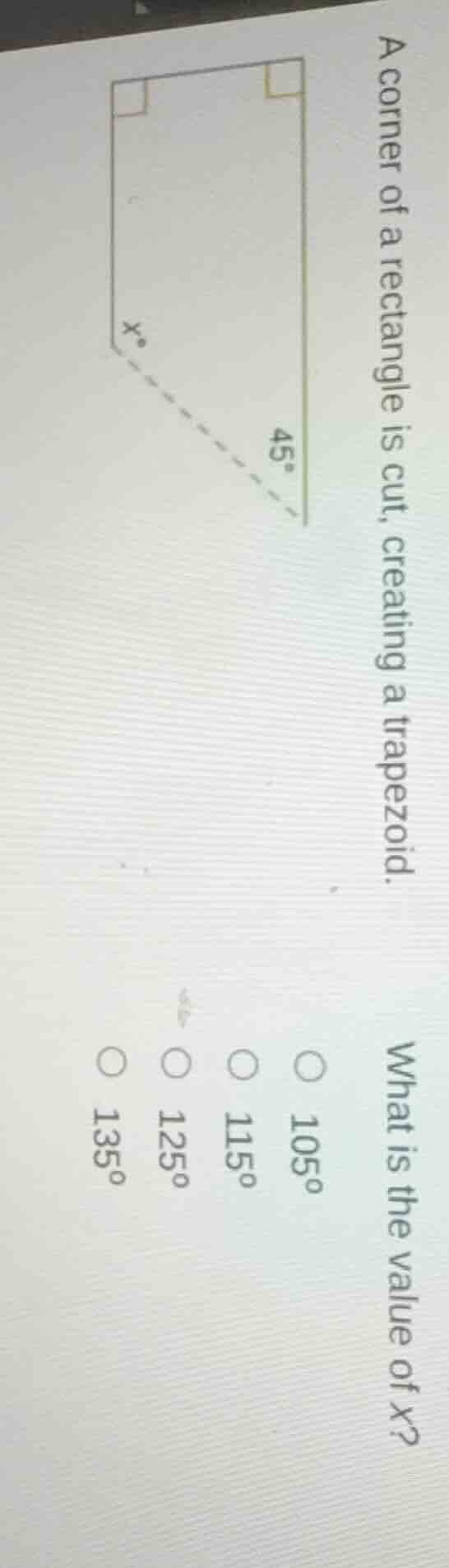
a corner of a rectangle is cut, creating a trapezoid. what is the value of x? 105° 115° 125° 135°
Step1: Recall rectangle angle property
A rectangle has all angles equal to \(90^\circ\). When a corner is cut, we form a triangle with a \(45^\circ\) angle and the original right angle.
Step2: Use linear pair or supplementary angles
The sum of angles on a straight line is \(180^\circ\). The angle adjacent to \(x\) and the \(45^\circ\) angle, along with the right angle, but more simply, the angle \(x\) and the angle formed by the cut (which is supplementary to the angle in the triangle) relate. Wait, actually, when we cut the rectangle's corner (a right angle, \(90^\circ\)) to form a triangle with a \(45^\circ\) angle, the angle adjacent to \(x\) inside the trapezoid: the triangle is isosceles? Wait, no. The original angle is \(90^\circ\), we cut it, so the two angles formed with the cut line: one is \(45^\circ\) (given), and the other angle in the triangle is \(180^\circ - 90^\circ - 45^\circ= 45^\circ\)? Wait, no. Wait, the rectangle's angle is \(90^\circ\), when we cut it, we have a straight line (the side of the trapezoid) and the cut line. So the angle \(x\) and the angle adjacent to it (from the cut) should add up to \(180^\circ\)? Wait, no. Wait, the correct approach: in a rectangle, each angle is \(90^\circ\). When we cut a corner, we create a triangle where one angle is \(90^\circ\) (the rectangle's angle), but wait, no—when we cut the corner, we remove a triangle, so the remaining angle at that vertex of the trapezoid: the sum of angles around a point? No, along the side. Wait, the two angles formed by the cut on the rectangle's side: one is \(45^\circ\) (given), and the other angle (let's call it \(y\)) and \(x\) are supplementary (since they are on a straight line). But also, in the rectangle, the angle was \(90^\circ\), so the triangle that was cut off has angles: the right angle was \(90^\circ\), so the two angles of the triangle are \(45^\circ\) and \(45^\circ\) (since \(180 - 90 - 45 = 45\)). Wait, no, the triangle is a right triangle? Wait, no, the rectangle's corner is a right angle, so when we cut it with a line, we form a triangle with one angle \(45^\circ\), so the other angle in the triangle is \(90^\circ - 45^\circ = 45^\circ\)? No, that's not right. Wait, the correct way: the angle \(x\) and the \(45^\circ\) angle are supplementary to the right angle? Wait, no. Let's think again. The original angle is \(90^\circ\). When we cut the corner, we have a straight line (the edge of the trapezoid) and the cut line. So the angle between the trapezoid's side and the cut line is \(45^\circ\), so the angle \(x\) and the angle adjacent to it (from the cut) should add up to \(180^\circ\). But the adjacent angle: since the rectangle's angle is \(90^\circ\), and we have a triangle with angle \(45^\circ\), the angle between the trapezoid's side and the cut line is \(180^\circ - 90^\circ - 45^\circ = 45^\circ\)? No, that's not. Wait, I'm overcomplicating. The correct formula: in a trapezoid, consecutive angles between the two parallel sides are supplementary? Wait, no, this is a trapezoid formed by cutting a rectangle, so it's a right trapezoid? Wait, the original rectangle has two right angles at the top, and when we cut the bottom right corner, we have a trapezoid with two right angles at the top, one angle \(x\) at the bottom left, and the angle at the bottom right: the cut creates a \(45^\circ\) angle. Wait, the sum of angles in a quadrilateral is \(360^\circ\). The trapezoid has two right angles (\(90^\circ\) each), one angle \(x\), and one angle which is \(180^\circ - 45^\circ = 135^\circ\)? Wait, no. Wait, let's lis…

Snap & solve any problem in the app
Get step-by-step solutions on Sovi AI
Photo-based solutions with guided steps
Explore more problems and detailed explanations
\(135^\circ\) (corresponding to the option 135°)