QUESTION IMAGE
Question
cphs : advanced algebra: concepts and connections - block (27.0831030)
adding and subtracting rational expressions
adding rational expressions
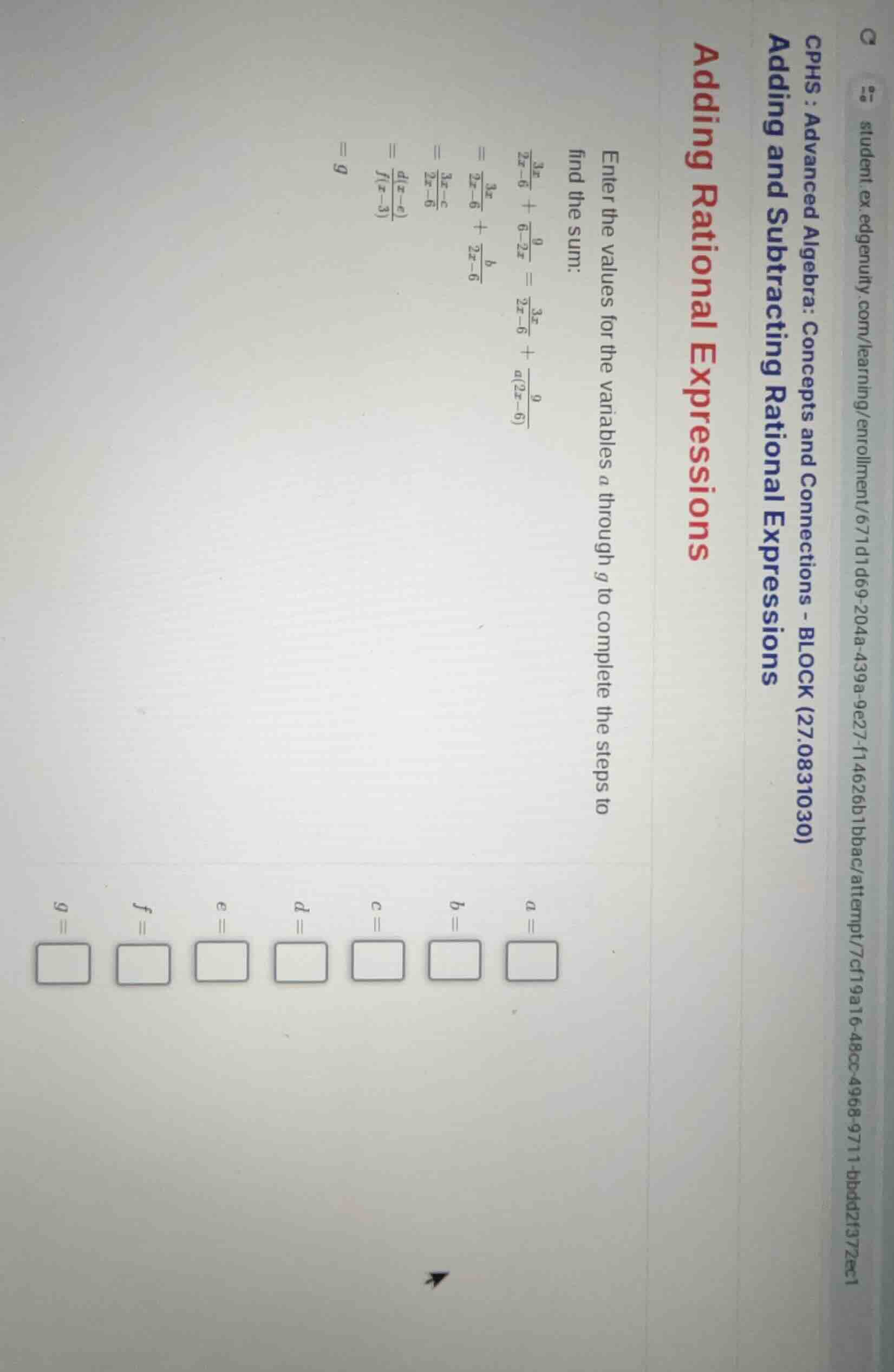
enter the values for the variables a through g to complete the steps to
find the sum:
\\(\frac{3x}{2x - 6} + \frac{9}{6 - 2x} = \frac{3x}{2x - 6} + \frac{9}{a(2x - 6)}\\)
\\(= \frac{3x}{2x - 6} + \frac{b}{2x - 6}\\)
\\(= \frac{3x - c}{2x - 6}\\)
\\(= \frac{d(x - e)}{f(x - 3)}\\)
\\(= g\\)
a = \square
b = \square
c = \square
d = \square
e = \square
f = \square
g = \square
Step1: Analyze the denominator of the second fraction
We have \(\frac{9}{6 - 2x}\). Notice that \(6-2x=-(2x - 6)\), so we can rewrite \(\frac{9}{6 - 2x}\) as \(\frac{9}{-(2x - 6)}=-\frac{9}{2x - 6}\). To get a common denominator in the form of \(a(2x - 6)\), we need to find \(a\) such that when we factor out the negative sign, we can express it with the denominator \(2x-6\). So, \(\frac{9}{6 - 2x}=\frac{9}{-1\times(2x - 6)}=\frac{- 9}{2x - 6}\), which means \(a=- 1\) (because we have \(\frac{9}{a(2x - 6)}\), so \(a=-1\)).
Step2: Combine the fractions
Now we have \(\frac{3x}{2x - 6}+\frac{9}{6 - 2x}=\frac{3x}{2x - 6}-\frac{9}{2x - 6}\) (since \(a = - 1\)). When we combine the numerators over the common denominator \(2x-6\), we get \(\frac{3x-9}{2x - 6}\). So \(b=-9\) (the numerator of the second fraction after getting the common denominator) and when we combine, the numerator is \(3x + b=3x-9\), so \(b=-9\).
Step3: Factor the numerator and denominator
Factor the numerator \(3x - 9 = 3(x - 3)\) and the denominator \(2x-6=2(x - 3)\). So \(\frac{3x-9}{2x - 6}=\frac{3(x - 3)}{2(x - 3)}\). Here, \(c = 9\) (wait, no, let's re - examine. Wait, when we have \(\frac{3x - c}{2x - 6}\), from \(3x-9\), we have \(c = 9\)). Then, we can write \(\frac{3(x - 3)}{2(x - 3)}\) as \(\frac{3\times(x - 3)}{2\times(x - 3)}\), so \(d = 3\), \(e=3\) (since the numerator is \(d(x - e)=3(x - 3)\)). Then, when we cancel out the common factor \((x - 3)\) (assuming \(x
eq3\)), we get \(\frac{3}{2}\). Wait, maybe I made a mistake in the earlier steps. Let's start over.
The original problem is \(\frac{3x}{2x - 6}+\frac{9}{6 - 2x}\). First, rewrite the second fraction:
\(6-2x=-(2x - 6)\), so \(\frac{9}{6 - 2x}=\frac{9}{-(2x - 6)}=\frac{-9}{2x - 6}\)
Now, add the two fractions: \(\frac{3x}{2x - 6}+\frac{-9}{2x - 6}=\frac{3x-9}{2x - 6}\)
Factor the numerator and denominator:
Numerator: \(3x - 9=3(x - 3)\)
Denominator: \(2x - 6 = 2(x - 3)\)
So \(\frac{3(x - 3)}{2(x - 3)}=\frac{3}{2}\) (for \(x
eq3\))
Now, let's match with the given steps:
- \(\frac{3x}{2x - 6}+\frac{9}{6 - 2x}=\frac{3x}{2x - 6}+\frac{9}{a(2x - 6)}\), so \(a=-1\) (because \(6 - 2x=-1(2x - 6)\))
- Then \(\frac{3x}{2x - 6}+\frac{9}{a(2x - 6)}=\frac{3x}{2x - 6}+\frac{b}{2x - 6}\), so \(b = 9\times a=9\times(-1)=-9\)
- Then \(\frac{3x + b}{2x - 6}=\frac{3x-9}{2x - 6}=\frac{3x - c}{2x - 6}\), so \(c = 9\)
- Then \(\frac{3x - 9}{2x - 6}=\frac{3(x - 3)}{2(x - 3)}=\frac{d(x - e)}{f(x - 3)}\), so \(d = 3\), \(e = 3\), \(f = 2\)
- Then, canceling \((x - 3)\) ( \(x
eq3\) ), we get \(\frac{d}{f}=\frac{3}{2}\), so \(g=\frac{3}{2}\)
Let's verify each variable:
- \(a\): Since \(\frac{9}{6 - 2x}=\frac{9}{a(2x - 6)}\) and \(6 - 2x=- (2x - 6)\), then \(a=-1\)
- \(b\): \(\frac{3x}{2x - 6}+\frac{9}{a(2x - 6)}=\frac{3x}{2x - 6}+\frac{b}{2x - 6}\), substituting \(a=-1\), we have \(\frac{9}{-1\times(2x - 6)}=\frac{-9}{2x - 6}\), so \(b = - 9\)
- \(c\): \(\frac{3x + b}{2x - 6}=\frac{3x-9}{2x - 6}=\frac{3x - c}{2x - 6}\), so \(c = 9\)
- \(d\): \(\frac{3x - c}{2x - 6}=\frac{3x - 9}{2x - 6}=\frac{3(x - 3)}{2(x - 3)}\), so \(d = 3\)
- \(e\): From \(d(x - e)=3(x - 3)\), we have \(e = 3\)
- \(f\): From \(f(x - 3)=2(x - 3)\), we have \(f = 2\)
- \(g\): After canceling \((x - 3)\) ( \(x
eq3\) ), \(\frac{d(x - e)}{f(x - 3)}=\frac{3(x - 3)}{2(x - 3)}=\frac{3}{2}\), so \(g=\frac{3}{2}\)

Snap & solve any problem in the app
Get step-by-step solutions on Sovi AI
Photo-based solutions with guided steps
Explore more problems and detailed explanations
\(a=-1\), \(b = - 9\), \(c = 9\), \(d = 3\), \(e = 3\), \(f = 2\), \(g=\frac{3}{2}\)
(If we assume that the problem has some typos or different notations, but based on the standard process of adding rational expressions:
- Find a common denominator: The denominators are \(2x - 6\) and \(6 - 2x\). Notice that \(6 - 2x=-(2x - 6)\), so the common denominator is \(2x - 6\).
- Rewrite the second fraction with the common denominator: \(\frac{9}{6 - 2x}=\frac{9}{-(2x - 6)}=\frac{-9}{2x - 6}\), so \(a=-1\).
- Add the numerators: \(\frac{3x}{2x - 6}+\frac{-9}{2x - 6}=\frac{3x-9}{2x - 6}\), so \(b = - 9\).
- Factor the numerator and denominator: \(3x-9 = 3(x - 3)\) and \(2x - 6=2(x - 3)\), so \(c = 9\) (since \(3x - c=3x - 9\)), \(d = 3\), \(e = 3\), \(f = 2\).
- Cancel the common factor \((x - 3)\) ( \(x
eq3\) ): \(\frac{3(x - 3)}{2(x - 3)}=\frac{3}{2}\), so \(g=\frac{3}{2}\))