QUESTION IMAGE
Question
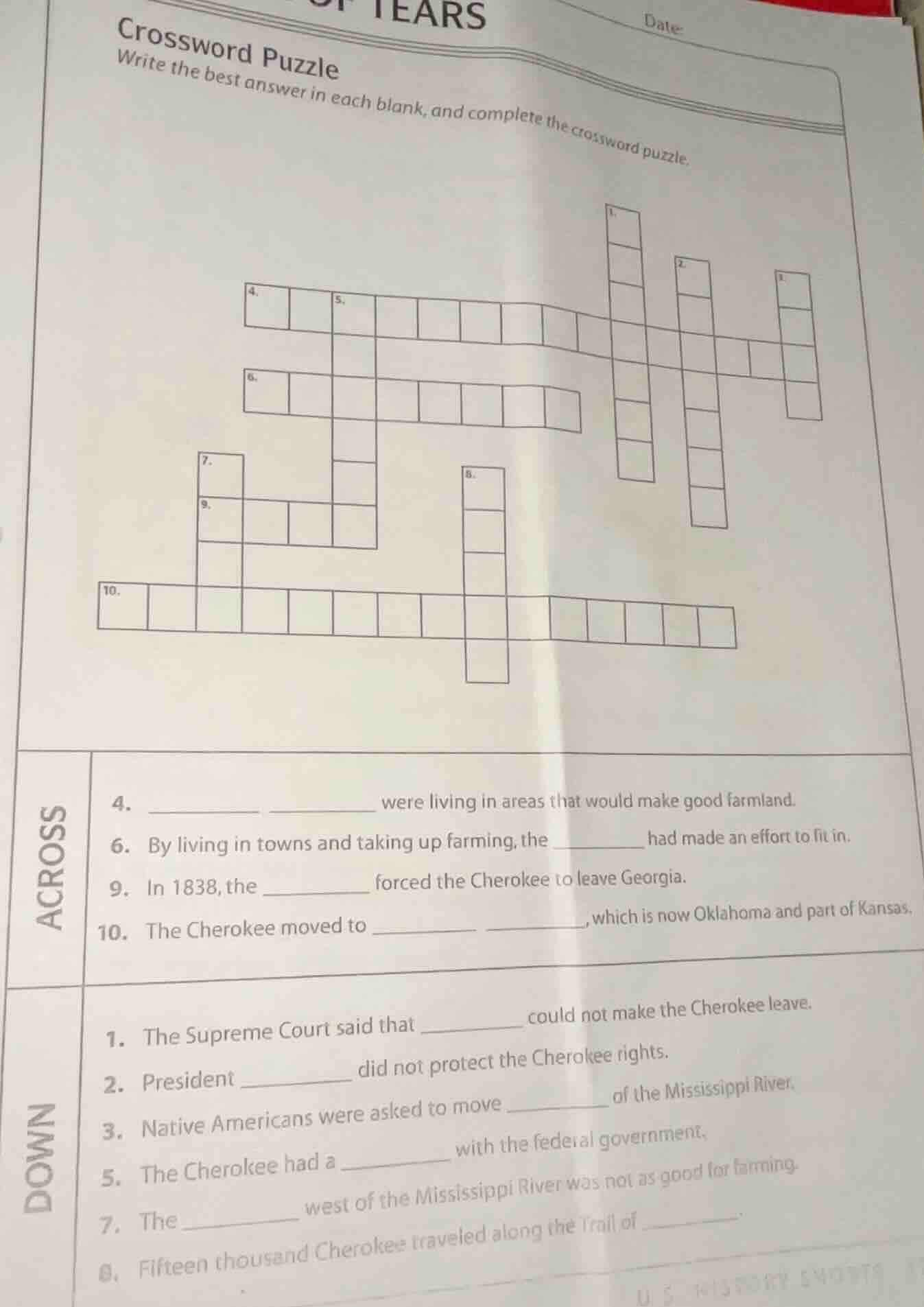
crossword puzzle
write the best answer in each blank, and complete the crossword puzzle.
across
- ____ ____ were living in areas that would make good farmland.
- by living in towns and taking up farming, the ______ had made an effort to fit in.
- in 1838, the ______ forced the cherokee to leave georgia.
- the cherokee moved to ____ ____, which is now oklahoma and part of kansas.
down
- the supreme court said that ______ could not make the cherokee leave.
- president ______ did not protect the cherokee rights.
- native americans were asked to move ______ of the mississippi river.
- the cherokee had a ______ with the federal government.
- the ______ west of the mississippi river was not as good for farming.
- fifteen thousand cherokees traveled along the trail of ______.
To solve this crossword puzzle related to the Cherokee and Native American history, we analyze each clue:
Across
- Native Americans were living in areas that would make good farmland. (Refers to Native American tribes, including the Cherokee, in fertile regions)
- By living in towns and taking up farming, the Cherokee had made an effort to fit in. (The Cherokee assimilated by adopting European - style living, including farming)
- In 1838, the army (or “United States” could also fit, but “army” is more direct in the context of forcing removal) forced the Cherokee to leave Georgia. The US Army was involved in the forced relocation of the Cherokee.
- The Cherokee moved to Indian Territory, which is now Oklahoma and part of Kansas. This was the designated area for Native American relocation.
Down
- The Supreme Court said that Georgia could not make the Cherokee leave. The Supreme Court case Worcester v. Georgia ruled that Georgia had no right to enforce laws on Cherokee land.
- President Jackson (Andrew Jackson) did not protect the Cherokee rights. Jackson was supportive of Native American removal and ignored the Supreme Court's ruling.
- Native Americans were asked to move west of the Mississippi River. The Indian Removal Act aimed to relocate Native Americans to the west of the Mississippi.
- The Cherokee had a treaty with the federal government. There were various treaties between the Cherokee and the US government, though many were not honored.
- The land west of the Mississippi River was not as good for farming. The land in Indian Territory was less fertile compared to the lands the Cherokee left.
- Fifteen thousand Cherokees traveled along the Trail of Tears. The Trail of Tears was the forced relocation route of the Cherokee, resulting in many deaths.
Filling the Crossword (Key Answers for Blanks)
- Across 4: Native Americans
- Across 6: Cherokee
- Across 9: Army (or United States)
- Across 10: Indian Territory
- Down 1: Georgia
- Down 2: Jackson
- Down 3: West
- Down 5: Treaty
- Down 7: Land
- Down 8: Tears
(Note: The actual filling of the crossword grid would use these answers based on the number of letters in each blank. For example, “Native Americans” for Across 4 (assuming the blank has two words with the appropriate number of letters), “Cherokee” for Across 6, etc.)

Snap & solve any problem in the app
Get step-by-step solutions on Sovi AI
Photo-based solutions with guided steps
Explore more problems and detailed explanations
To solve this crossword puzzle related to the Cherokee and Native American history, we analyze each clue:
Across
- Native Americans were living in areas that would make good farmland. (Refers to Native American tribes, including the Cherokee, in fertile regions)
- By living in towns and taking up farming, the Cherokee had made an effort to fit in. (The Cherokee assimilated by adopting European - style living, including farming)
- In 1838, the army (or “United States” could also fit, but “army” is more direct in the context of forcing removal) forced the Cherokee to leave Georgia. The US Army was involved in the forced relocation of the Cherokee.
- The Cherokee moved to Indian Territory, which is now Oklahoma and part of Kansas. This was the designated area for Native American relocation.
Down
- The Supreme Court said that Georgia could not make the Cherokee leave. The Supreme Court case Worcester v. Georgia ruled that Georgia had no right to enforce laws on Cherokee land.
- President Jackson (Andrew Jackson) did not protect the Cherokee rights. Jackson was supportive of Native American removal and ignored the Supreme Court's ruling.
- Native Americans were asked to move west of the Mississippi River. The Indian Removal Act aimed to relocate Native Americans to the west of the Mississippi.
- The Cherokee had a treaty with the federal government. There were various treaties between the Cherokee and the US government, though many were not honored.
- The land west of the Mississippi River was not as good for farming. The land in Indian Territory was less fertile compared to the lands the Cherokee left.
- Fifteen thousand Cherokees traveled along the Trail of Tears. The Trail of Tears was the forced relocation route of the Cherokee, resulting in many deaths.
Filling the Crossword (Key Answers for Blanks)
- Across 4: Native Americans
- Across 6: Cherokee
- Across 9: Army (or United States)
- Across 10: Indian Territory
- Down 1: Georgia
- Down 2: Jackson
- Down 3: West
- Down 5: Treaty
- Down 7: Land
- Down 8: Tears
(Note: The actual filling of the crossword grid would use these answers based on the number of letters in each blank. For example, “Native Americans” for Across 4 (assuming the blank has two words with the appropriate number of letters), “Cherokee” for Across 6, etc.)