QUESTION IMAGE
Question
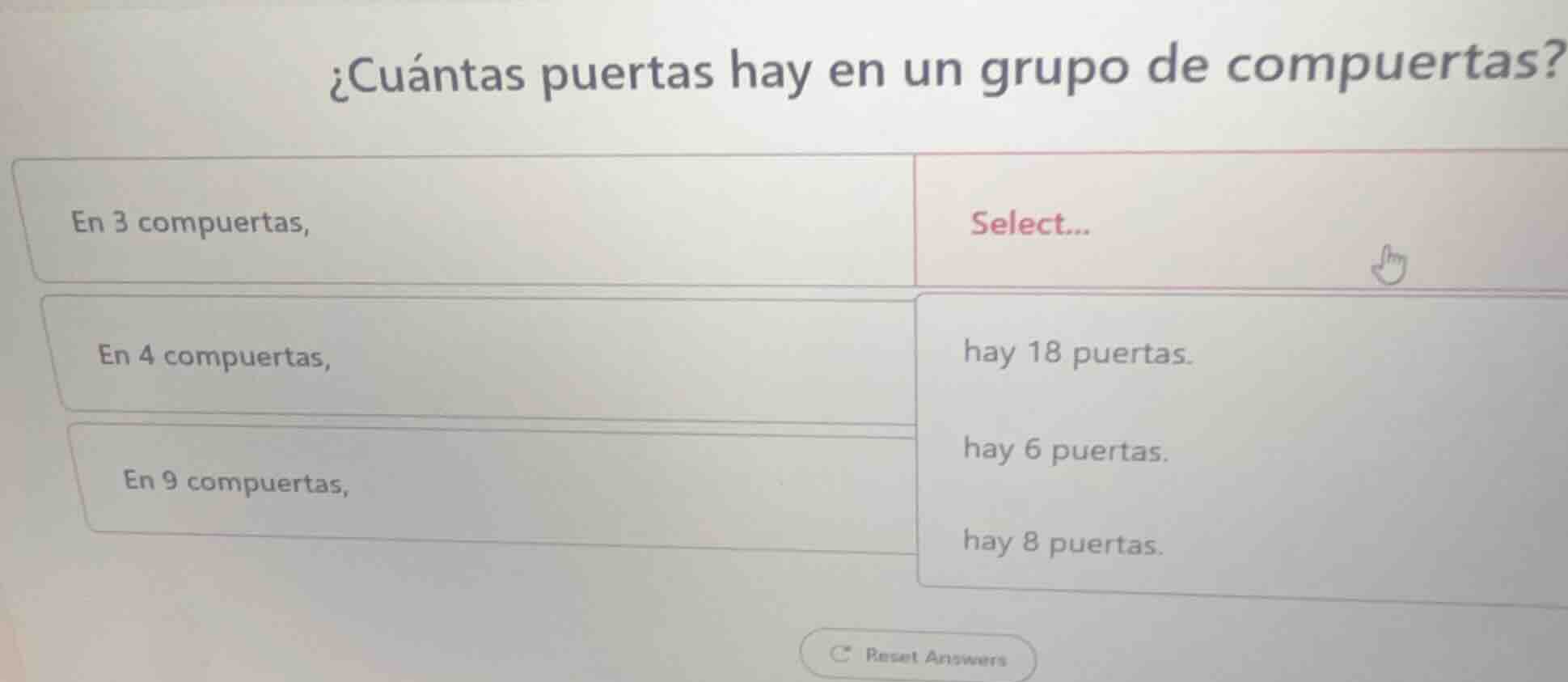
¿cuántas puertas hay en un grupo de compuertas?
en 3 compuertas, select...
en 4 compuertas,
en 9 compuertas,
hay 18 puertas.
hay 6 puertas.
hay 8 puertas.
reset answers
Step1: Analyze the relationship between the number of "compuertas" (let's assume each "compuerta" has a fixed number of doors). Let's check the options. For 3 compuertas, if we assume a pattern, let's see the options. The option "hay 6 puertas" for 3 compuertas would mean each compuerta has 2 doors (since 32=6). For 4 compuertas, 42=8, but the option is "hay 8 puertas"? Wait, no, the options are for each row. Wait, the first row is "En 3 compuertas," the second "En 4 compuertas," third "En 9 compuertas" (wait, no, the third row is "En 9 compuertas"? Wait, the image shows: first row left "En 3 compuertas," right select; second row left "En 4 compuertas," right select; third row left "En 9 compuertas" (maybe a typo, but the options are "hay 18 puertas," "hay 6 puertas," "hay 8 puertas." Let's match:
For "En 3 compuertas," 3*2=6, so "hay 6 puertas."
For "En 4 compuertas," 4*2=8, so "hay 8 puertas."
For "En 9 compuertas," 92=18, so "hay 18 puertas." Wait, but the options are three, so maybe each row is a separate question? Wait, the original question is "¿Cuántas puertas hay en un grupo de compuertas?" (How many doors are in a group of gates?). So for "En 3 compuertas" (In 3 gates), the answer should be 6 (32), "En 4 compuertas" (In 4 gates) 8 (42), "En 9 compuertas" 18 (92). But the options are three, so let's assign:
- En 3 compuertas: hay 6 puertas (since 3*2=6)
- En 4 compuertas: hay 8 puertas (4*2=8)
- En 9 compuertas: hay 18 puertas (9*2=18)
So for the first row "En 3 compuertas," the correct option is "hay 6 puertas." For the second row "En 4 compuertas," "hay 8 puertas." For the third row (if it's 9 compuertas), "hay 18 puertas." But the image shows the options in a dropdown for all? Wait, maybe the first row "En 3 compuertas" should be matched with "hay 6 puertas," second "En 4 compuertas" with "hay 8 puertas," third (maybe a typo, like 9) with "hay 18 puertas." But the user's question is about the selection. Let's assume the first row "En 3 compuertas" should have "hay 6 puertas" (since 32=6), second "En 4 compuertas" "hay 8 puertas" (42=8), third (if 9) "hay 18 puertas" (9*2=18). But the options are three, so each row is a separate match. So:
- En 3 compuertas: hay 6 puertas (3*2=6)
- En 4 compuertas: hay 8 puertas (4*2=8)
- En 9 compuertas: hay 18 puertas (9*2=18)
So for the first row (En 3 compuertas), the answer is "hay 6 puertas"; for En 4 compuertas, "hay 8 puertas"; for En 9 compuertas, "hay 18 puertas." But the image shows the dropdown with three options, so maybe each row is a separate selection. Let's focus on the first row: "En 3 compuertas," the correct option is "hay 6 puertas" (since 3*2=6).
Step2: Confirm the pattern. If each compuerta has 2 doors, then 3 compuertas: 32=6, 4 compuertas: 42=8, 9 compuertas: 9*2=18. So the options match this pattern.

Snap & solve any problem in the app
Get step-by-step solutions on Sovi AI
Photo-based solutions with guided steps
Explore more problems and detailed explanations
For "En 3 compuertas," the answer is "hay 6 puertas"; for "En 4 compuertas," the answer is "hay 8 puertas"; for "En 9 compuertas" (if that's the third row), the answer is "hay 18 puertas." But based on the first row (En 3 compuertas), the correct selection is "hay 6 puertas." (Assuming the first row is the one to answer, as per the image's first select box.)