QUESTION IMAGE
Question
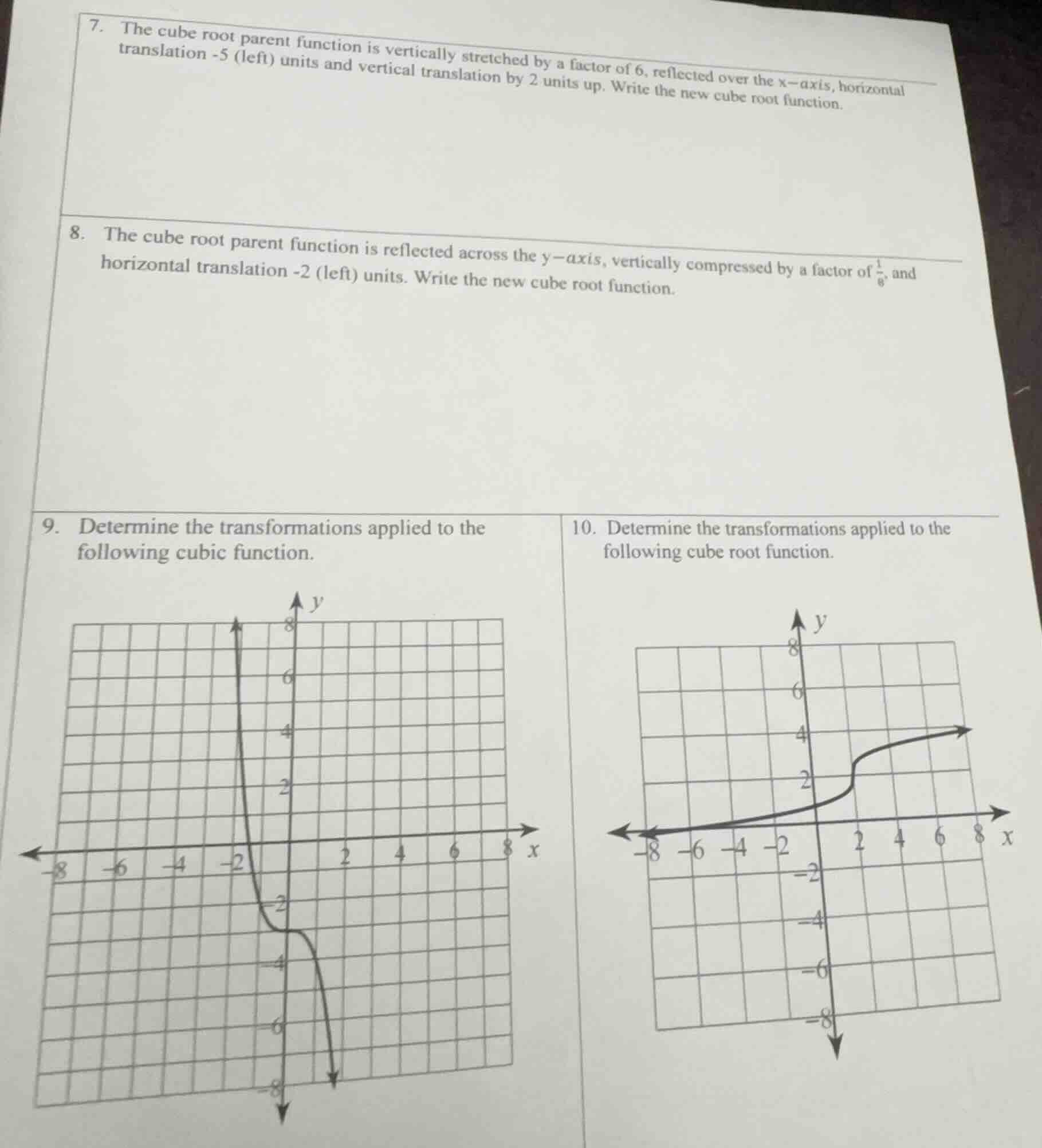
- the cube root parent function is vertically stretched by a factor of 6, reflected over the x-axis, horizontal translation -5 (left) units and vertical translation by 2 units up. write the new cube root function.
- the cube root parent function is reflected across the y-axis, vertically compressed by a factor of \\(\frac{1}{8}\\), and horizontal translation -2 (left) units. write the new cube root function.
- determine the transformations applied to the following cubic function.
- determine the transformations applied to the following cube root function.
Question 7
Step1: Recall the parent function
The parent cube root function is \( y = \sqrt[3]{x} \).
Step2: Apply vertical stretch
A vertical stretch by a factor of \( a \) is given by multiplying the function by \( a \). Here, \( a = 6 \), so we have \( y = 6\sqrt[3]{x} \).
Step3: Reflect over the x - axis
Reflecting over the x - axis changes the sign of the function. So now we have \( y=- 6\sqrt[3]{x} \).
Step4: Apply horizontal translation
A horizontal translation of \( h \) units is given by replacing \( x \) with \( x - h \). A horizontal translation of - 5 (left 5 units) means \( h=-5 \), so we replace \( x \) with \( x-(-5)=x + 5 \). The function becomes \( y=-6\sqrt[3]{x + 5} \).
Step5: Apply vertical translation
A vertical translation of \( k \) units up is given by adding \( k \) to the function. Here, \( k = 2 \), so we add 2 to the function. The final function is \( y=-6\sqrt[3]{x + 5}+2 \).
Step1: Recall the parent function
The parent cube root function is \( y=\sqrt[3]{x} \).
Step2: Reflect over the y - axis
Reflecting over the y - axis means replacing \( x \) with \( -x \). So the function becomes \( y = \sqrt[3]{-x}=-\sqrt[3]{x} \) (since \( \sqrt[3]{-x}=-\sqrt[3]{x} \)).
Step3: Apply vertical compression
A vertical compression by a factor of \( a=\frac{1}{8} \) is given by multiplying the function by \( a \). So we have \( y=\frac{1}{8}\times(-\sqrt[3]{x})=-\frac{1}{8}\sqrt[3]{x} \).
Step4: Apply horizontal translation
A horizontal translation of - 2 (left 2 units) means we replace \( x \) with \( x-(-2)=x + 2 \). The final function is \( y =-\frac{1}{8}\sqrt[3]{x + 2} \).
- Identify the parent function: The parent cubic function is \( y = x^{3} \).
- Horizontal translation: The graph of the cubic function seems to be shifted horizontally. The vertex (or the point of inflection) of the parent cubic function \( y=x^{3} \) is at \( (0,0) \). For the given graph, the point of inflection seems to be at \( (0,-3) \)? Wait, no, looking at the graph, the key point (the point where the function changes its curvature) is at \( x = 0,y=-3 \)? Wait, actually, let's re - examine. The parent cubic function \( y = x^{3} \) passes through \( (0,0) \), \( (1,1) \), \( (- 1,-1) \). The given graph: Let's check the x - intercept or the point of inflection. The graph is shifted horizontally? Wait, no, the graph of the cubic function in the picture: Let's see the transformation. The parent function \( y=x^{3} \). If we look at the graph, it seems to be reflected over the x - axis (since the cubic function is decreasing from left to right, while the parent \( y = x^{3} \) is increasing from left to right for \( x>0 \) and decreasing for \( x < 0 \), but the given graph has a different behavior). Wait, actually, the cubic function \( y=-x^{3}-3 \)? Wait, no, let's do it step by step.
- Reflection: The parent cubic function \( y = x^{3} \) has a positive leading coefficient (the coefficient of \( x^{3} \) is 1). The given graph is decreasing as \( x \) increases, so it is reflected over the x - axis (multiply by - 1), so we have \( y=-x^{3} \).
- Vertical translation: The graph of \( y=-x^{3} \) has its point of inflection at \( (0,0) \). The given graph has its point of inflection at \( (0,-3) \), so it is shifted down by 3 units (vertical translation of - 3 units). So the transformations are: reflection over the x - axis, vertical translation 3 units down, and maybe no horizontal translation (or horizontal translation 0 units). Wait, also, looking at the graph, the shape seems to be vertically stretched or compressed? Wait, the parent \( y=-x^{3} \) at \( x = 1 \) is \( y=-1 \), at \( x = 2 \) is \( y=-8 \). In the given graph, at \( x = 1 \), what's the y - value? The graph at \( x = 1 \) seems to be at \( y=-4 \) or so? Wait, maybe there is a vertical stretch. Wait, the parent cubic function \( y = x^{3} \). Let's assume the function is \( y=-2x^{3}-3 \)? Wait, no, maybe I made a mistake. Let's start over.
- The general form of a cubic function is \( y=a(x - h)^{3}+k \), where \( (h,k) \) is the point of inflection.
- For the parent function \( y = x^{3} \), \( h = 0,k = 0,a = 1 \).
- Looking at the given graph, the point of inflection is at \( (0,-3) \), so \( h = 0,k=-3 \).
- The function is decreasing, so \( a<0 \). Let's take two points. Let's say when \( x = 1 \), the y - value: from the graph, when \( x = 1 \), \( y\approx - 5 \) (since at \( x = 1 \), the graph is below \( y=-4 \)). For the function \( y=a(x - 0)^{3}-3=ax^{3}-3 \). When \( x = 1 \), \( y=a - 3 \). If \( y=-5 \), then \( a=-2 \). So the function is \( y=-2x^{3}-3 \). So the transformations are: vertical stretch by a factor of 2, reflection over the x - axis (since \( a=-2 \), the negative sign indicates reflection over x - axis and the absolute value 2 indicates vertical stretch), and vertical translation 3 units down.

Snap & solve any problem in the app
Get step-by-step solutions on Sovi AI
Photo-based solutions with guided steps
Explore more problems and detailed explanations
\( y=-6\sqrt[3]{x + 5}+2 \)