QUESTION IMAGE
Question
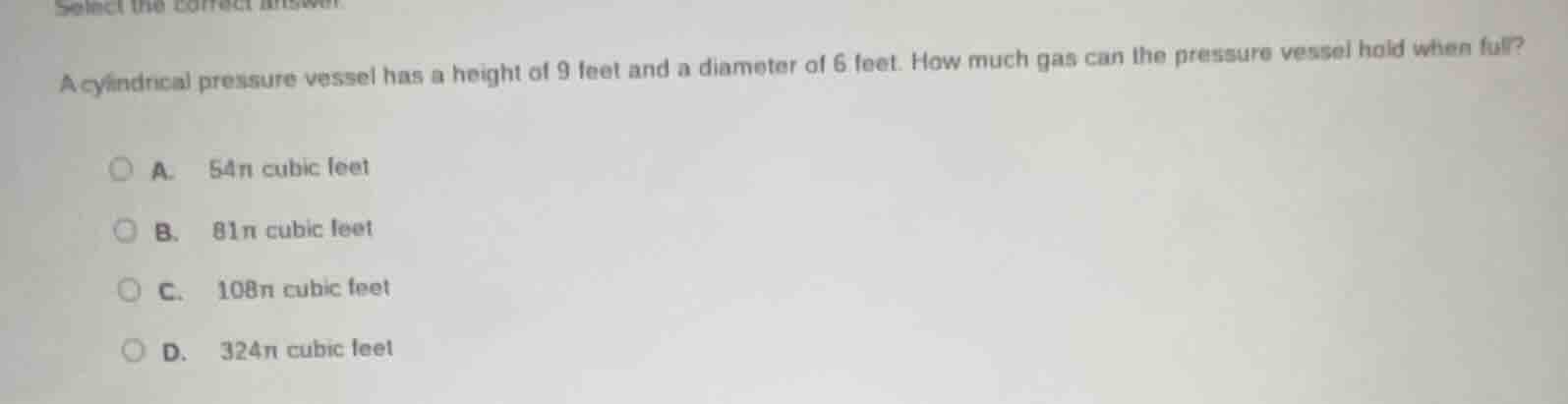
a cylindrical pressure vessel has a height of 9 feet and a diameter of 6 feet. how much gas can the pressure vessel hold when full?
a. 54π cubic feet
b. 81π cubic feet
c. 108π cubic feet
d. 324π cubic feet
Step1: Recall the formula for the volume of a cylinder
The volume \( V \) of a cylinder is given by the formula \( V=\pi r^{2}h \), where \( r \) is the radius and \( h \) is the height.
Step2: Find the radius
The diameter \( d = 6 \) feet. The radius \( r=\frac{d}{2}=\frac{6}{2} = 3 \) feet.
Step3: Substitute the values of \( r \) and \( h \) into the formula
We know that \( r = 3 \) feet and \( h=9 \) feet. Substituting these values into the formula \( V=\pi r^{2}h \), we get \( V=\pi\times(3)^{2}\times9 \).
First, calculate \( (3)^{2}=9 \). Then, \( V=\pi\times9\times9=\pi\times81 = 81\pi \) cubic feet.

Snap & solve any problem in the app
Get step-by-step solutions on Sovi AI
Photo-based solutions with guided steps
Explore more problems and detailed explanations
B. \( 81\pi \) cubic feet