QUESTION IMAGE
Question
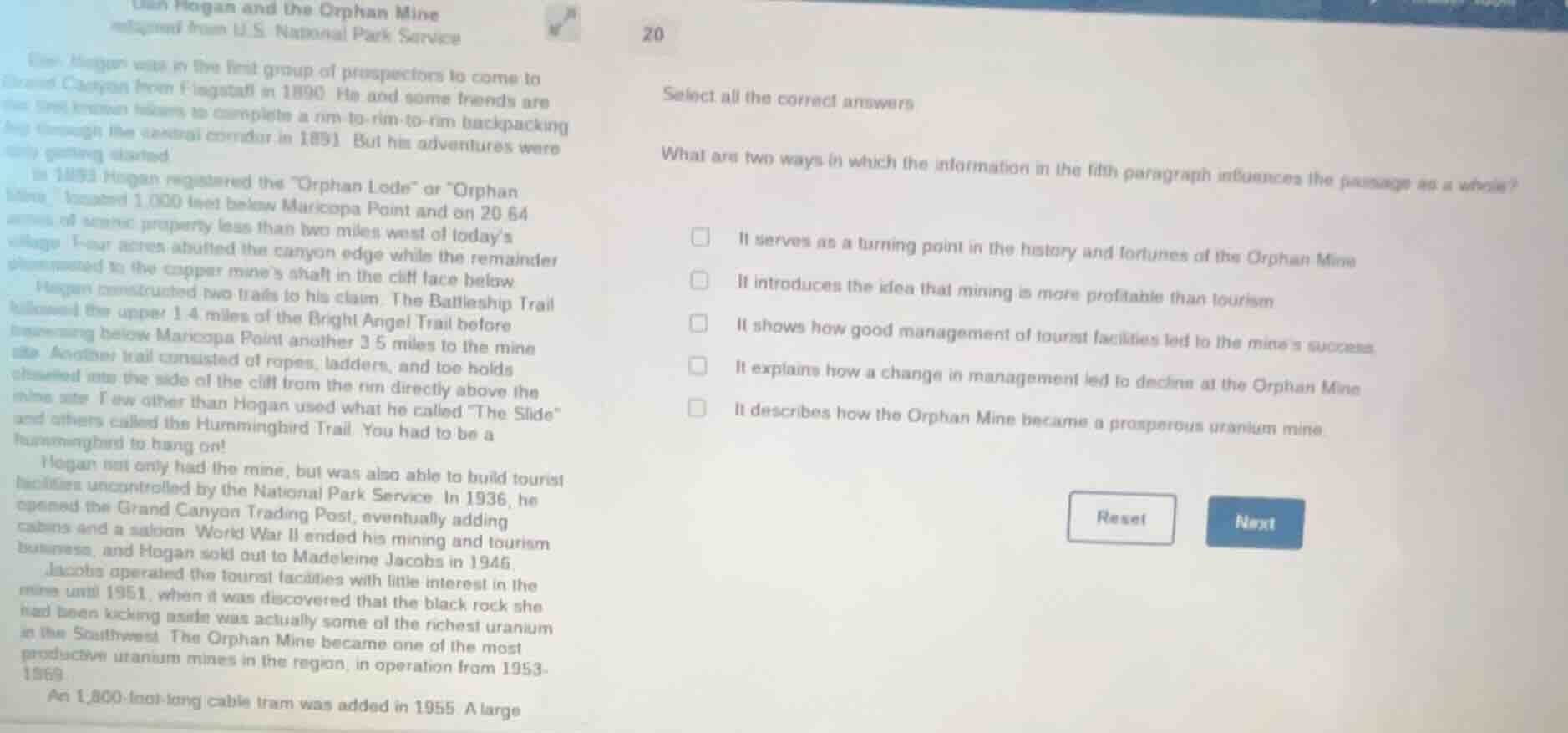
dan hogan and the orphan mine
adapted from u.s. national park service
dan hogan was in the first group of prospectors to come to
grand canyon from flagstaff in 1890. he and some friends are
the first known hikers to complete a rim - to - rim - to - rim backpacking
trip through the central corridor in 1891. but his adventures were
only getting started.
in 1893 hogan registered the “orphan lode” or “orphan
mine”, located 1,000 feet below maricopa point and on 20.64
acres of scenic property less than two miles west of today’s
village. four acres abutted the canyon edge while the remainder
plummeted to the copper mine’s shaft in the cliff face below.
hogan constructed two trails to his claim. the battleship trail
bolstered the upper 1.4 miles of the bright angel trail before
descending below maricopa point another 3.5 miles to the mine
site. another trail consisted of ropes, ladders, and toe holds
chiseled into the side of the cliff from the rim directly above the
mine site. few other than hogan used what he called “the slide”
and others called the hummingbird trail. you had to be a
hummingbird to hang on!
hogan not only had the mine, but was also able to build tourist
facilities uncontrolled by the national park service. in 1936, he
opened the grand canyon trading post, eventually adding
cabins and a saloon. world war ii ended his mining and tourism
business, and hogan sold out to madeleine jacobs in 1946.
jacobs operated the tourist facilities with little interest in the
mine until 1951, when it was discovered that the black rock she
had been kicking aside was actually some of the richest uranium
in the southwest. the orphan mine became one of the most
productive uranium mines in the region, in operation from 1953–
1969.
an 1,800 - foot - long cable tram was added in 1955. a large
20
select all the correct answers
what are two ways in which the information in the fifth paragraph influences the passage as a whole?
□ it serves as a turning point in the history and fortunes of the orphan mine
□ it introduces the idea that mining is more profitable than tourism
□ it shows how good management of tourist facilities led to the mine’s success
□ it explains how a change in management led to decline at the orphan mine
□ it describes how the orphan mine became a prosperous uranium mine
First, identify the fifth paragraph: it states that Jacobs ran tourist facilities until 1951, when discarded black rock was found to be rich uranium, turning the Orphan Mine into a top regional uranium mine operating 1953-1969.
- This is a turning point: the mine shifted from copper/tourism to profitable uranium operations, changing its fortunes.
- It directly details how the mine became a prosperous uranium mine.
Other options are incorrect: no claim mining is more profitable than tourism; management of tourism did not lead to mine success; no change in management causing decline is mentioned here.

Snap & solve any problem in the app
Get step-by-step solutions on Sovi AI
Photo-based solutions with guided steps
Explore more problems and detailed explanations
- It serves as a turning point in the history and fortunes of the Orphan Mine
- It describes how the Orphan Mine became a prosperous uranium mine