QUESTION IMAGE
Question
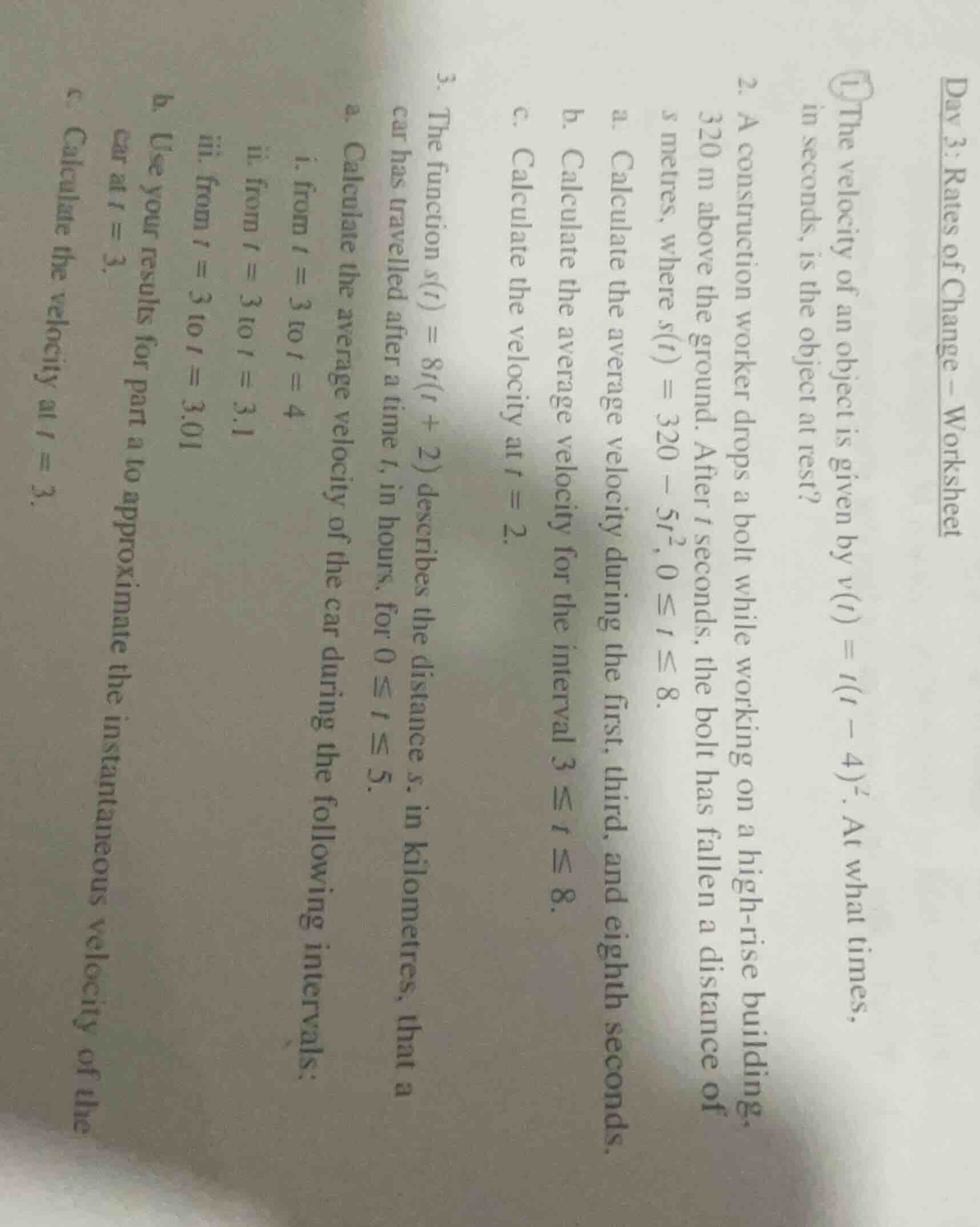
day 3: rates of change - worksheet
1 the velocity of an object is given by ( v(t) = t(t - 4)^2 ). at what times, in seconds, is the object at rest?
2 a construction worker drops a bolt while working on a high - rise building, 320 m above the ground. after ( t ) seconds, the bolt has fallen a distance of ( s ) metres, where ( s(t)=320 - 5t^2 ), ( 0leq tleq8 ).
a. calculate the average velocity during the first, third, and eighth seconds.
b. calculate the average velocity for the interval ( 3leq tleq8 ).
c. calculate the velocity at ( t = 2 ).
3 the function ( s(t)=8t(t + 2) ) describes the distance ( s ), in kilometres, that a car has travelled after a time ( t ), in hours, for ( 0leq tleq5 ).
a. calculate the average velocity of the car during the following intervals:
i. from ( t = 3 ) to ( t = 4 )
ii. from ( t = 3 ) to ( t = 3.1 )
iii. from ( t = 3 ) to ( t = 3.01 )
b. use your results for part a to approximate the instantaneous velocity of the car at ( t = 3 ).
c. calculate the velocity at ( t = 3 ).
Problem 1: Velocity of an Object
The velocity function is \( v(t) = t(t - 4)^2 \). We need to find when the object is at rest, i.e., when \( v(t)=0 \).
Step 1: Set the velocity function to zero
We have the equation \( t(t - 4)^2=0 \).
Step 2: Solve for \( t \)
Using the zero - product property, if \( ab = 0 \), then either \( a = 0 \) or \( b=0 \).
- For \( t=0 \), the equation is satisfied since when \( t = 0 \), \( 0\times(0 - 4)^2=0\times16 = 0 \).
- For \( (t - 4)^2=0 \), taking the square root of both sides, we get \( t-4=0 \), so \( t = 4 \).
Problem 2: Bolt Dropped from a Building
The distance function is \( s(t)=320 - 5t^2 \), \( 0\leq t\leq8 \)
Part (a): Average velocity during the first, third, and eighth seconds
The average velocity over the interval \([a,b]\) is given by \( \text{Average velocity}=\frac{s(b)-s(a)}{b - a} \)
- First second (\( t = 0 \) to \( t = 1 \))
- Step 1: Find \( s(0) \) and \( s(1) \)
- \( s(0)=320-5\times0^2=320 \)
- \( s(1)=320 - 5\times1^2=320 - 5=315 \)
- Step 2: Calculate average velocity
- \( \text{Average velocity}=\frac{s(1)-s(0)}{1 - 0}=\frac{315 - 320}{1}=- 5\space m/s \)
- Third second (\( t = 2 \) to \( t = 3 \))
- Step 1: Find \( s(2) \) and \( s(3) \)
- \( s(2)=320-5\times2^2=320 - 20 = 300 \)
- \( s(3)=320-5\times3^2=320 - 45 = 275 \)
- Step 2: Calculate average velocity
- \( \text{Average velocity}=\frac{s(3)-s(2)}{3 - 2}=\frac{275 - 300}{1}=-25\space m/s \)
- Eighth second (\( t = 7 \) to \( t = 8 \))
- Step 1: Find \( s(7) \) and \( s(8) \)
- \( s(7)=320-5\times7^2=320 - 245 = 75 \)
- \( s(8)=320-5\times8^2=320 - 320 = 0 \)
- Step 2: Calculate average velocity
- \( \text{Average velocity}=\frac{s(8)-s(7)}{8 - 7}=\frac{0 - 75}{1}=-75\space m/s \)
Part (b): Average velocity for the interval \( 3\leq t\leq8 \)
- Step 1: Find \( s(3) \) and \( s(8) \)
- \( s(3)=320-5\times3^2=320 - 45 = 275 \)
- \( s(8)=0 \)
- Step 2: Calculate average velocity
- \( \text{Average velocity}=\frac{s(8)-s(3)}{8 - 3}=\frac{0 - 275}{5}=\frac{- 275}{5}=-55\space m/s \)
Part (c): Velocity at \( t = 2 \)
The velocity function is the derivative of the distance function. If \( s(t)=320 - 5t^2 \), then \( v(t)=s^\prime(t) \)
- Step 1: Differentiate \( s(t) \)
- Using the power rule \( \frac{d}{dt}(t^n)=nt^{n - 1} \), \( s^\prime(t)=\frac{d}{dt}(320)-5\frac{d}{dt}(t^2) \)
- \( \frac{d}{dt}(320) = 0 \) and \( \frac{d}{dt}(t^2)=2t \), so \( v(t)=- 10t \)
- Step 2: Evaluate at \( t = 2 \)
- \( v(2)=-10\times2=-20\space m/s \)
Problem 3: Car's Distance Function \( s(t)=8t(t + 2) \)
Part (a): Average velocity over intervals
The average velocity over \([a,b]\) is \( \frac{s(b)-s(a)}{b - a} \), and \( s(t)=8t^2+16t \)
- i. From \( t = 3 \) to \( t = 4 \)
- Step 1: Find \( s(3) \) and \( s(4) \)
- \( s(3)=8\times3^2+16\times3=8\times9 + 48=72 + 48 = 120 \)
- \( s(4)=8\times4^2+16\times4=8\times16+64 = 128+64 = 192 \)
- Step 2: Calculate average velocity
- \( \text{Average velocity}=\frac{s(4)-s(3)}{4 - 3}=\frac{192 - 120}{1}=72\space km/h \)
- ii. From \( t = 3 \) to \( t = 3.1 \)
- Step 1: Find \( s(3) \) and \( s(3.1) \)
- \( s(3)=120 \) (from above)
- \( s(3.1)=8\times(3.1)^2+16\times3.1=8\times9.61+49.6=76.88 + 49.6 = 126.48 \)
- Step 2: Calculate average velocity
- \( \text{Average velocity}=\frac{s(3.1)-s(3)}{3.1 - 3}=\frac{126.48 - 120}{0.1}=\frac{6.48}{0.1}=64.8\space km/h \)
- **iii. From \(…

Snap & solve any problem in the app
Get step-by-step solutions on Sovi AI
Photo-based solutions with guided steps
Explore more problems and detailed explanations
s
Problem 1
The object is at rest at \( t = 0 \) seconds and \( t = 4 \) seconds.
Problem 2
- (a)
- First second: \(-5\space m/s\)
- Third second: \(-25\space m/s\)
- Eighth second: \(-75\space m/s\)
- (b) \(-55\space m/s\)
- (c) \(-20\space m/s\)
Problem 3
- (a)
- i. \( 72\space km/h\)
- ii. \( 64.8\space km/h\)
- iii. \( 64.08\space km/h\)
- (b) Approximately \( 64\space km/h\)
- (c) \( 64\space km/h\)