QUESTION IMAGE
Question
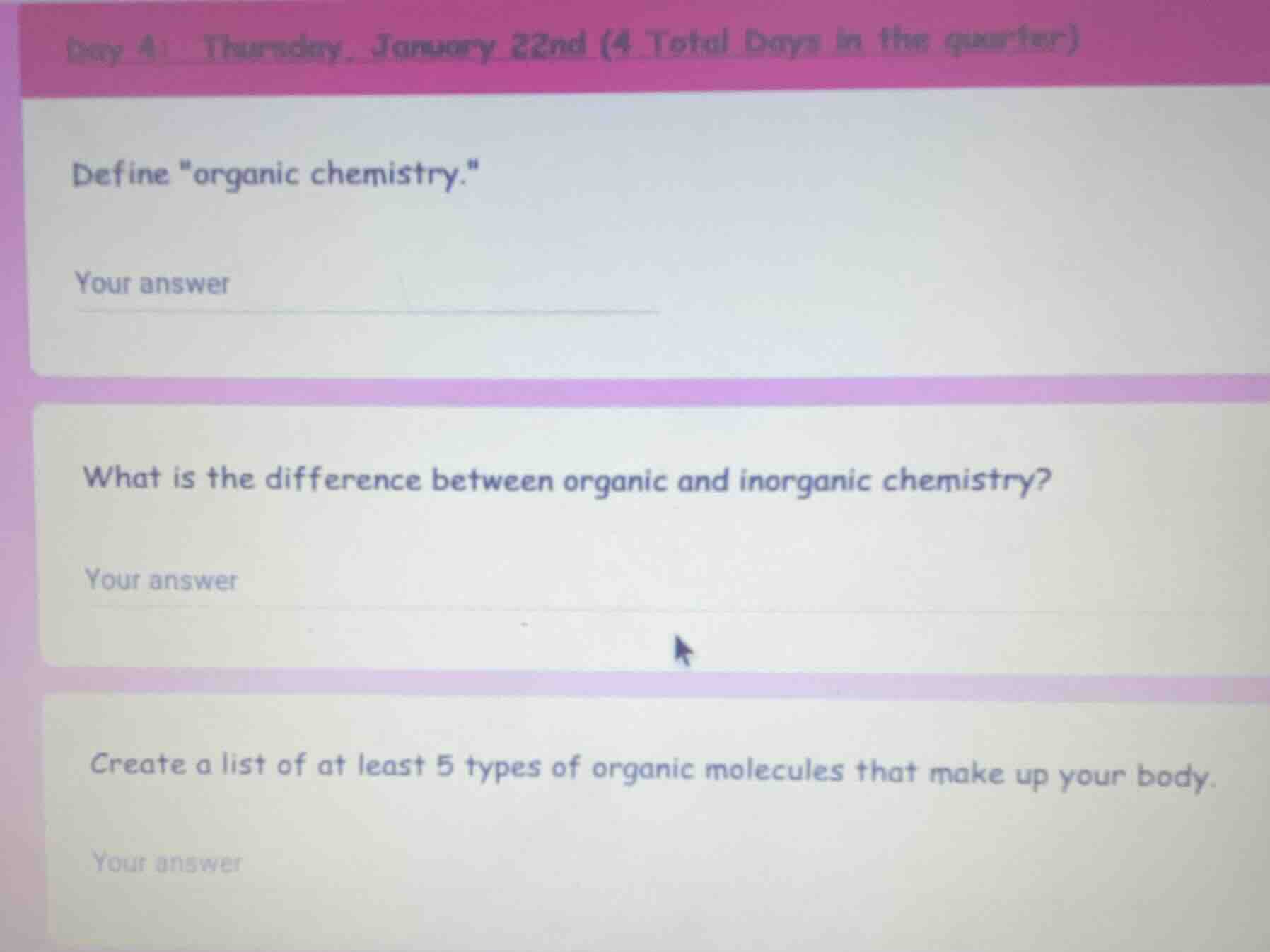
day 4: thursday, january 22nd (4 total days in the quarter)
define \organic chemistry.\
your answer
what is the difference between organic and inorganic chemistry?
your answer
create a list of at least 5 types of organic molecules that make up your body.
your answer
First Sub - Question: Define "organic chemistry."
Organic chemistry is a branch of chemistry that focuses on the study of carbon - containing compounds, along with their structure, properties, synthesis, and reactions. Carbon atoms can form a wide variety of bonds and structures, which leads to a vast number of organic compounds. These compounds often also contain other elements such as hydrogen, oxygen, nitrogen, sulfur, and halogens.
- Compound Focus: Organic chemistry deals mainly with carbon - based compounds. Inorganic chemistry focuses on compounds that are not carbon - based (with some exceptions like carbonates, cyanides, etc.).
- Bonding and Structure: Organic compounds typically have covalent bonds, and many have complex molecular structures with long carbon chains or rings. Inorganic compounds often have ionic or covalent bonds, and their structures are generally less complex in terms of carbon - related complexity (for non - carbon - based inorganic compounds).
- Reactivity: Organic reactions are often slower and more complex, involving mechanisms like substitution, addition, elimination. Inorganic reactions can be faster, and many involve redox reactions, precipitation, acid - base reactions of inorganic species.
- Occurrence in Nature: Organic compounds are the basis of living organisms (biomolecules like proteins, carbohydrates). Inorganic compounds are found in minerals, non - living matter (like salts in water, metal oxides in rocks).
- Proteins: Made of amino acids, they have structural (like collagen in skin) and functional (like enzymes for catalysis) roles in the body.
- Carbohydrates: Include monosaccharides (e.g., glucose for energy), disaccharides (e.g., sucrose), and polysaccharides (e.g., glycogen for energy storage).
- Lipids: Such as triglycerides (for energy storage), phospholipids (form cell membranes), and cholesterol (important for cell membrane structure and hormone synthesis).
- Nucleic Acids (DNA and RNA): DNA (deoxyribonucleic acid) stores genetic information, and RNA (ribonucleic acid) is involved in protein synthesis. They are made of nucleotides.
- Steroids: A type of lipid, like cholesterol (as mentioned), and steroid hormones such as testosterone and estrogen which regulate physiological processes.
- Glycogen: A polysaccharide carbohydrate that stores glucose in the liver and muscles for energy.

Snap & solve any problem in the app
Get step-by-step solutions on Sovi AI
Photo-based solutions with guided steps
Explore more problems and detailed explanations
Organic chemistry is the branch of chemistry that studies carbon - containing compounds (and their structure, properties, synthesis, and reactions), often with other elements like H, O, N, S, halogens.