QUESTION IMAGE
Question
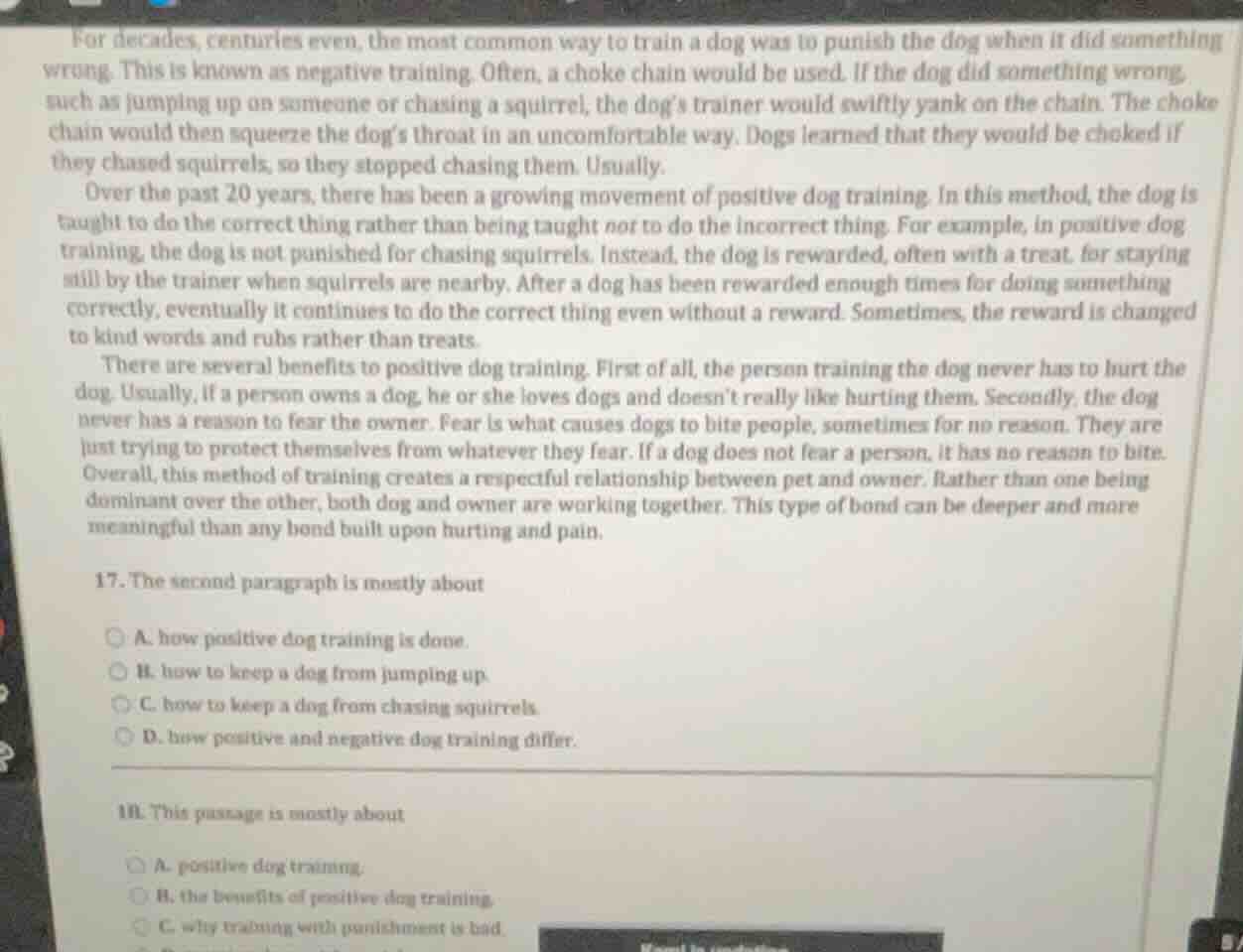
for decades, centuries even, the most common way to train a dog was to punish the dog when it did something wrong. this is known as negative training. often, a choke chain would be used. if the dog did something wrong, such as jumping up on someone or chasing a squirrel, the dog’s trainer would swiftly yank on the chain. the choke chain would then squeeze the dog’s throat in an uncomfortable way. dogs learned that they would be choked if they chased squirrels, so they stopped chasing them. usually. over the past 20 years, there has been a growing movement of positive dog training. in this method, the dog is taught to do the correct thing rather than being taught not to do the incorrect thing. for example, in positive dog training, the dog is not punished for chasing squirrels. instead, the dog is rewarded, often with a treat, for staying still by the trainer when squirrels are nearby. after a dog has been rewarded enough times for doing something correctly, eventually it continues to do the correct thing even without a reward. sometimes, the reward is changed to kind words and rubs rather than treats. there are several benefits to positive dog training. first of all, the person training the dog never has to hurt the dog. usually, if a person owns a dog, he or she loves dogs and doesn’t really like hurting them. secondly, the dog never has a reason to fear the owner. fear is what causes dogs to bite people, sometimes for no reason. they are just trying to protect themselves from whatever they fear. if a dog does not fear a person, it has no reason to bite. overall, this method of training creates a respectful relationship between pet and owner. rather than one being dominant over the other, both dog and owner are working together. this type of bond can be deeper and more meaningful than any bond built upon hurting and pain. 17. the second paragraph is mostly about a. how positive dog training is done. b. how to keep a dog from jumping up c. how to keep a dog from chasing squirrels d. how positive and negative dog training differ. 18. this passage is mostly about a. positive dog training. b. the benefits of positive dog training. c. why training with punishment is bad.
- For question 17: The second paragraph focuses on describing the process of positive dog training, using an example of rewarding a dog for staying still instead of punishing chasing squirrels. It does not focus on only stopping jumping, only stopping chasing squirrels, or comparing positive and negative training in depth.
- For question 18: The passage first introduces negative dog training, then explains positive dog training, and finally outlines its benefits. The overall focus is positive dog training as the main subject, with benefits and negative training serving to contextualize it.

Snap & solve any problem in the app
Get step-by-step solutions on Sovi AI
Photo-based solutions with guided steps
Explore more problems and detailed explanations
- A. how positive dog training is done.
- A. positive dog training.