QUESTION IMAGE
Question
decide and defend
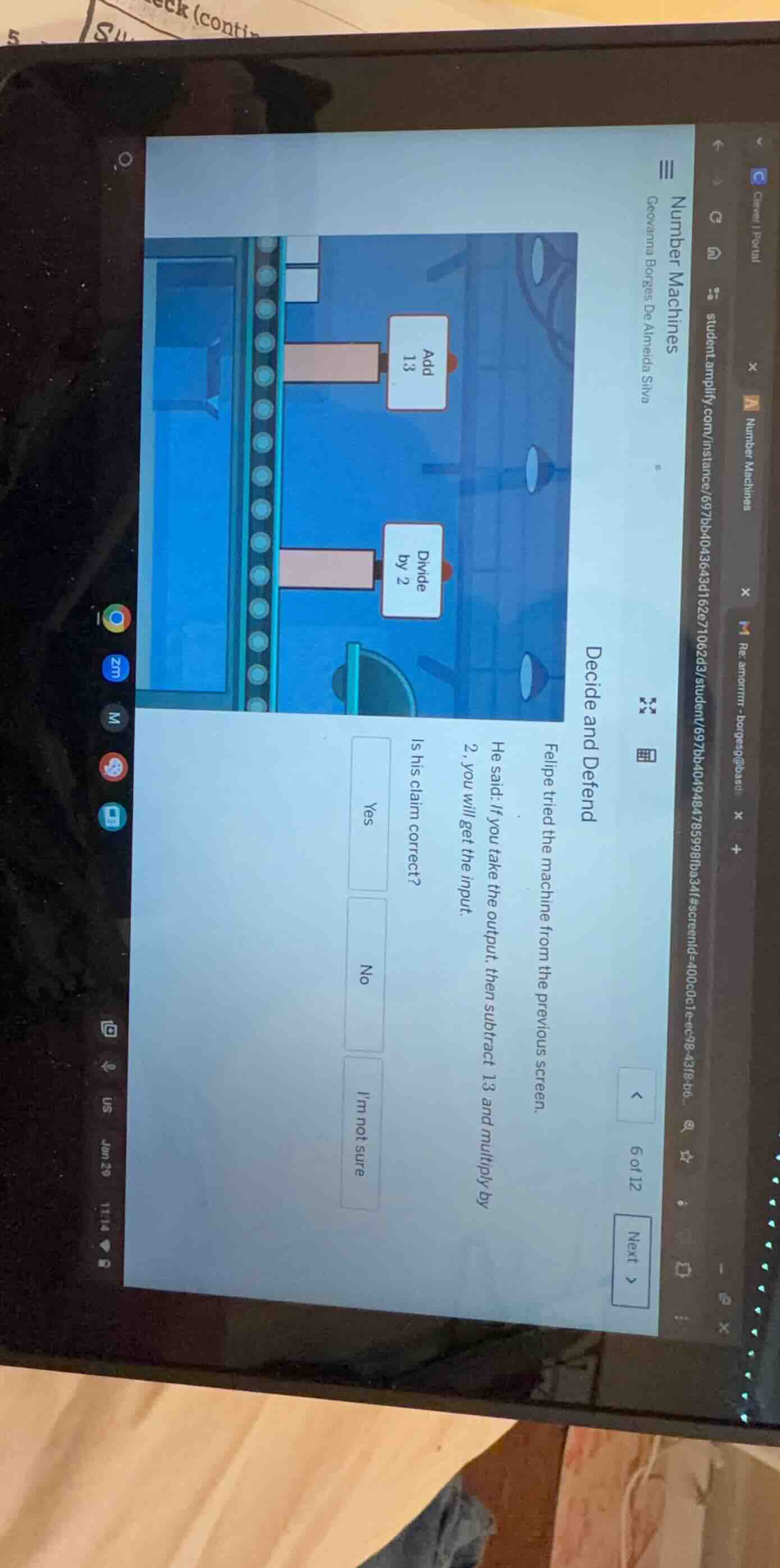
felipe tried the machine from the previous screen.
he said: if you take the output, then subtract 13 and multiply by 2, you will get the input.
is his claim correct?
yes
no
im not sure
Step1: Understand the Machine's Process
Let the input be \( x \). The machine first adds 13: \( x + 13 \), then divides by 2: \( \frac{x + 13}{2} \). So the output \( y=\frac{x + 13}{2} \).
Step2: Reverse the Process (Felipe's Claim)
Felipe says: take output \( y \), subtract 13, multiply by 2 to get input \( x \). Let's test this. Start with output \( y=\frac{x + 13}{2} \). Subtract 13: \( y - 13=\frac{x + 13}{2}-13=\frac{x + 13 - 26}{2}=\frac{x - 13}{2} \). Multiply by 2: \( 2(y - 13)=x - 13 \), which is not \( x \). Wait, maybe I misread. Wait, the correct reverse: To get \( x \) from \( y=\frac{x + 13}{2} \), multiply \( y \) by 2: \( 2y=x + 13 \), then subtract 13: \( 2y-13=x \). Oh! Felipe said "subtract 13 and multiply by 2" – but order matters. Wait, no: If the machine is \( y=(x + 13)/2 \), then solving for \( x \): \( 2y=x + 13 \implies x = 2y-13 \). So the reverse process is: multiply output by 2, then subtract 13. But Felipe said: subtract 13, then multiply by 2. Let's test with a number. Let \( x = 5 \). Machine: \( 5 + 13 = 18 \), divide by 2: \( y = 9 \). Now Felipe's process: take \( y = 9 \), subtract 13: \( 9 - 13=-4 \), multiply by 2: \( -8 \), which is not 5. Correct reverse: multiply by 2: \( 18 \), subtract 13: \( 5 \), which is \( x \). Wait, but maybe the problem's "previous screen" had a different input? Wait, maybe the machine is "Add 13" then "Divide by 2", so output \( y=(x + 13)/2 \). To get \( x \) from \( y \), we do \( x = 2y - 13 \), which is (multiply by 2) then (subtract 13). Felipe said "subtract 13 and multiply by 2" – that's \( 2(y - 13)=2y - 26 \), which is not \( x \) (since \( x = 2y - 13 \)). Wait, but maybe I made a mistake. Wait, let's take \( x = 1 \). Machine: \( 1 + 13 = 14 \), divide by 2: \( y = 7 \). Felipe's process: \( 7 - 13=-6 \), multiply by 2: \( -12
eq 1 \). Correct reverse: \( 7\times2=14 \), \( 14 - 13=1 \), which is \( x \). So Felipe's order is wrong. But wait, maybe the problem's "previous screen" had the machine as "Divide by 2 then Add 13"? No, the image shows "Add 13" then "Divide by 2". Wait, maybe the question is: If the machine is \( \text{Add 13} \) then \( \text{Divide by 2} \), then the reverse (to get input from output) is \( \text{Multiply by 2} \) then \( \text{Subtract 13} \). Felipe said "subtract 13 and multiply by 2" – which is the wrong order. But wait, maybe the problem has a typo, or I misread. Wait, the question says "Felipe tried the machine from the previous screen. He said: If you take the output, then subtract 13 and multiply by 2, you will get the input. Is his claim correct?" Let's do algebra: Let input be \( x \), output \( y=(x + 13)/2 \). Felipe's process: \( 2(y - 13)=2y - 26 \). Input \( x = 2y - 13 \). So \( 2y - 26 \) vs \( 2y - 13 \): not equal. So his claim is wrong? Wait, but maybe the machine is "Divide by 2 then Add 13"? No, the image shows "Add 13" first, then "Divide by 2". Wait, maybe I messed up the order. Let's re-express: Machine steps: 1. Add 13: \( x + 13 \). 2. Divide by 2: \( (x + 13)/2 \). So output \( y=(x + 13)/2 \). Solve for \( x \): \( 2y=x + 13 \implies x = 2y - 13 \). So the correct process to get \( x \) from \( y \) is: multiply \( y \) by 2, then subtract 13. Felipe's process: subtract 13 from \( y \), then multiply by 2: \( 2(y - 13)=2y - 26 \), which is not equal to \( x = 2y - 13 \). Therefore, his claim is incorrect? Wait, but maybe the previous screen's machine was different. Wait, maybe the machine is "Divide by 2" then "Add 13"? Let's test. If machine is \( x/2 + 13 = y \), then solving for \( x \):…

Snap & solve any problem in the app
Get step-by-step solutions on Sovi AI
Photo-based solutions with guided steps
Explore more problems and detailed explanations
Yes