QUESTION IMAGE
Question
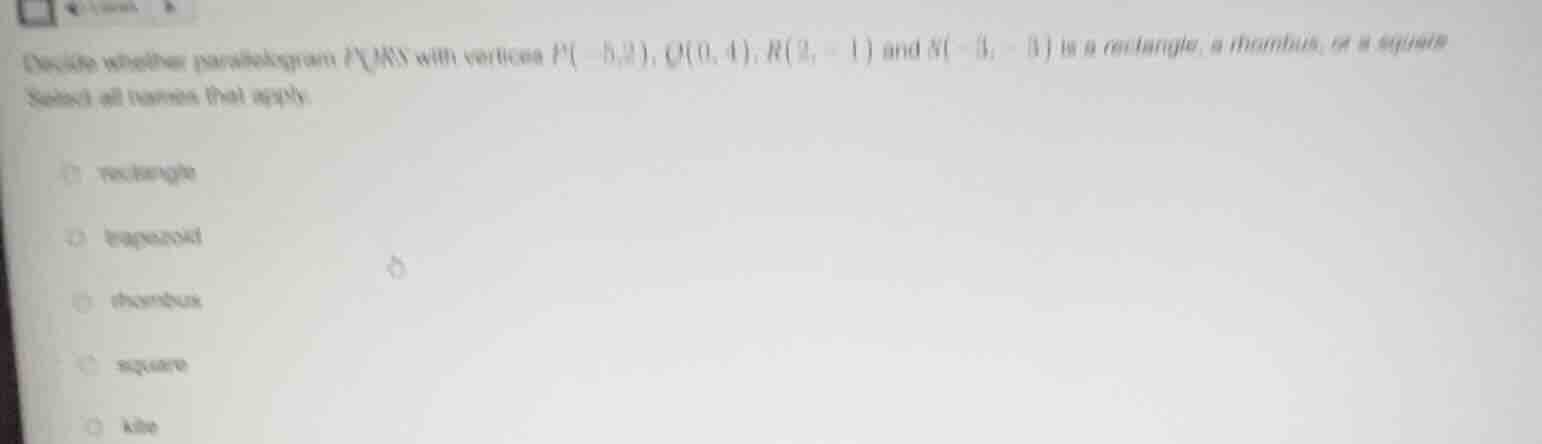
decide whether parallelogram pqrs with vertices p(-5,3), q(0,4), r(3,-1) and s(-2,-2) is a rectangle, a rhombus, or a square. select all names that apply. \bigcirc rectangle \bigcirc trapezoid \bigcirc rhombus \bigcirc square \bigcirc kite
Step1: Calculate side lengths
Use distance formula $d=\sqrt{(x_2-x_1)^2+(y_2-y_1)^2}$:
- $PQ=\sqrt{(0-(-5))^2+(4-2)^2}=\sqrt{25+4}=\sqrt{29}$
- $QR=\sqrt{(2-0)^2+(-1-4)^2}=\sqrt{4+25}=\sqrt{29}$
- $RS=\sqrt{(-3-2)^2+(-3-(-1))^2}=\sqrt{25+4}=\sqrt{29}$
- $SP=\sqrt{(-5-(-3))^2+(2-(-3))^2}=\sqrt{4+25}=\sqrt{29}$
Step2: Calculate diagonal lengths
- $PR=\sqrt{(2-(-5))^2+(-1-2)^2}=\sqrt{49+9}=\sqrt{58}$
- $QS=\sqrt{(-3-0)^2+(-3-4)^2}=\sqrt{9+49}=\sqrt{58}$
Step3: Verify properties
All sides equal ($\sqrt{29}$), diagonals equal ($\sqrt{58}$). For a rhombus with equal diagonals, it is a square, and all squares are rectangles.

Snap & solve any problem in the app
Get step-by-step solutions on Sovi AI
Photo-based solutions with guided steps
Explore more problems and detailed explanations
rectangle, rhombus, square