QUESTION IMAGE
Question
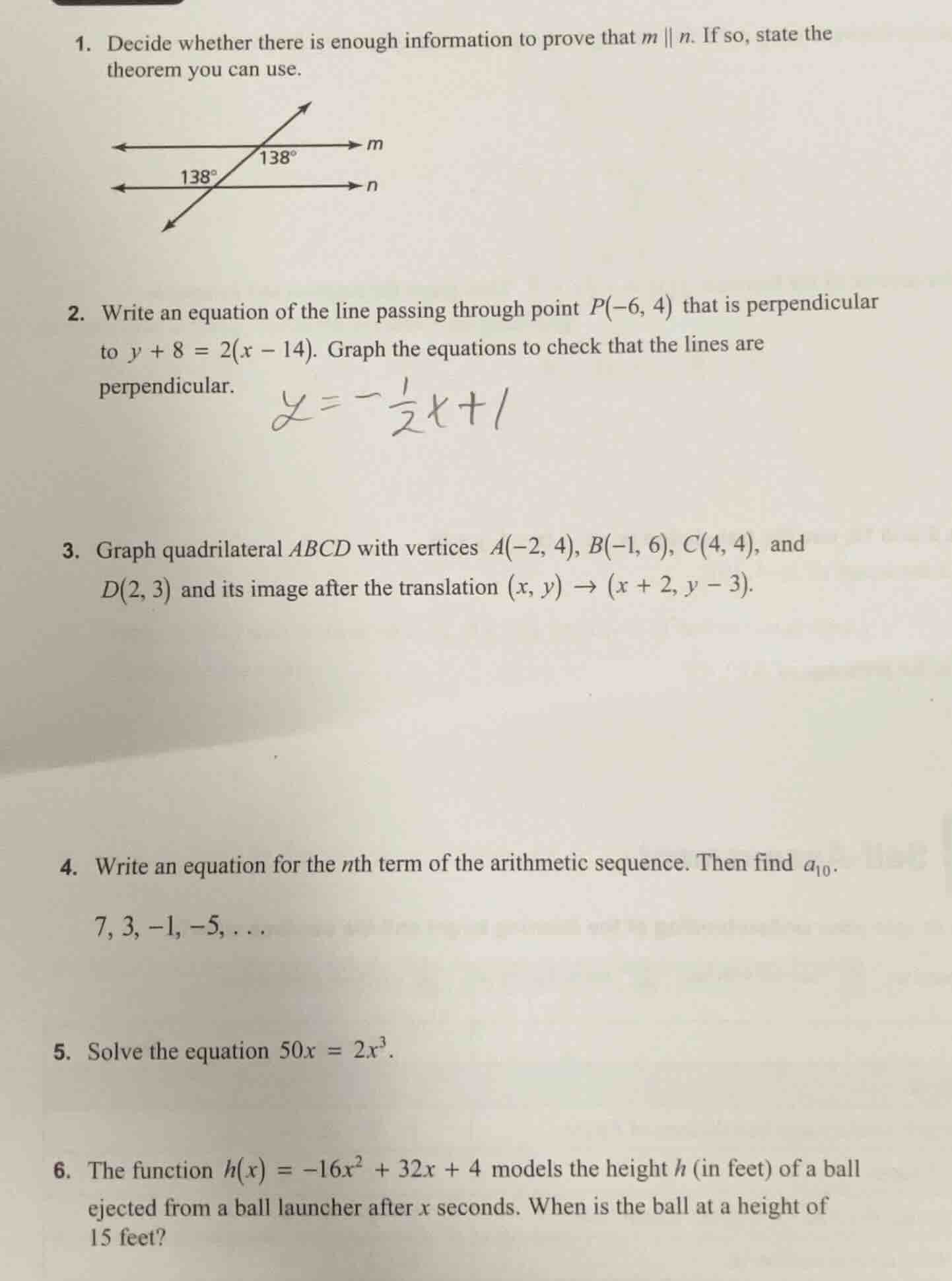
- decide whether there is enough information to prove that $m \parallel n$. if so, state the theorem you can use.
- write an equation of the line passing through point $p(-6, 4)$ that is perpendicular to $y + 8 = 2(x - 14)$. graph the equations to check that the lines are perpendicular.
- graph quadrilateral $abcd$ with vertices $a(-2, 4)$, $b(-1, 6)$, $c(4, 4)$, and $d(2, 3)$ and its image after the translation $(x, y) \to (x + 2, y - 3)$.
- write an equation for the $n$th term of the arithmetic sequence. then find $a_{10}$.
$7, 3, -1, -5, \dots$
- solve the equation $50x = 2x^3$.
- the function $h(x) = -16x^2 + 32x + 4$ models the height $h$ (in feet) of a ball ejected from a ball launcher after $x$ seconds. when is the ball at a height of 15 feet?
Problem 1
Step1: Identify the angles
The two angles given are both \(138^\circ\) and they are alternate interior angles (or also can be considered as same - side angles in a way that shows parallelism).
Step2: Apply the theorem
The theorem for proving two lines parallel when alternate interior angles are equal is: If alternate interior angles are congruent, then the two lines are parallel. Since the two \(138^\circ\) angles are alternate interior angles (formed by a transversal cutting lines \(m\) and \(n\)) and they are equal, we can prove that \(m\parallel n\) using the "Alternate Interior Angles Theorem" (or also, since they are same - side angles and supplementary? Wait, no, \(138^\circ+138^\circ = 276^\circ\), no. Wait, actually, the two angles are alternate interior angles. So the theorem is: If alternate interior angles are congruent, then the lines are parallel.
Step1: Find the slope of the given line
The given line is \(y + 8=2(x - 14)\). In slope - intercept form \(y=mx + b\), where \(m\) is the slope, the given line has a slope \(m_1 = 2\).
Step2: Find the slope of the perpendicular line
If two lines are perpendicular, the product of their slopes is \(- 1\). Let the slope of the perpendicular line be \(m_2\). Then \(m_1\times m_2=-1\). Substituting \(m_1 = 2\), we get \(2\times m_2=-1\), so \(m_2=-\frac{1}{2}\).
Step3: Use the point - slope form to find the equation
The point - slope form of a line is \(y - y_1=m(x - x_1)\), where \((x_1,y_1)=(-6,4)\) and \(m =-\frac{1}{2}\). Substituting these values, we have \(y - 4=-\frac{1}{2}(x + 6)\).
Step4: Simplify the equation
\(y-4=-\frac{1}{2}x-3\), then \(y=-\frac{1}{2}x + 1\).
Step1: Graph the original quadrilateral
- For point \(A(-2,4)\): Move 2 units to the left of the origin on the x - axis and 4 units up on the y - axis.
- For point \(B(-1,6)\): Move 1 unit to the left of the origin on the x - axis and 6 units up on the y - axis.
- For point \(C(4,4)\): Move 4 units to the right of the origin on the x - axis and 4 units up on the y - axis.
- For point \(D(2,3)\): Move 2 units to the right of the origin on the x - axis and 3 units up on the y - axis. Connect the points \(A - B - C - D - A\) to get quadrilateral \(ABCD\).
Step2: Apply the translation \((x,y)\to(x + 2,y - 3)\)
- For point \(A(-2,4)\): New \(x=-2 + 2=0\), new \(y = 4-3 = 1\), so \(A'(0,1)\).
- For point \(B(-1,6)\): New \(x=-1+2 = 1\), new \(y=6 - 3=3\), so \(B'(1,3)\).
- For point \(C(4,4)\): New \(x=4 + 2=6\), new \(y=4-3 = 1\), so \(C'(6,1)\).
- For point \(D(2,3)\): New \(x=2+2 = 4\), new \(y=3-3 = 0\), so \(D'(4,0)\).
Step3: Graph the image
Plot the points \(A'(0,1)\), \(B'(1,3)\), \(C'(6,1)\), \(D'(4,0)\) and connect them to get the image of quadrilateral \(ABCD\) after translation.

Snap & solve any problem in the app
Get step-by-step solutions on Sovi AI
Photo-based solutions with guided steps
Explore more problems and detailed explanations
Yes, we can prove \(m\parallel n\). The theorem used is the Alternate Interior Angles Theorem (since the alternate interior angles are congruent, each equal to \(138^\circ\)).