QUESTION IMAGE
Question
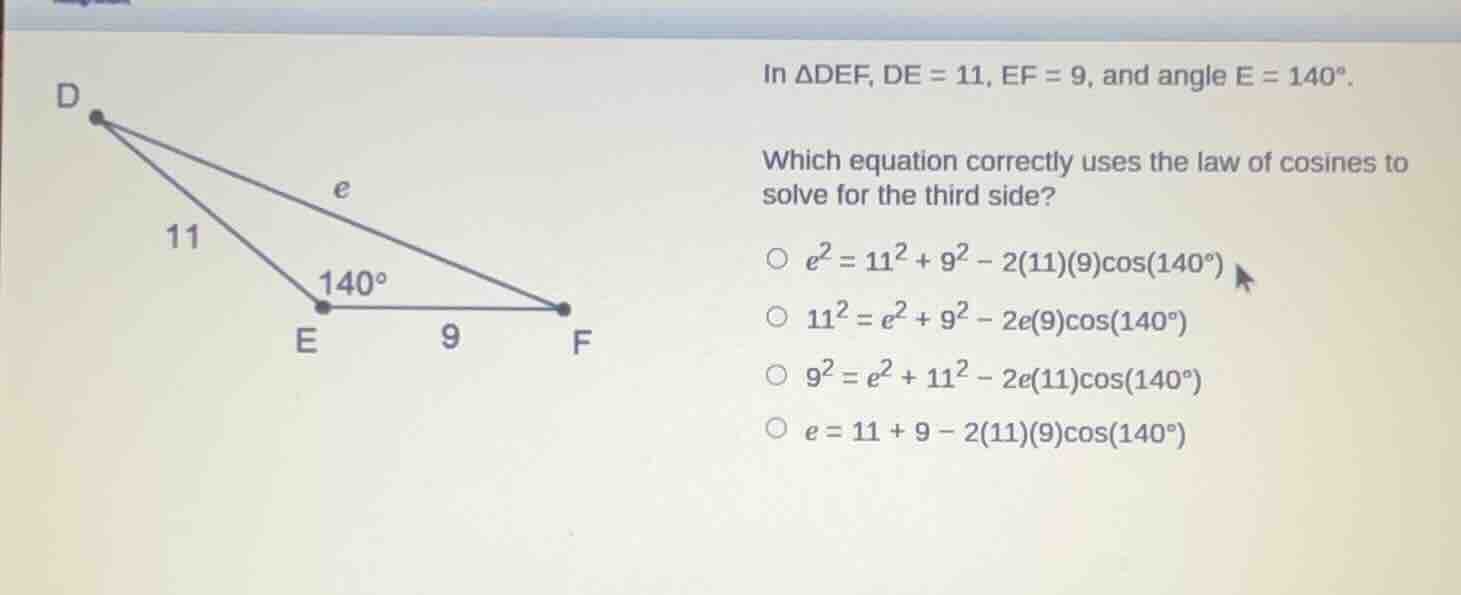
in δdef, de = 11, ef = 9, and angle e = 140°. which equation correctly uses the law of cosines to solve for the third side? ○ $e^2 = 11^2 + 9^2 - 2(11)(9)cos(140°)$ ○ $11^2 = e^2 + 9^2 - 2e(9)cos(140°)$ ○ $9^2 = e^2 + 11^2 - 2e(11)cos(140°)$ ○ $e = 11 + 9 - 2(11)(9)cos(140°)$
Step1: Recall Law of Cosines
The Law of Cosines states that for a triangle with sides \(a\), \(b\), and \(c\), and the angle \(C\) opposite side \(c\), the formula is \(c^{2}=a^{2}+b^{2}-2ab\cos(C)\).
Step2: Identify Sides and Angle in \(\triangle DEF\)
In \(\triangle DEF\), we have \(DE = 11\), \(EF=9\), angle \(E = 140^{\circ}\), and we want to find side \(e\) (which is \(DF\)). The side \(e\) is opposite angle \(E\). So, using the Law of Cosines, if \(a = 11\), \(b = 9\), \(C=140^{\circ}\), and \(c = e\), then the formula becomes \(e^{2}=11^{2}+9^{2}-2(11)(9)\cos(140^{\circ})\).
We check the other options:
- The second option has \(11^{2}=e^{2}+9^{2}-2e(9)\cos(140^{\circ})\): This misapplies the Law of Cosines as the side opposite angle \(E\) is \(e\), not \(11\).
- The third option has \(9^{2}=e^{2}+11^{2}-2e(11)\cos(140^{\circ})\): Similarly, misapplies the Law of Cosines as the side opposite angle \(E\) is \(e\), not \(9\).
- The fourth option has \(e = 11 + 9-2(11)(9)\cos(140^{\circ})\): This is incorrect as the Law of Cosines involves squares of sides, not just the sides themselves.

Snap & solve any problem in the app
Get step-by-step solutions on Sovi AI
Photo-based solutions with guided steps
Explore more problems and detailed explanations
\(e^{2}=11^{2}+9^{2}-2(11)(9)\cos(140^{\circ})\) (the first option)