QUESTION IMAGE
Question
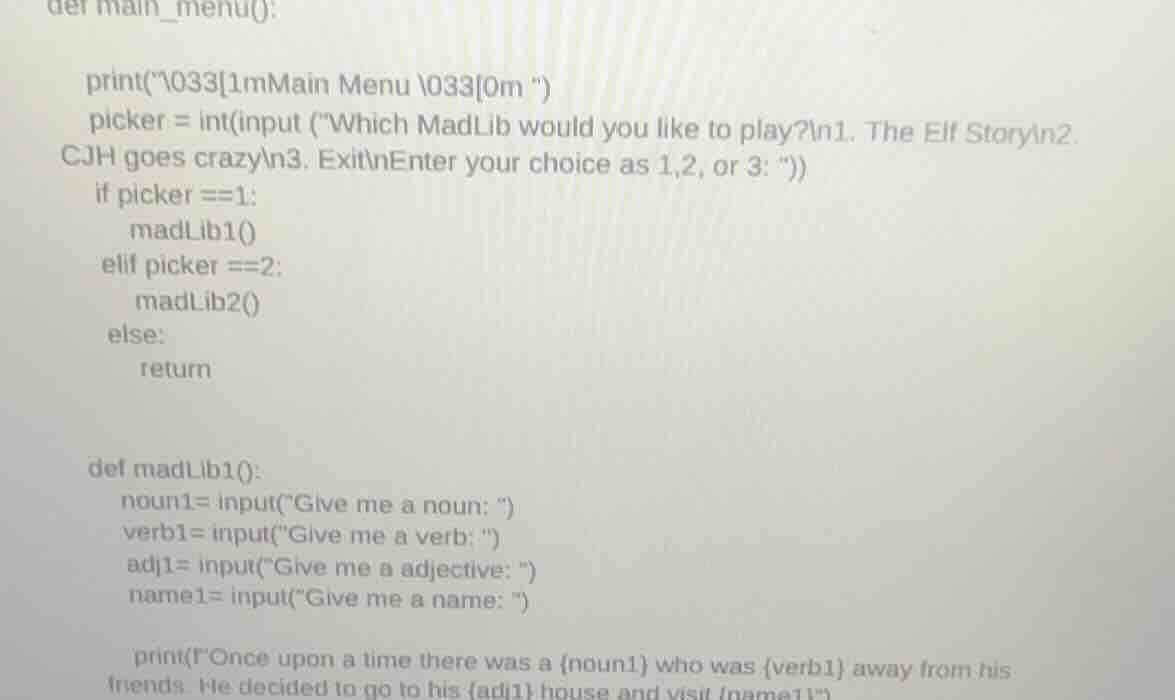
def main_menu():
print(\\\0331mmain menu \\0330m \)
picker = int(input (\which madlib would you like to play?\
- the elf story\
- cjh goes crazy\
- exit\
enter your choice as 1,2, or 3: \))
if picker ==1:
madlib1()
elif picker ==2:
madlib2()
else:
return
def madlib1():
noun1= input(\give me a noun: \)
verb1= input(\give me a verb: \)
adj1= input(\give me a adjective: \)
name1= input(\give me a name: \)
print(f\once upon a time there was a {noun1} who was {verb1} away from his friends. he decided to go to his {adj1} house and visit {name1}\)
To analyze this Python code (related to creating a MadLibs - style program):
1. Overall Functionality
The code defines a main_menu function. This function presents a menu to the user, asking which MadLib to play (option 1, 2) or to exit (option 3). Based on the user's input, it either calls madLib1 or madLib2 (the code for madLib2 is not fully shown here) or returns (exits) if the user chooses option 3.
The madLib1 function is defined to get user input for a noun, a verb, an adjective, and a name. Then it prints out a story using these user - provided words.
2. Code Structure and Syntax
- Function Definitions: The functions
main_menuandmadLib1are defined using thedefkeyword. In Python, this is the correct way to define functions. - Input Handling: The
inputfunction is used to get user input. Inmain_menu, the input is converted to an integer usingint(input(...))so that it can be compared with the integer values 1, 2, or 3. InmadLib1, the input is taken as strings (since no type conversion is done, and the default return type ofinputis a string) for the noun, verb, adjective, and name. - Control Flow: In the
main_menufunction, anif - elif - elsestructure is used to control the flow of the program based on the user's choice. If the user enters 1,madLib1is called; if 2,madLib2(not fully defined here) would be called; and if any other value (presumably 3, as per the menu prompt), the function returns, effectively ending the program's execution in the context of this function. - String Formatting: In the
printstatement ofmadLib1, f - strings are used (Python 3.6+ feature) to format the output[SSE onError error]

Snap & solve any problem in the app
Get step-by-step solutions on Sovi AI
Photo-based solutions with guided steps
Explore more problems and detailed explanations
To analyze this Python code (related to creating a MadLibs - style program):
1. Overall Functionality
The code defines a main_menu function. This function presents a menu to the user, asking which MadLib to play (option 1, 2) or to exit (option 3). Based on the user's input, it either calls madLib1 or madLib2 (the code for madLib2 is not fully shown here) or returns (exits) if the user chooses option 3.
The madLib1 function is defined to get user input for a noun, a verb, an adjective, and a name. Then it prints out a story using these user - provided words.
2. Code Structure and Syntax
- Function Definitions: The functions
main_menuandmadLib1are defined using thedefkeyword. In Python, this is the correct way to define functions. - Input Handling: The
inputfunction is used to get user input. Inmain_menu, the input is converted to an integer usingint(input(...))so that it can be compared with the integer values 1, 2, or 3. InmadLib1, the input is taken as strings (since no type conversion is done, and the default return type ofinputis a string) for the noun, verb, adjective, and name. - Control Flow: In the
main_menufunction, anif - elif - elsestructure is used to control the flow of the program based on the user's choice. If the user enters 1,madLib1is called; if 2,madLib2(not fully defined here) would be called; and if any other value (presumably 3, as per the menu prompt), the function returns, effectively ending the program's execution in the context of this function. - String Formatting: In the
printstatement ofmadLib1, f - strings are used (Python 3.6+ feature) to format the output[SSE onError error]