QUESTION IMAGE
Question
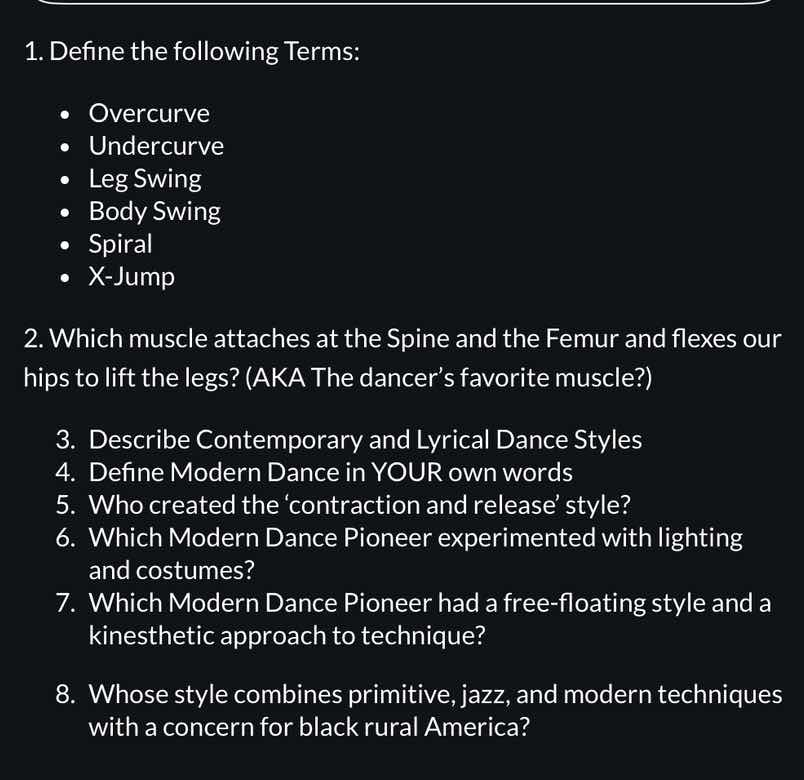
- define the following terms:
- overcurve
- undercurve
- leg swing
- body swing
- spiral
- x - jump
- which muscle attaches at the spine and the femur and flexes our hips to lift the legs? (aka the dancer’s favorite muscle?)
- describe contemporary and lyrical dance styles
- define modern dance in your own words
- who created the ‘contraction and release’ style?
- which modern dance pioneer experimented with lighting and costumes?
- which modern dance pioneer had a free - floating style and a kinesthetic approach to technique?
- whose style combines primitive, jazz, and modern techniques with a concern for black rural america?
Question 2
The muscle that attaches to the spine (specifically the lumbar vertebrae) and the femur, and is responsible for flexing the hips to lift the legs (often favored by dancers) is the iliopsoas. The iliopsoas is a composite muscle made up of the psoas major and the iliacus. The psoas major originates from the lumbar vertebrae, and the iliacus originates from the iliac fossa of the pelvis. Together, they insert onto the lesser trochanter of the femur and function to flex the hip joint, which is crucial for movements like lifting the leg (as in dance movements, walking, running, etc.).
The "contraction and release" style in modern dance was created by Martha Graham. Martha Graham developed a unique movement vocabulary where "contraction" involves the pulling in of the abdomen (creating a concave shape in the torso) and "release" is the subsequent outward expansion or letting go of that contracted energy. This technique became a foundational element of her choreographic style and has had a profound influence on modern dance.
Loie Fuller was a modern dance pioneer who experimented extensively with lighting and costumes. She was known for her performances with large, flowing silk costumes that she manipulated with her arms while using colored lighting (often projected through glass slides) to create dramatic, ethereal visual effects. Her work blurred the lines between dance, theater, and visual art, and her innovations in stagecraft (lighting and costuming) were highly influential in the development of modern dance and theatrical performance.

Snap & solve any problem in the app
Get step-by-step solutions on Sovi AI
Photo-based solutions with guided steps
Explore more problems and detailed explanations
The muscle that attaches at the spine (lumbar vertebrae) and the femur (lesser trochanter) and flexes the hips to lift the legs (the dancer’s favorite muscle) is the iliopsoas (composed of the psoas major and iliacus muscles).