QUESTION IMAGE
Question
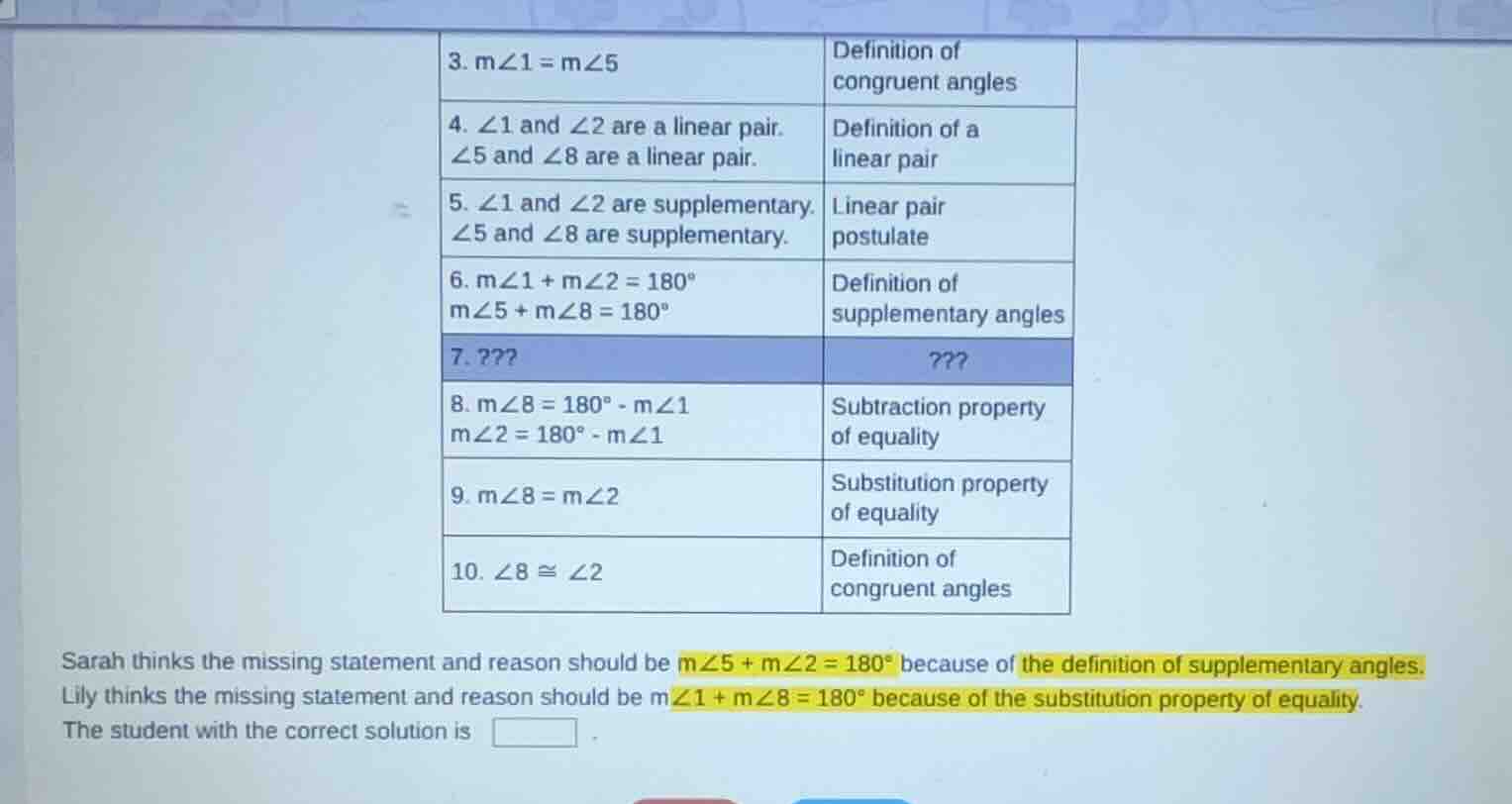
- $mangle1 = mangle5$ definition of congruent angles
- $angle1$ and $angle2$ are a linear pair. $angle5$ and $angle8$ are a linear pair. definition of a linear pair
- $angle1$ and $angle2$ are supplementary. $angle5$ and $angle8$ are supplementary. linear pair postulate
- $mangle1 + mangle2 = 180^circ$ $mangle5 + mangle8 = 180^circ$ definition of supplementary angles
- ??? ???
- $mangle8 = 180^circ - mangle1$ $mangle2 = 180^circ - mangle1$ subtraction property of equality
- $mangle8 = mangle2$ substitution property of equality
- $angle8 cong angle2$ definition of congruent angles
sarah thinks the missing statement and reason should be $mangle5 + mangle2 = 180^circ$ because of the definition of supplementary angles.
lily thinks the missing statement and reason should be $mangle1 + mangle8 = 180^circ$ because of the substitution property of equality.
the student with the correct solution is .
Step1: Analyze Sarah's Reasoning
Sarah proposes \( m\angle5 + m\angle2 = 180^\circ \) with the definition of supplementary angles. But we know \( m\angle1 = m\angle5 \) (from step 3) and \( m\angle1 + m\angle2 = 180^\circ \) (step 6). However, the definition of supplementary angles requires a linear pair or a known supplementary relationship, and there's no direct info that \( \angle5 \) and \( \angle2 \) are supplementary, so Sarah's reason is incorrect.
Step2: Analyze Lily's Reasoning
Lily proposes \( m\angle1 + m\angle8 = 180^\circ \) with the substitution property. From step 6, we have \( m\angle5 + m\angle8 = 180^\circ \), and from step 3, \( m\angle1 = m\angle5 \). Substituting \( m\angle1 \) for \( m\angle5 \) in \( m\angle5 + m\angle8 = 180^\circ \) gives \( m\angle1 + m\angle8 = 180^\circ \), which uses the substitution property of equality. So Lily's reasoning is correct.

Snap & solve any problem in the app
Get step-by-step solutions on Sovi AI
Photo-based solutions with guided steps
Explore more problems and detailed explanations
Lily (the student with the correct solution is Lily, as her reasoning follows the substitution property of equality using the known equal angles and supplementary angle definitions from previous steps)