QUESTION IMAGE
Question
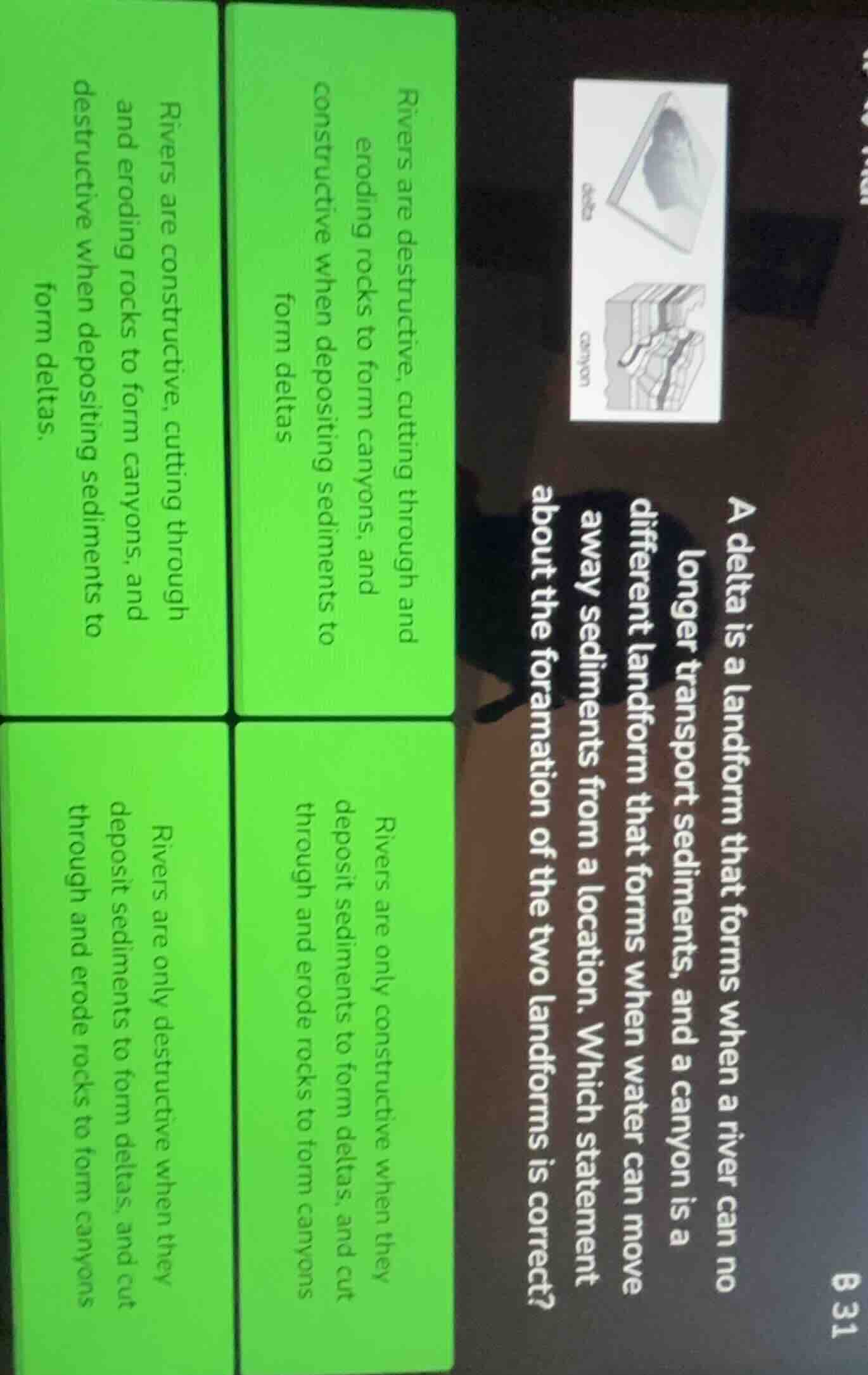
a delta is a landform that forms when a river can no longer transport sediments, and a canyon is a different landform that forms when water can move away sediments from a location. which statement about the formation of the two landforms is correct?
rivers are destructive, cutting through and eroding rocks to form canyons, and constructive when depositing sediments to form deltas
rivers are constructive, cutting through and eroding rocks to form canyons, and destructive when depositing sediments to form deltas
rivers are only constructive when they deposit sediments to form deltas, and cut through and erode rocks to form canyons
rivers are only destructive when they deposit sediments to form deltas, and cut through and erode rocks to form canyons
To solve this, we analyze each option:
- Option 1 (top - left green box): States rivers are constructive (cutting through/eroding rocks to form canyons) and destructive (depositing sediments to form deltas). This matches the definitions: Canyons form via erosion (destructive? Wait, no—wait, erosion is destructive, deposition is constructive. Wait, re - check:
- Canyons: Form when rivers erode (cut through) rocks (destructive process, as it breaks down land).
- Deltas: Form when rivers deposit sediments (constructive process, as it builds new land). So rivers are both destructive (eroding for canyons) and constructive (depositing for deltas). This option’s wording: “Rivers are constructive, cutting through and eroding rocks to form canyons, and destructive when depositing sediments to form deltas.” Wait, no—eroding is destructive, depositing is constructive. Wait, maybe the option’s labels (constructive/destructive) were mixed? Wait, no, let's re - evaluate the other options.
- Option 2 (top - right green box): Says rivers are destructive (cutting through/eroding) and constructive (depositing). But the wording is “Rivers are destructive, cutting through and eroding rocks to form canyons, and constructive when depositing sediments to form deltas.” This is correct. Wait, no, the first option (top - left) and this? Wait, no, let's check the other options:
- Option 3 (bottom - right green box): Claims rivers are “only constructive” which is wrong, as they erode (destructive).
- Option 4 (bottom - left green box): Claims rivers are “only destructive” which is wrong, as they deposit (constructive).
Wait, the correct logic:
- Destructive process: Erosion (breaking down land, like cutting through rocks to form canyons).
- Constructive process: Deposition (building new land, like depositing sediments to form deltas).
So rivers perform both: erode (destructive) to form canyons and deposit (constructive) to form deltas.
Looking at the top - left green box (first option): “Rivers are constructive, cutting through and eroding rocks to form canyons, and destructive when depositing sediments to form deltas.” Wait, no—eroding is destructive, depositing is constructive. So the correct option should have: rivers are destructive (when eroding to form canyons) and constructive (when depositing to form deltas).
Wait, the top - right green box: “Rivers are destructive, cutting through and eroding rocks to form canyons, and constructive when depositing sediments to form deltas.” Yes, this is correct. Wait, but in the image, the top - left and top - right—let me re - read the OCR:
Top - right green box: “Rivers are destructive, cutting through and eroding rocks to form canyons, and constructive when depositing sediments to form deltas”
Top - left green box: “Rivers are constructive, cutting through and eroding rocks to form canyons, and destructive when depositing sediments to form deltas”
Bottom - right: “Rivers are only constructive when they deposit sediments to form deltas, and cut through and erode rocks to form canyons” (wrong, as eroding is destructive)
Bottom - left: “Rivers are only destructive when they deposit sediments to form deltas, and cut through and erode rocks to form canyons” (wrong, deposition is constructive)
So the correct option is the top - right green box (the second option in the grid) with the text: “Rivers are destructive, cutting through and eroding rocks to form canyons, and constructive when depositing sediments to form deltas” (or the first green box? Wait, no, the OCR for the top…
To determine the correct statement, we analyze the processes of river action:
- Destructive process: Erosion (e.g., cutting through rocks to form canyons, as it breaks down land).
- Constructive process: Deposition (e.g., depositing sediments to form deltas, as it builds new land).
- Option 3 (bottom - right) and 4 (bottom - left) are wrong because rivers are not “only constructive” or “only destructive” (they do both erosion and deposition).
- Option 1 (top - left) mislabels the processes (eroding is destructive, depositing is constructive, but it swaps the labels).
- Option 2 (top - right) correctly identifies: rivers are destructive (when eroding to form canyons) and constructive (when depositing to form deltas).

Snap & solve any problem in the app
Get step-by-step solutions on Sovi AI
Photo-based solutions with guided steps
Explore more problems and detailed explanations
The correct option is the one with the text: "Rivers are destructive, cutting through and eroding rocks to form canyons, and constructive when depositing sediments to form deltas" (the top - right green box option).