QUESTION IMAGE
Question
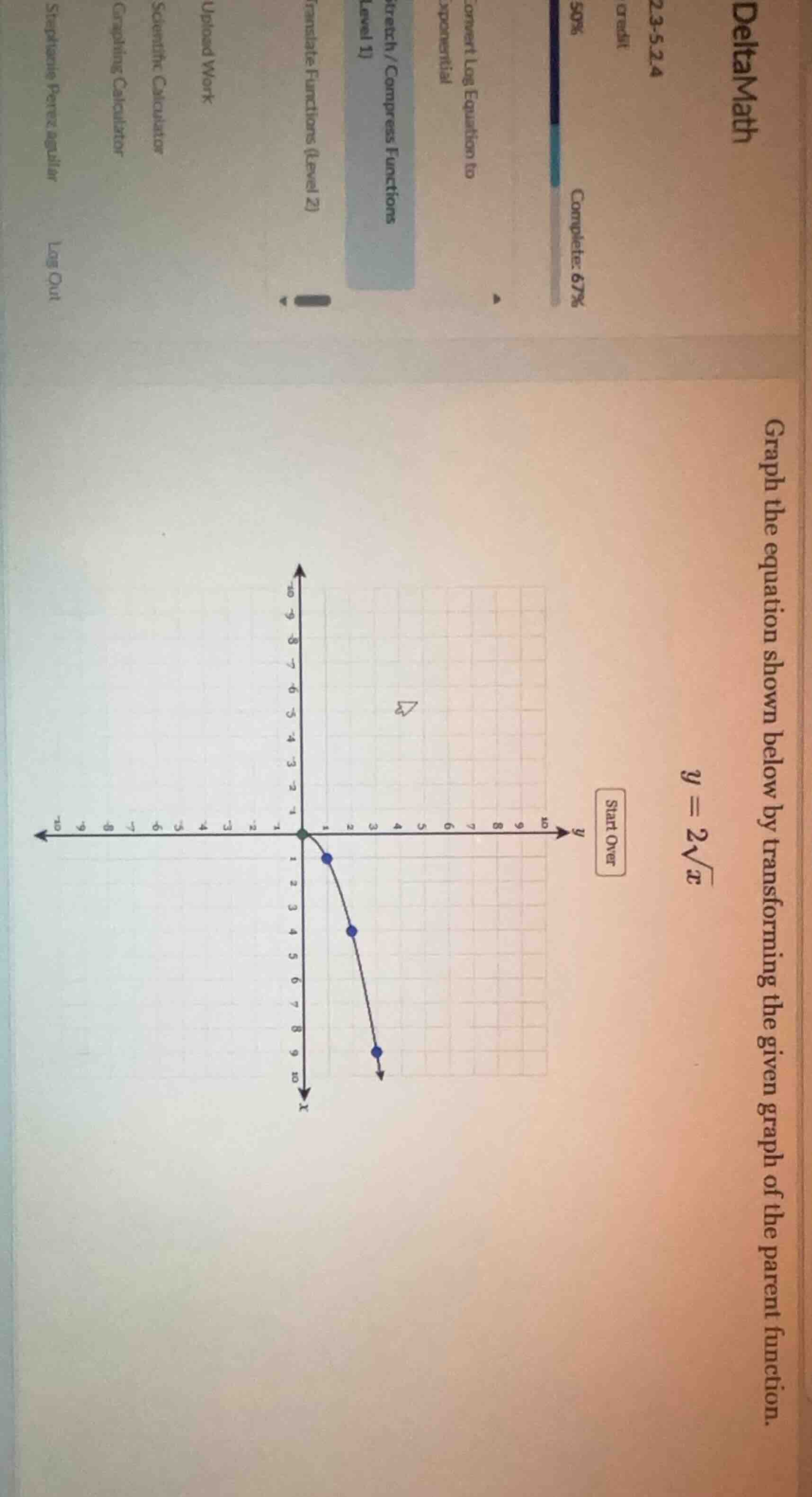
deltamath 23-5-2.4 credit 50% complete: 67% convert log equation to exponential stretch / compress functions (level 1) translate functions (level 2) upload work scientific calculator graphing calculator stephanie perezagudlar log out graph the equation shown below by transforming the given graph of the parent function. \\( y = 2\sqrt{x} \\) start over
Step1: Identify the parent function
The parent function for \( y = 2\sqrt{x} \) is \( y=\sqrt{x} \). The graph of \( y = \sqrt{x} \) starts at the origin \((0,0)\) and passes through \((1,1)\), \((4,2)\), \((9,3)\) etc.
Step2: Analyze the transformation (vertical stretch)
The function \( y = 2\sqrt{x} \) is a vertical stretch of the parent function \( y=\sqrt{x} \) by a factor of 2. For a vertical stretch by a factor of \( a \) (\( a>1 \)) of a function \( y = f(x) \), the new function is \( y = a\cdot f(x) \). Here, \( a = 2 \) and \( f(x)=\sqrt{x} \).
Step3: Find key points of the transformed function
- For \( x = 0 \): \( y=2\sqrt{0}=0 \), so the point is \((0,0)\).
- For \( x = 1 \): \( y=2\sqrt{1}=2 \), so the point is \((1,2)\).
- For \( x = 4 \): \( y=2\sqrt{4}=4 \), so the point is \((4,4)\).
- For \( x = 9 \): \( y=2\sqrt{9}=6 \), so the point is \((9,6)\).
Step4: Graph the transformed function
Plot the points \((0,0)\), \((1,2)\), \((4,4)\), \((9,6)\) and draw a smooth curve through them, starting at the origin and increasing, which is a vertical stretch of the square - root parent function.

Snap & solve any problem in the app
Get step-by-step solutions on Sovi AI
Photo-based solutions with guided steps
Explore more problems and detailed explanations
To graph \( y = 2\sqrt{x} \):
- Start with the parent function \( y=\sqrt{x} \) (passes through \((0,0)\), \((1,1)\), \((4,2)\), \((9,3)\)).
- Vertically stretch each \( y \) - coordinate of the parent function's points by a factor of 2:
- \((0,0)\) remains \((0,0)\).
- \((1,1)\) becomes \((1,2)\).
- \((4,2)\) becomes \((4,4)\).
- \((9,3)\) becomes \((9,6)\).
- Plot these new points \((0,0)\), \((1,2)\), \((4,4)\), \((9,6)\) and draw a smooth curve through them, starting at the origin and increasing. The graph is a vertical stretch of \( y = \sqrt{x} \) by a factor of 2.