QUESTION IMAGE
Question
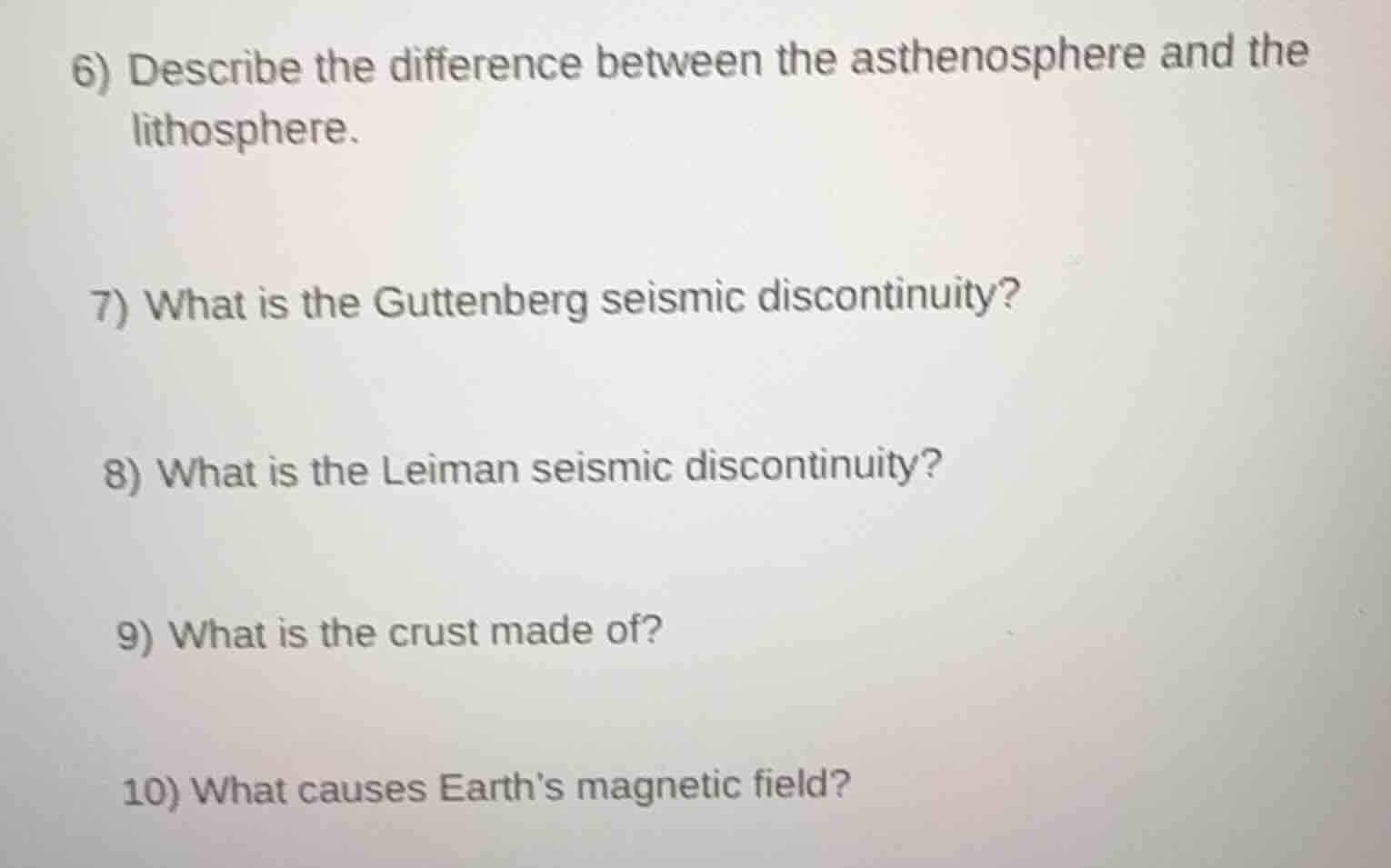
- describe the difference between the asthenosphere and the lithosphere.
- what is the guttenberg seismic discontinuity?
- what is the leiman seismic discontinuity?
- what is the crust made of?
- what causes earths magnetic field?
Brief Explanations
- The lithosphere is Earth's rigid, outermost layer, while the asthenosphere is a ductile, partially molten layer beneath it. Key differences lie in physical state, depth, and function: the lithosphere is broken into tectonic plates that move atop the flowing asthenosphere.
- The Gutenberg (Guttenberg) discontinuity is a boundary in Earth's interior marking the transition between the mantle and the outer core, identified by a sharp drop in seismic wave velocities.
- The Lehmann (Leiman) discontinuity is a seismic boundary within Earth's inner core, where seismic wave velocities increase abruptly, indicating a change in the inner core's structure or composition.
- Earth's crust is divided into two types: continental crust is primarily made of felsic rocks like granite (rich in silica, aluminum, oxygen), while oceanic crust is made of mafic rocks like basalt (rich in iron, magnesium, silica).
- Earth's magnetic field is caused by the geodynamo effect: the motion of molten, electrically conductive iron and nickel in the outer core, driven by heat from the inner core and Earth's rotation, generates electric currents that produce the magnetic field.

Snap & solve any problem in the app
Get step-by-step solutions on Sovi AI
Photo-based solutions with guided steps
Explore more problems and detailed explanations
- The lithosphere is Earth's rigid, cool outer layer (crust + upper mantle, ~5-150 km thick) broken into tectonic plates. The asthenosphere is a ductile, partially molten layer beneath the lithosphere (~100-660 km deep) that allows tectonic plates to move atop it.
- It is the seismic boundary between Earth's mantle and outer core (at ~2900 km depth), marked by a sharp decrease in P-wave velocity and the disappearance of S-waves (since S-waves cannot travel through liquid).
- It is a seismic discontinuity within Earth's inner core (at ~5150 km depth), defined by a sudden increase in seismic wave velocities, suggesting a change in the inner core's crystal structure or orientation.
- Continental crust is composed mainly of silica- and aluminum-rich felsic rocks (e.g., granite). Oceanic crust is composed of silica- and magnesium-rich mafic rocks (e.g., basalt).
- Earth's magnetic field is generated by the geodynamo effect: the convective motion of electrically conductive molten iron and nickel in the outer core, combined with Earth's rotation, creates electric currents that produce the global magnetic field.