QUESTION IMAGE
Question
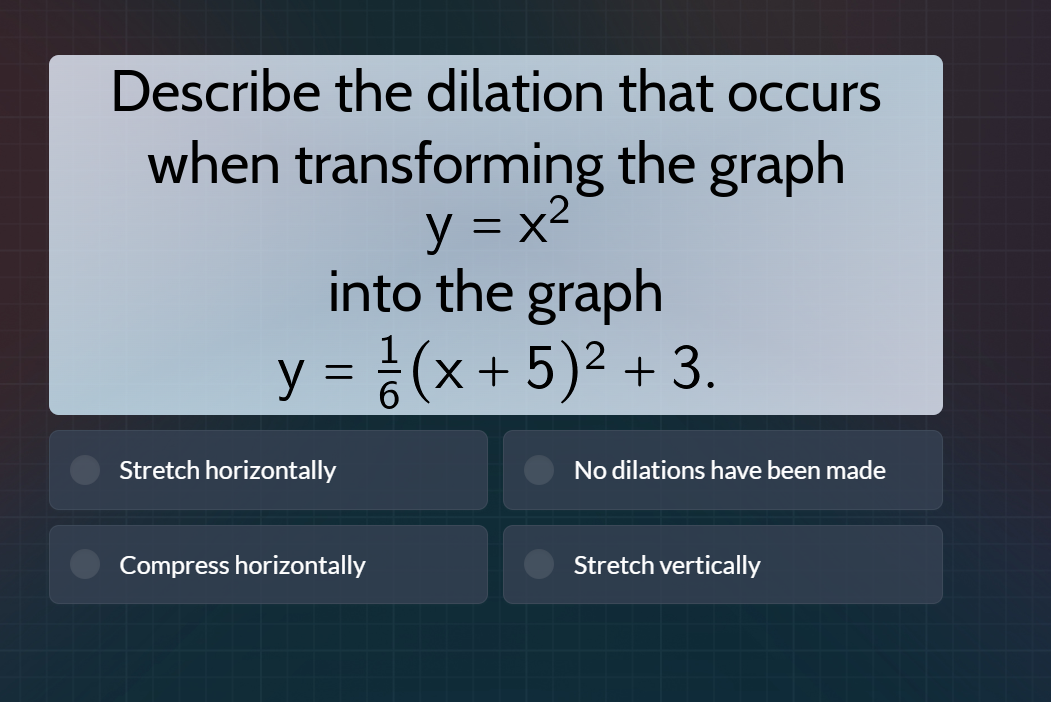
describe the dilation that occurs when transforming the graph $y = x^2$ into the graph $y = \frac{1}{6}(x + 5)^2 + 3$. stretch horizontally no dilations have been made compress horizontally stretch vertically
For a quadratic function in the form \( y = a(x - h)^2 + k \), the coefficient \( a \) determines vertical dilation. If \( |a|>1 \), it's a vertical compression; if \( 0<|a|<1 \), it's a vertical stretch. Here, the original function is \( y = x^2 \) (where \( a = 1 \)) and the transformed function is \( y=\frac{1}{6}(x + 5)^2+3 \) with \( a=\frac{1}{6} \). Since \( 0<\frac{1}{6}<1 \), this represents a vertical stretch (as a value between 0 and 1 for \( a \) in vertical dilation causes a vertical stretch, making the graph wider vertically). Horizontal dilation is determined by factors inside the parentheses affecting \( x \), but here the transformation inside the parentheses is a horizontal shift (\( x+5 \) is a shift left, not a dilation). So the dilation is a vertical stretch.

Snap & solve any problem in the app
Get step-by-step solutions on Sovi AI
Photo-based solutions with guided steps
Explore more problems and detailed explanations
Stretch vertically