QUESTION IMAGE
Question
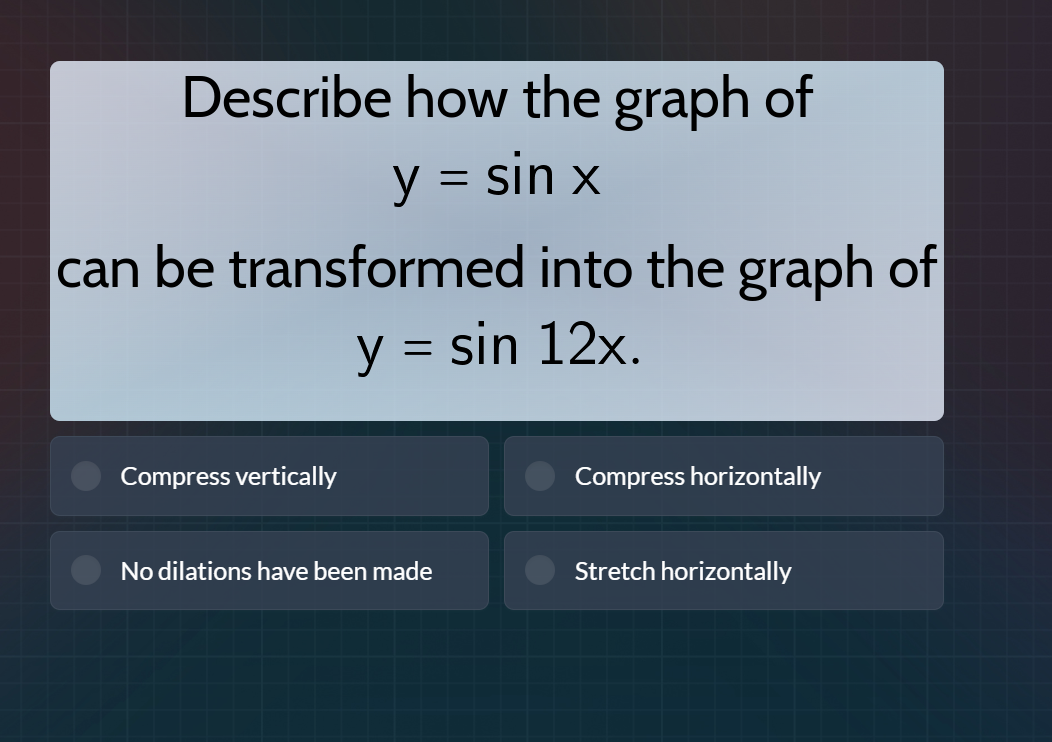
describe how the graph of
y = sin x
can be transformed into the graph of
y = sin 12x.
compress vertically
compress horizontally
no dilations have been made
stretch horizontally
Step1: Recall Horizontal Dilation Rule
For a function \( y = f(Bx) \), if \( |B|>1 \), the graph of \( y = f(x) \) is compressed horizontally by a factor of \( \frac{1}{|B|} \). Here, \( f(x)=\sin x \) and \( B = 12>1 \).
Step2: Analyze the Transformation
The original function is \( y=\sin x \), and the transformed function is \( y = \sin(12x) \). Comparing with \( y = f(Bx) \) where \( f(x)=\sin x \) and \( B = 12 \), since \( B>1 \), the graph of \( y=\sin x \) is compressed horizontally to get \( y=\sin(12x) \).

Snap & solve any problem in the app
Get step-by-step solutions on Sovi AI
Photo-based solutions with guided steps
Explore more problems and detailed explanations
B. Compress horizontally