QUESTION IMAGE
Question
describe the magnetic field:
a magnetic field is...
model the magnetic field:
Describe the magnetic field:
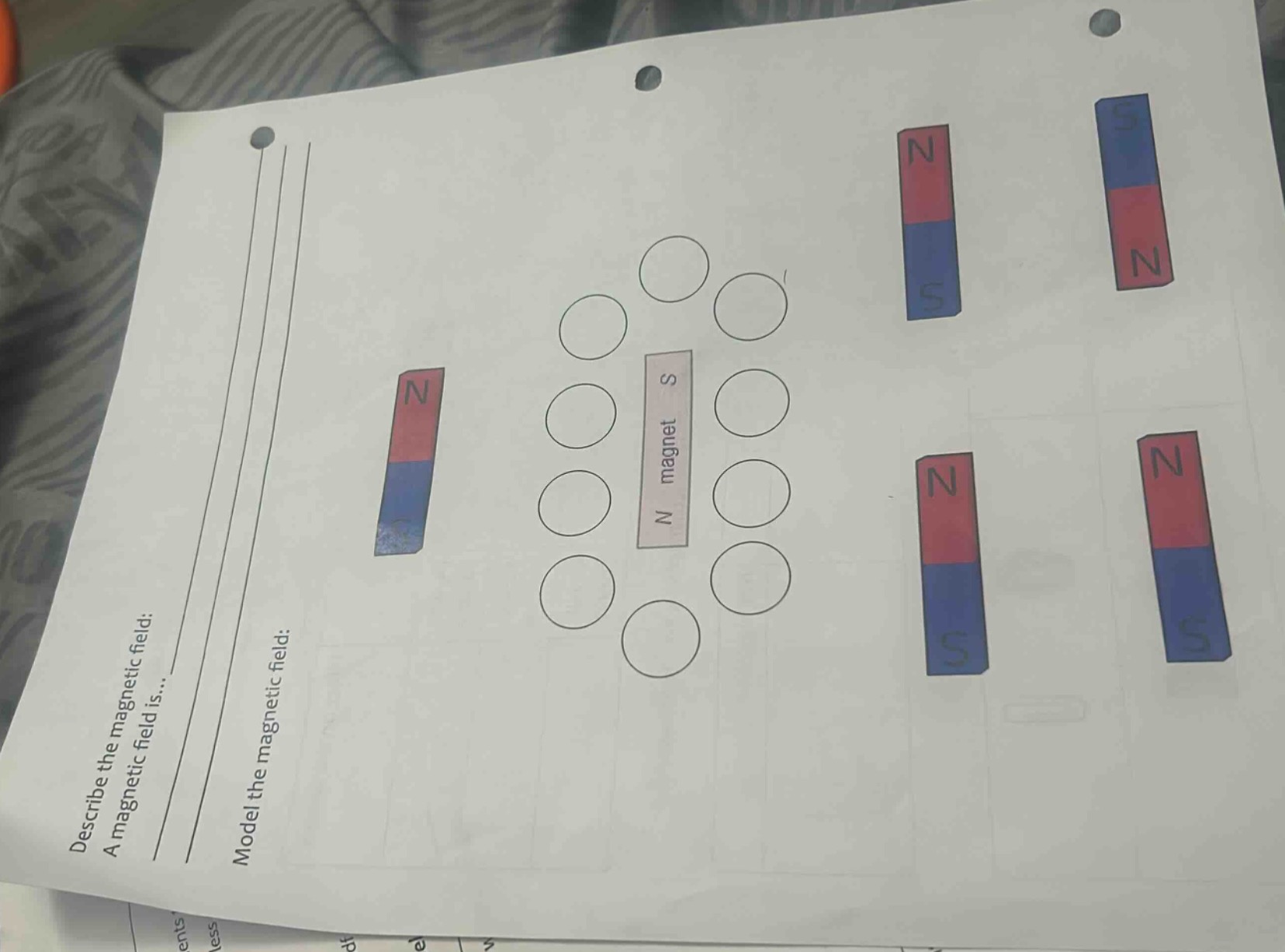
A magnetic field is the region around a magnet (like the shown bar magnet with N - North and S - South poles) where magnetic forces act. For a bar magnet, magnetic field lines emerge from the North (N) pole and enter the South (S) pole. These lines are invisible but can be visualized using magnetic materials (like iron filings, represented by the circles here) which align along the field lines. The field exerts forces on other magnets (the surrounding bar magnets) – opposite poles attract (e.g., N of one magnet to S of another) and like poles repel (N - N or S - S push apart).
Step1: Identify Magnet Poles
The central magnet has N (North) at the bottom and S (South) at the top.
Step2: Determine Field Line Direction
Magnetic field lines flow out of the N pole and into the S pole.
Step3: Place Magnetic Materials (Circles)
Align the circles (representing iron filings) along the field lines. So, near the N pole, filings point away (toward S - direction), and near S pole, filings point toward S (from N - direction). Also, for the surrounding bar magnets:
- The left bar magnet (N top, S bottom): Its S pole is near the central magnet’s N pole – they attract, so filings between them curve from central N to left S.
- Top - right magnet (N top, S bottom): Its S pole (top) is near central S? No, central top is S. Wait, central magnet: N at bottom, S at top. So top - right magnet: S top, N bottom. So central S (top) and top - right S (top) repel? No, top - right magnet: S (top), N (bottom). Central magnet: S (top). So S - S repel? Wait, no, magnetic poles: like poles repel, opposite attract. So central S (top) and top - right S (top) repel, so field lines between them curve away from each other.
- Bottom - right magnets: Both have N top, S bottom. Central N (bottom) and bottom - right N (top) repel? Wait, bottom - right magnets: first (left - bottom - right) N top, S bottom; second (right - bottom - right) N top, S bottom. Central N is at bottom. So central N (bottom) and bottom - right N (top) repel, so field lines between them curve away.
But simpler: For the central magnet, draw field lines as loops from N (bottom) to S (top), and the circles (filings) align along these loops. So in the circle grid around the central magnet, the filings (circles) should be oriented such that near the central N (bottom), they point up (toward central S), and near central S (top), they point down (toward central N). Also, for the left bar magnet (N top, S bottom), since its S (bottom) is near central N (bottom), they attract, so filings between central N and left S curve from central N to left S.
Step4: Sketch/Model (Text - based)
In the circle grid:
- Rows near central N (bottom row of circles): filings point up (toward central S).
- Rows near central S (top row of circles): filings point down (toward central N).
- Middle rows: curve from N to S, forming loops.
- For surrounding bar magnets:
- Left magnet: Filings between central N and left S align from central N to left S (attraction).
- Top - right magnet (S top, N bottom): Filings between central S and top - right S repel, so curve away from each other.
- Bottom - right magnets (N top, S bottom): Filings between central N and bottom - right N repel, curve away from each other.
But a basic model: The circles (filings) around the central bar magnet align in lines from N (bottom) to S (top), forming a pattern where filings near N point toward S, and near S point toward N, with curved lines in between.

Snap & solve any problem in the app
Get step-by-step solutions on Sovi AI
Photo-based solutions with guided steps
Explore more problems and detailed explanations
A magnetic field is the area around a magnet (e.g., the N - S bar magnet here) where magnetic forces occur. Field lines go from the magnet’s North (N) pole to South (S) pole, affecting other magnets (attracting opposite poles, repelling like poles) and aligning magnetic materials (e.g., iron filings in the circles) along these lines.