QUESTION IMAGE
Question
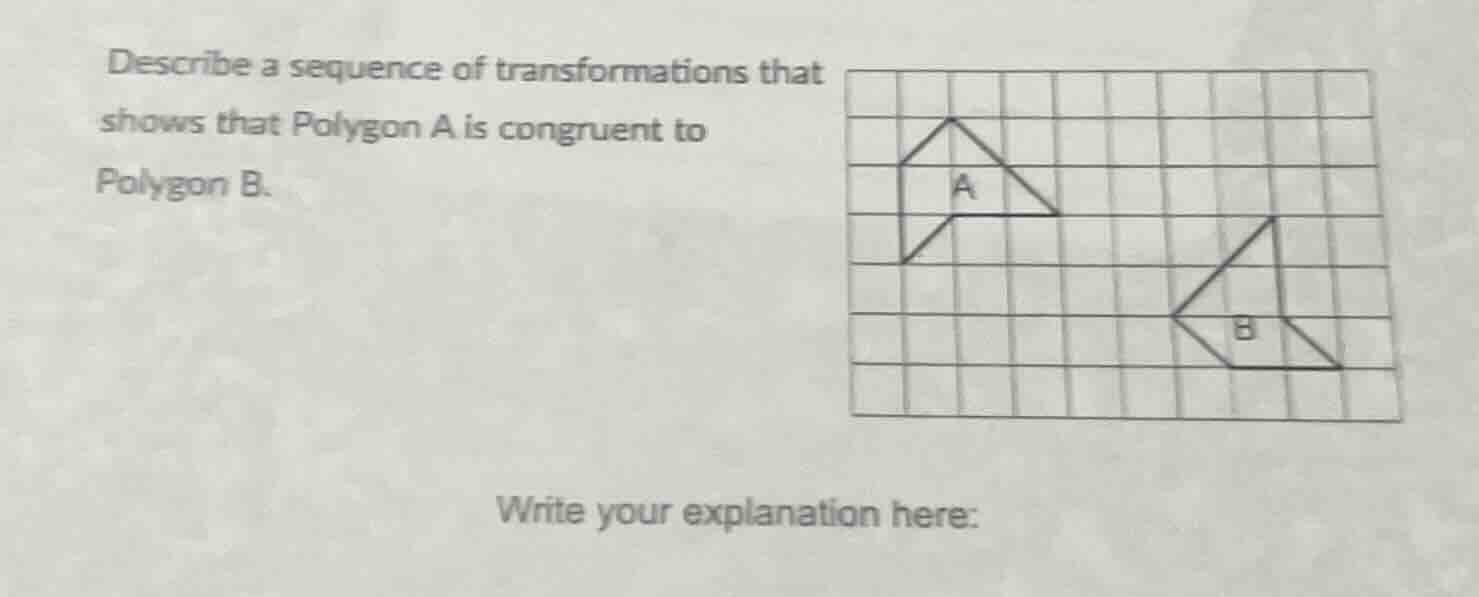
describe a sequence of transformations that shows that polygon a is congruent to polygon b. write your explanation here:
Step1: Rotate Polygon A
Rotate Polygon A 90 degrees clockwise (or counter - clockwise, depending on the orientation) around a suitable vertex (for example, the bottom - left vertex) so that its orientation matches that of Polygon B. The rotation can be done using the rotation rules for coordinate systems (if we consider the grid as a coordinate plane). For a 90 - degree clockwise rotation about the origin \((x,y)\to(y, - x)\), but in the context of the grid, we can visually align the sides.
Step2: Translate the rotated Polygon A
After rotation, we need to translate (move) the polygon horizontally and vertically to match the position of Polygon B. Count the number of units to move right and down (or other directions) to get from the rotated Polygon A to Polygon B. For example, if after rotation, we move the polygon 5 units to the right and 2 units down, it will coincide with Polygon B. (The exact number of units depends on the grid. By visually inspecting the grid, we can see that after a 90 - degree clockwise rotation, moving a certain number of horizontal and vertical units will align Polygon A with Polygon B.)

Snap & solve any problem in the app
Get step-by-step solutions on Sovi AI
Photo-based solutions with guided steps
Explore more problems and detailed explanations
One possible sequence is: 1. Rotate Polygon A 90° clockwise about its bottom - left vertex. 2. Translate the rotated polygon 5 units to the right and 2 units down (the translation values are based on the grid spacing; the rotation and translation should be such that Polygon A coincides with Polygon B).