QUESTION IMAGE
Question
describe the similarity transformation that maps $\triangle abc$ to $\triangle rst$ (dilations have a center at the origin).
a \\ rotation $180^\circ$ about the origin followed by a dilation with a scale factor of 3
b \\ rotation $90^\circ$ counterclockwise about the origin followed by a dilation with a scale factor of $\frac{1}{3}$
c \\ rotation $180^\circ$ about the origin followed by a dilation with a scale factor of $\frac{1}{3}$
d \\ rotation $90^\circ$ counterclockwise about the origin followed by a dilation with a scale factor of 3
Step1: Identify Coordinates
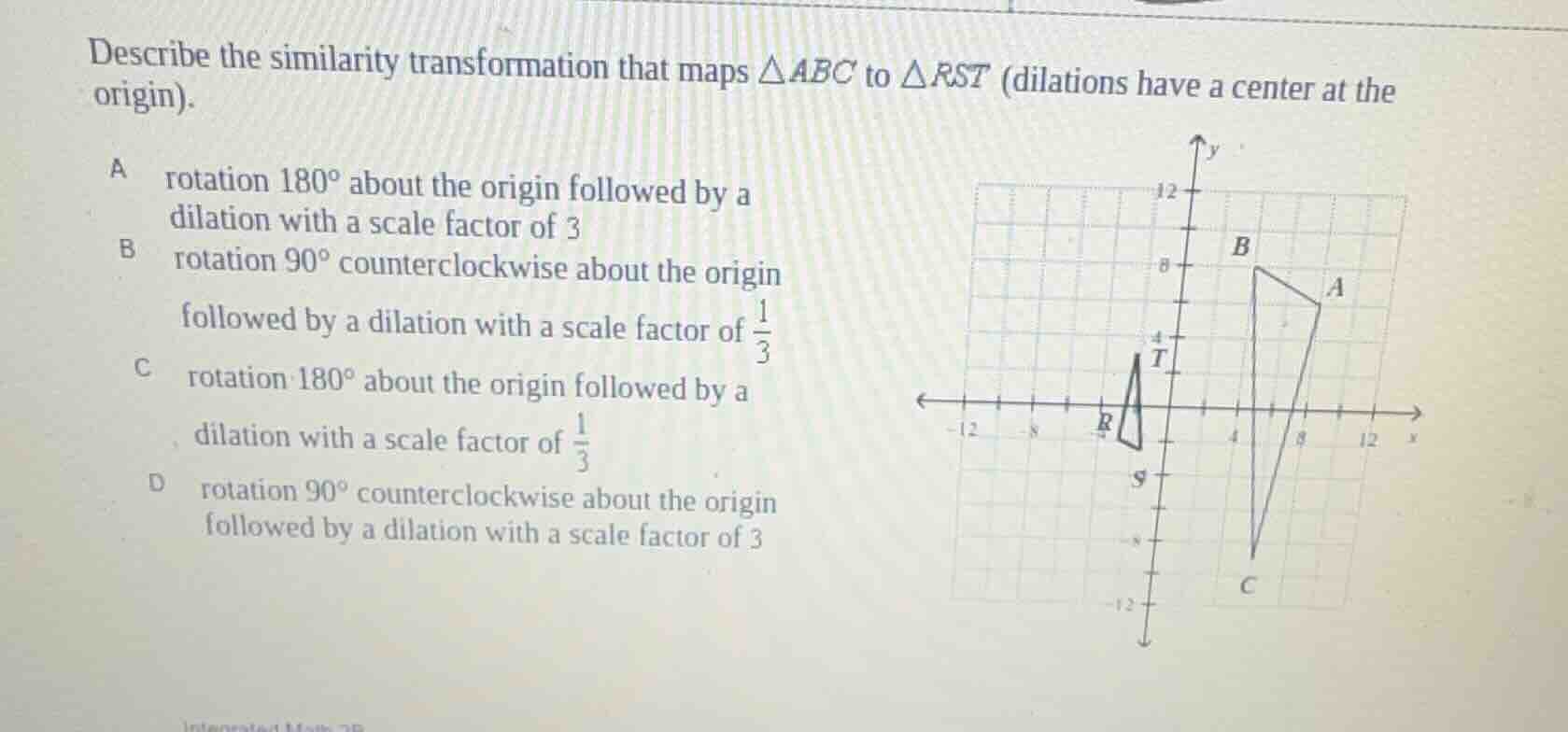
First, find coordinates of \( \triangle ABC \) and \( \triangle RST \). From the graph:
- \( A(8, 7) \), \( B(6, 8) \), \( C(6, -10) \)
- \( R(-2, -1) \), \( S(-2, -2) \), \( T(-1, 2) \) (approx, but focus on transformation)
Step2: Analyze Rotation
A \( 180^\circ \) rotation about origin transforms \( (x, y) \to (-x, -y) \).
- For \( A(8, 7) \), \( 180^\circ \) rotation gives \( (-8, -7) \).
- For \( RST \), points are smaller, so dilation scale factor \( \frac{1}{3} \): \( (-8 \times \frac{1}{3}, -7 \times \frac{1}{3}) \approx (-2.67, -2.33) \), close to \( R, S, T \) scale.
- \( 90^\circ \) rotation would change axis, not matching.
- Scale factor: \( \triangle RST \) is smaller, so scale factor \( \frac{1}{3} \), not 3. So rotation \( 180^\circ \) then dilation \( \frac{1}{3} \).

Snap & solve any problem in the app
Get step-by-step solutions on Sovi AI
Photo-based solutions with guided steps
Explore more problems and detailed explanations
C. rotation \( 180^\circ \) about the origin followed by a dilation with a scale factor of \( \frac{1}{3} \)