QUESTION IMAGE
Question
describe some the similarities and differences between metals, nonmetals, and metalloids
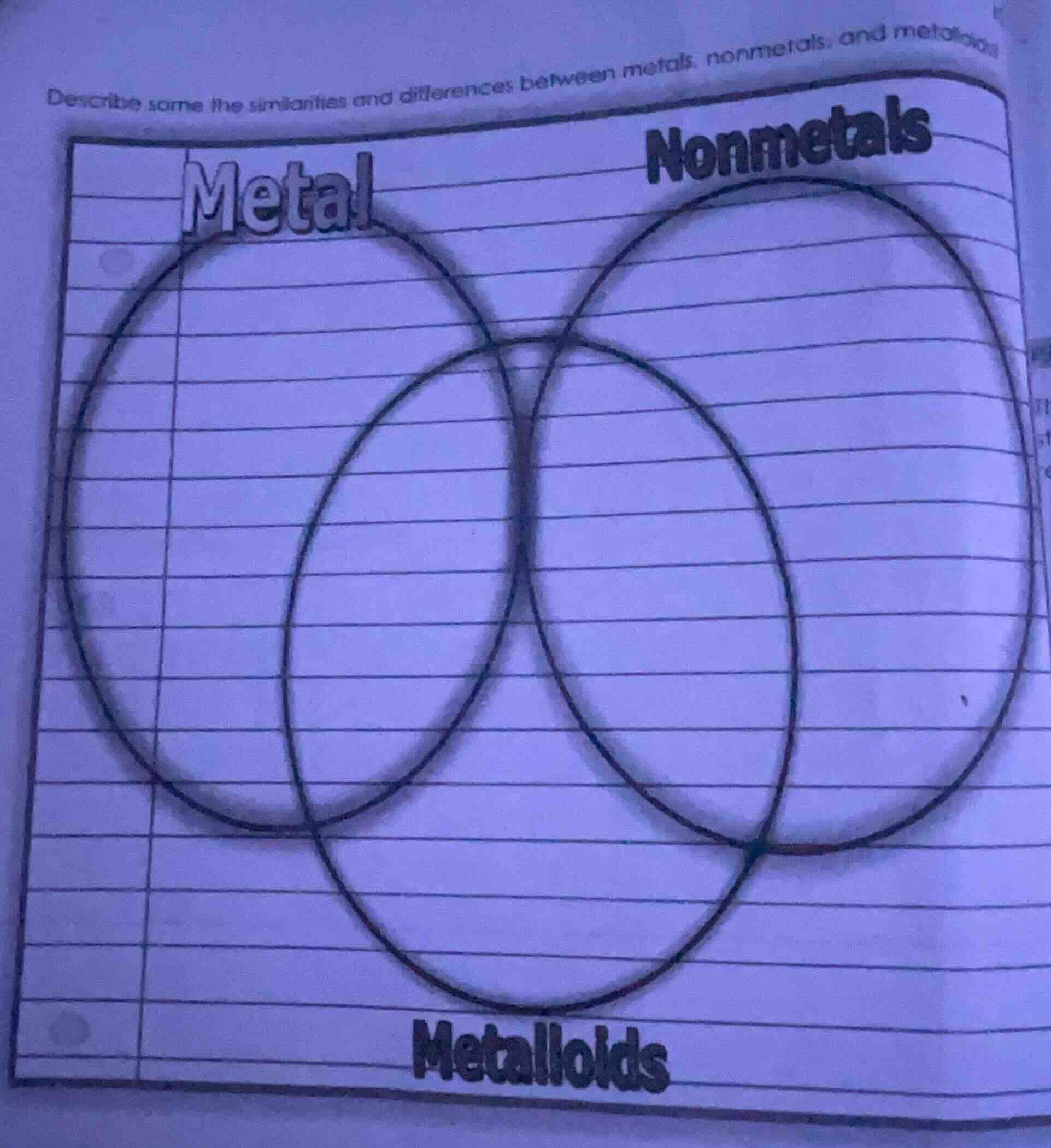
Brief Explanations
- Metal (only left circle): Unique properties include being good conductors of heat/electricity, having high luster, malleability, ductility, and typically being solid at room temperature (except mercury).
- Nonmetals (only right circle): Unique properties include being poor conductors (insulators), dull in appearance, brittle, and often gases or brittle solids at room temperature (except bromine, a liquid).
- Metalloids (only bottom circle): Unique properties include having a mix of metal and nonmetal traits, like being semi-conductors of electricity, which makes them useful in electronics.
- Metals + Metalloids (left overlapping section): Shared trait: Most are solid at room temperature.
- Nonmetals + Metalloids (right overlapping section): Shared trait: Can be brittle in solid form.
- Metals + Nonmetals (top overlapping section): Shared trait: Are all elements found on the periodic table.
- All three (center overlap): Shared trait: Are pure chemical substances made of atoms.

Snap & solve any problem in the app
Get step-by-step solutions on Sovi AI
Photo-based solutions with guided steps
Explore more problems and detailed explanations
Metal (only left circle):
- Good conductors of heat/electricity
- Lustrous, malleable, ductile
- Most are solid at room temp (Hg exception)
Nonmetals (only right circle):
- Poor heat/electricity conductors
- Dull, brittle
- Gases/brittle solids at room temp (Br exception)
Metalloids (only bottom circle):
- Semi-conductors of electricity
- Mix of metal/nonmetal traits
- Used in electronic components
Metals + Metalloids (left overlap):
- Mostly solid at room temperature
Nonmetals + Metalloids (right overlap):
- Brittle in solid form
Metals + Nonmetals (top overlap):
- Classified as pure elements on the periodic table
All three (center overlap):
- Composed of pure, distinct atoms