QUESTION IMAGE
Question
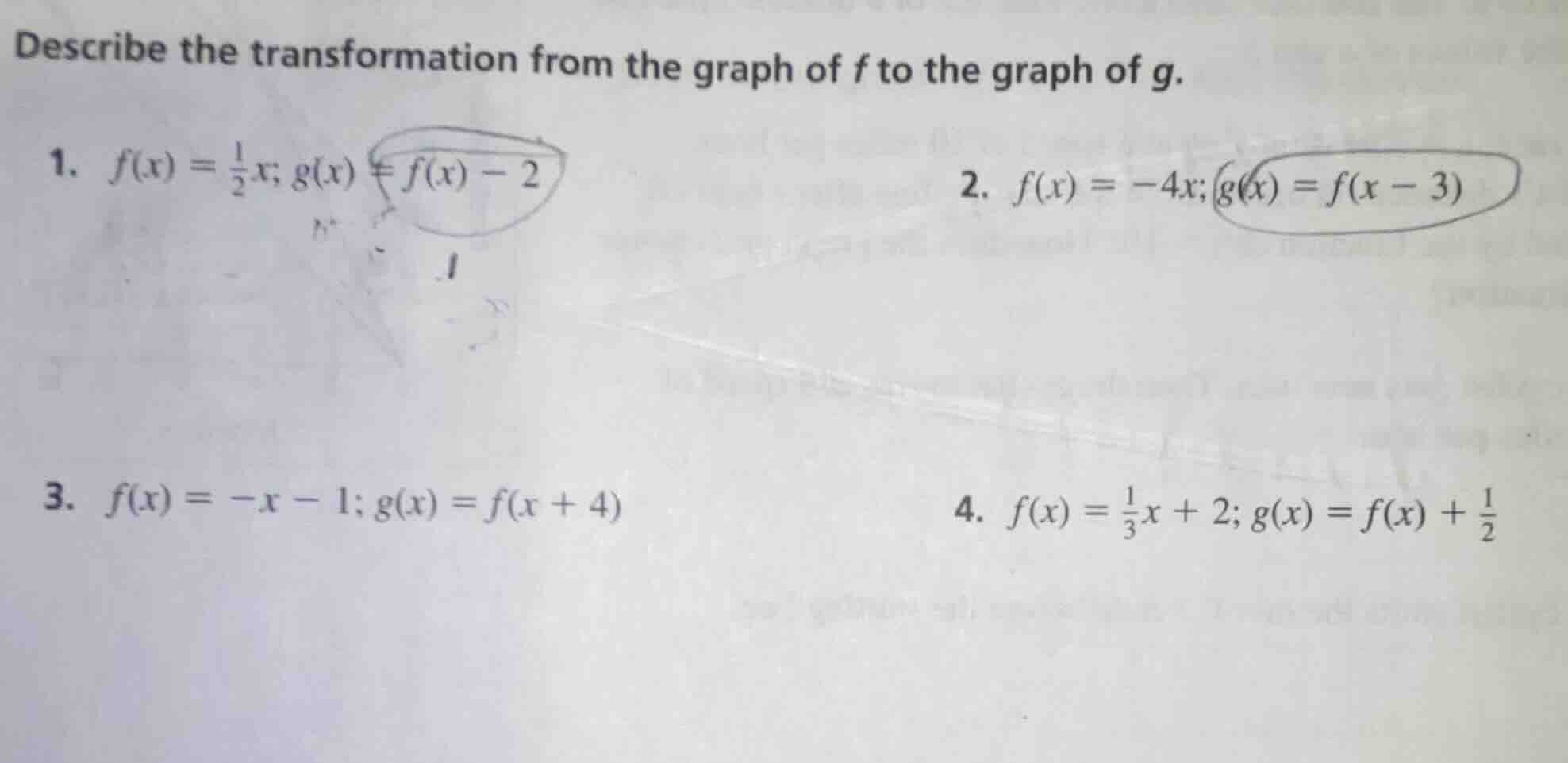
describe the transformation from the graph of f to the graph of g. 1. $f(x) = \frac{1}{2}x$; $g(x) = f(x) - 2$ 2. $f(x) = -4x$; $g(x) = f(x - 3)$ 3. $f(x) = -x - 1$; $g(x) = f(x + 4)$ 4. $f(x) = \frac{1}{3}x + 2$; $g(x) = f(x) + \frac{1}{2}$
Brief Explanations
- For $g(x)=f(x)-2$, subtracting a constant from $f(x)$ shifts the graph vertically downward by the constant's value.
- For $g(x)=f(x-3)$, replacing $x$ with $x-3$ in $f(x)$ shifts the graph horizontally to the right by 3 units.
- For $g(x)=f(x+4)$, replacing $x$ with $x+4$ in $f(x)$ shifts the graph horizontally to the left by 4 units.
- For $g(x)=f(x)+\frac{1}{2}$, adding a constant to $f(x)$ shifts the graph vertically upward by the constant's value.

Snap & solve any problem in the app
Get step-by-step solutions on Sovi AI
Photo-based solutions with guided steps
Explore more problems and detailed explanations
- The graph of $g$ is the graph of $f$ shifted down 2 units.
- The graph of $g$ is the graph of $f$ shifted right 3 units.
- The graph of $g$ is the graph of $f$ shifted left 4 units.
- The graph of $g$ is the graph of $f$ shifted up $\frac{1}{2}$ units.