QUESTION IMAGE
Question
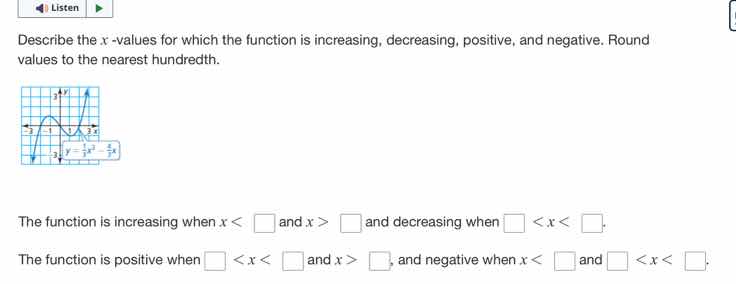
describe the x-values for which the function is increasing, decreasing, positive, and negative. round values to the nearest hundredth.
the function is increasing when $x < \square$ and $x > \square$ and decreasing when $\square < x < \square$.
the function is positive when $\square < x < \square$ and $x > \square$, and negative when $x < \square$ and $\square < x < \square$.
Step1: Identify increasing intervals
From the graph, the function rises as \(x\) moves left from the local minimum, and rises as \(x\) moves right from the local maximum. The local minimum is at \(x \approx 1.15\), local maximum at \(x \approx -1.15\).
Increasing: \(x < -1.15\) and \(x > 1.15\)
Step2: Identify decreasing interval
The function falls between the local maximum and local minimum.
Decreasing: \(-1.15 < x < 1.15\)
Step3: Identify positive intervals
The function is above the x-axis (positive) between its left and middle x-intercepts, and right of its right x-intercept. The x-intercepts are \(x \approx -2.00\), \(x \approx 0.00\), \(x \approx 2.00\).
Positive: \(-2.00 < x < 0.00\) and \(x > 2.00\)
Step4: Identify negative intervals
The function is below the x-axis (negative) left of the first x-intercept, and between the middle and right x-intercepts.
Negative: \(x < -2.00\) and \(0.00 < x < 2.00\)

Snap & solve any problem in the app
Get step-by-step solutions on Sovi AI
Photo-based solutions with guided steps
Explore more problems and detailed explanations
The function is increasing when \(x < -1.15\) and \(x > 1.15\) and decreasing when \(-1.15 < x < 1.15\).
The function is positive when \(-2.00 < x < 0.00\) and \(x > 2.00\), and negative when \(x < -2.00\) and \(0.00 < x < 2.00\).