QUESTION IMAGE
Question
description/rule
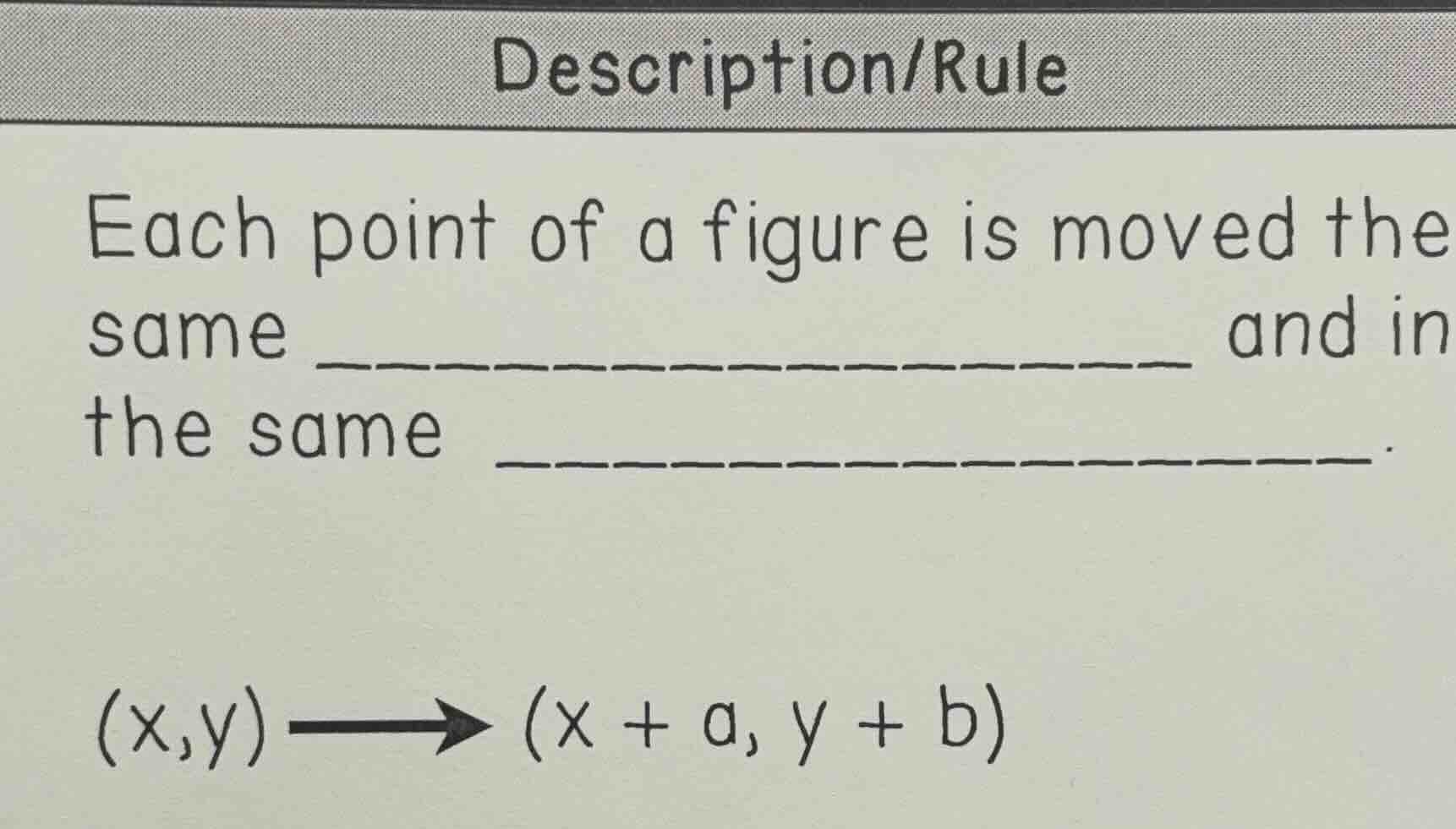
each point of a figure is moved the
same ______________________ and in
the same ______________________.
$(x,y) \longrightarrow (x + a, y + b)$
Step1: Recall the definition of translation
In a translation (a type of transformation in geometry), each point of a figure is moved the same distance and in the same direction. The given rule \((x,y)\to(x + a,y + b)\) also shows that we are adding a constant \(a\) (for horizontal movement) and \(b\) (for vertical movement), which means each point is moved a certain distance (determined by \(a\) and \(b\)) in a specific direction (right/left for \(x\)-component, up/down for \(y\)-component).
Step2: Fill in the blanks
The first blank should be "distance" because we move each point by the same length (distance), and the second blank should be "direction" because the movement is in the same orientation (direction) for all points.

Snap & solve any problem in the app
Get step-by-step solutions on Sovi AI
Photo-based solutions with guided steps
Explore more problems and detailed explanations
First blank: distance
Second blank: direction