QUESTION IMAGE
Question
details
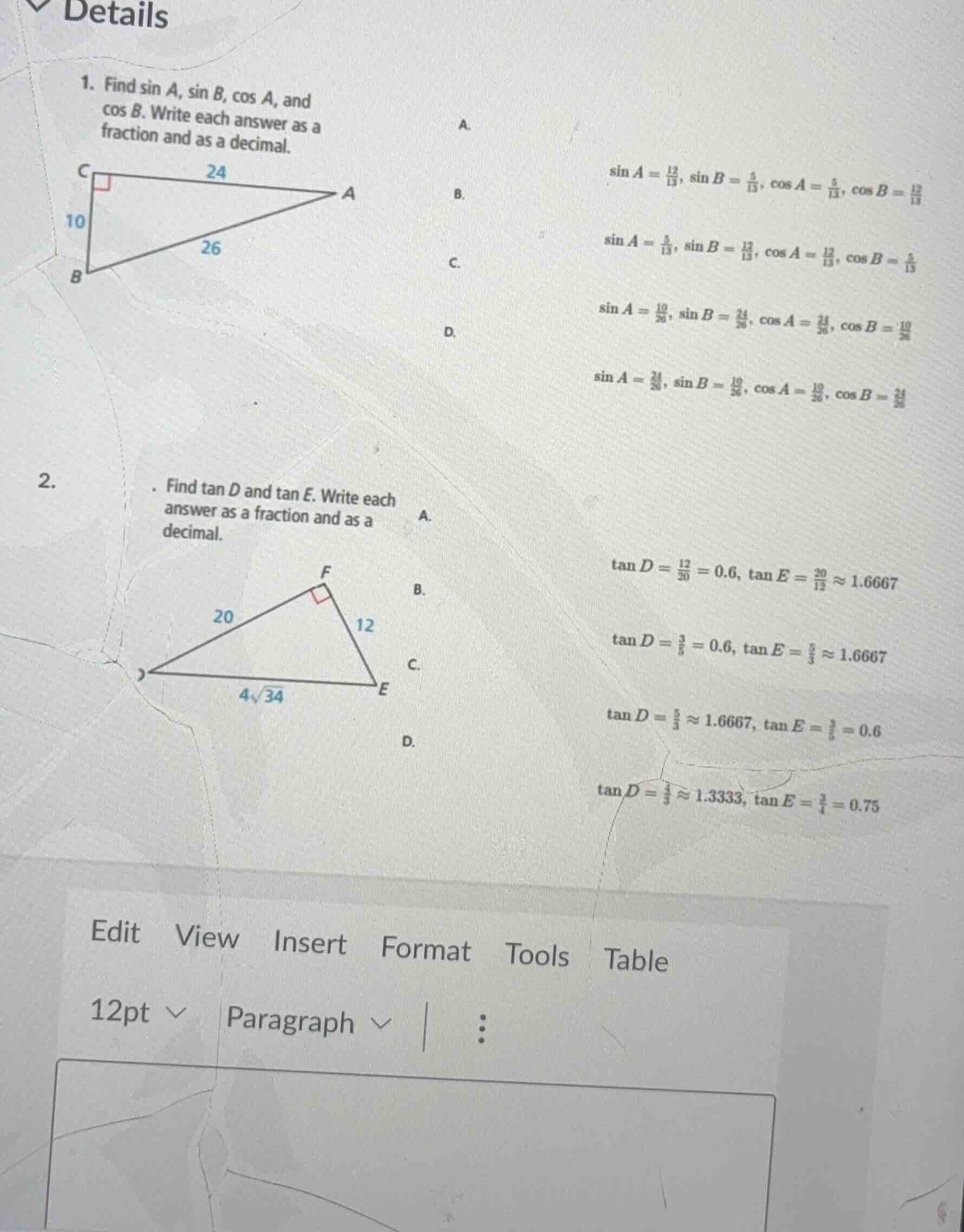
- find sin a, sin b, cos a, and
cos b. write each answer as a
fraction and as a decimal.
right triangle abc with right angle at c, bc=10, ac=24, ab=26
a.
$sin a = \frac{12}{13}$, $sin b = \frac{5}{13}$, $cos a = \frac{5}{13}$, $cos b = \frac{12}{13}$
b.
$sin a = \frac{5}{13}$, $sin b = \frac{12}{13}$, $cos a = \frac{12}{13}$, $cos b = \frac{5}{13}$
c.
$sin a = \frac{10}{26}$, $sin b = \frac{24}{26}$, $cos a = \frac{24}{26}$, $cos b = \frac{10}{26}$
d.
$sin a = \frac{24}{26}$, $sin b = \frac{10}{26}$, $cos a = \frac{10}{26}$, $cos b = \frac{24}{26}$
2.
. find tan d and tan e. write each
answer as a fraction and as a
decimal.
right triangle def with right angle at f, df=20, ef=12, de=$4\sqrt{34}$
a.
$\tan d = \frac{12}{20} = 0.6$, $\tan e = \frac{20}{12} \approx 1.6667$
b.
$\tan d = \frac{3}{5} = 0.6$, $\tan e = \frac{5}{3} \approx 1.6667$
c.
$\tan d = \frac{5}{3} \approx 1.6667$, $\tan e = \frac{3}{5} = 0.6$
d.
$\tan d = \frac{4}{3} \approx 1.3333$, $\tan e = \frac{3}{4} = 0.75$
Question 1
Step1: Recall trigonometric ratios
In a right triangle, \(\sin\theta=\frac{\text{opposite}}{\text{hypotenuse}}\) and \(\cos\theta=\frac{\text{adjacent}}{\text{hypotenuse}}\). For \(\triangle ABC\) with right angle at \(C\), hypotenuse \(AB = 26\), \(BC = 10\), \(AC = 24\).
Step2: Calculate \(\sin A\)
For \(\angle A\), opposite side is \(BC = 10\)? Wait, no: Wait, \(A\) is at vertex \(A\), so opposite side to \(A\) is \(BC = 10\)? Wait, no, wait: \(AC = 24\) (adjacent to \(A\)), \(BC = 10\) (opposite to \(A\)), hypotenuse \(AB = 26\). Wait, no, wait: \(\sin A=\frac{\text{opposite to }A}{\text{hypotenuse}}=\frac{BC}{AB}=\frac{10}{26}=\frac{5}{13}\)? Wait, no, wait the options: Wait option B: \(\sin A=\frac{5}{13}\), \(\sin B=\frac{12}{13}\). Wait, let's recheck:
Wait, \(A\): angle at \(A\), so sides: opposite is \(BC = 10\), adjacent is \(AC = 24\), hypotenuse \(AB = 26\). Wait, but \(10 - 24 - 26\) is a Pythagorean triple? \(10^2+24^2 = 100 + 576 = 676=26^2\), yes. So \(\sin A=\frac{BC}{AB}=\frac{10}{26}=\frac{5}{13}\), \(\cos A=\frac{AC}{AB}=\frac{24}{26}=\frac{12}{13}\). For \(\angle B\), opposite side is \(AC = 24\), adjacent is \(BC = 10\), so \(\sin B=\frac{AC}{AB}=\frac{24}{26}=\frac{12}{13}\), \(\cos B=\frac{BC}{AB}=\frac{10}{26}=\frac{5}{13}\). Wait, but option B: \(\sin A=\frac{5}{13}\), \(\sin B=\frac{12}{13}\), \(\cos A=\frac{12}{13}\), \(\cos B=\frac{5}{13}\). Yes, that matches. Wait, I think I made a mistake earlier: \(BC = 10\) (opposite to \(A\))? No, \(A\) is at the end of \(AC\) and \(AB\), so the sides: \(AC\) is from \(A\) to \(C\), \(AB\) is hypotenuse. So angle \(A\): the sides: opposite is \(BC\) (length 10), adjacent is \(AC\) (length 24), hypotenuse \(AB = 26\). So \(\sin A=\frac{BC}{AB}=\frac{10}{26}=\frac{5}{13}\), \(\cos A=\frac{AC}{AB}=\frac{24}{26}=\frac{12}{13}\). For angle \(B\): opposite is \(AC = 24\), adjacent is \(BC = 10\), so \(\sin B=\frac{AC}{AB}=\frac{24}{26}=\frac{12}{13}\), \(\cos B=\frac{BC}{AB}=\frac{10}{26}=\frac{5}{13}\). So option B is correct.
Step1: Recall tangent ratio
In a right triangle, \(\tan\theta=\frac{\text{opposite}}{\text{adjacent}}\). For \(\triangle DEF\) with right angle at \(F\), \(DF = 20\), \(EF = 12\)? Wait, no, the triangle has right angle at \(F\), so \(DF = 20\) (hypotenuse? No, \(DF\) and \(EF\) are legs? Wait, \(DF = 20\), \(EF = 12\), and hypotenuse \(DE = 4\sqrt{34}\). Let's check: \(20^2+12^2 = 400 + 144 = 544 = (4\sqrt{34})^2=16\times34 = 544\), yes. So for \(\angle D\), opposite side is \(EF = 12\), adjacent side is \(DF = 20\)? Wait, no: angle at \(D\), so opposite side is \(EF = 12\), adjacent side is \(DF = 20\)? Wait, \(\tan D=\frac{\text{opposite to }D}{\text{adjacent to }D}=\frac{EF}{DF}=\frac{12}{20}=\frac{3}{5}=0.6\). For \(\angle E\), opposite side is \(DF = 20\), adjacent side is \(EF = 12\), so \(\tan E=\frac{DF}{EF}=\frac{20}{12}=\frac{5}{3}\approx1.6667\). Wait, but option B: \(\tan D=\frac{3}{5}=0.6\), \(\tan E=\frac{5}{3}\approx1.6667\). Wait, but let's check the options:
Option B: \(\tan D=\frac{3}{5}=0.6\), \(\tan E=\frac{5}{3}\approx1.6667\). Let's verify:
\(\tan D=\frac{\text{opposite to }D}{\text{adjacent to }D}=\frac{EF}{DF}=\frac{12}{20}=\frac{3}{5}=0.6\). \(\tan E=\frac{\text{opposite to }E}{\text{adjacent to }E}=\frac{DF}{EF}=\frac{20}{12}=\frac{5}{3}\approx1.6667\). So option B is correct.

Snap & solve any problem in the app
Get step-by-step solutions on Sovi AI
Photo-based solutions with guided steps
Explore more problems and detailed explanations
B. \(\sin A = \frac{5}{13}\), \(\sin B = \frac{12}{13}\), \(\cos A = \frac{12}{13}\), \(\cos B = \frac{5}{13}\)