QUESTION IMAGE
Question
- determine the area of the square that would be attached to the hypotenuse of each right triangle. show your thinking. (4 marks)
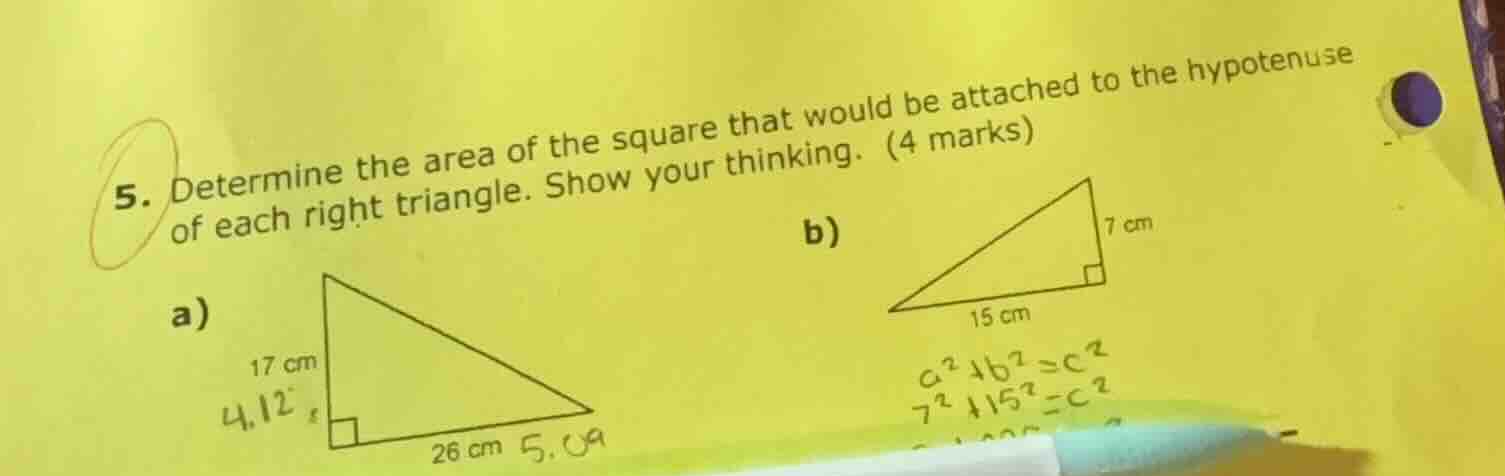
a) a right triangle with one leg 17 cm and the other leg 26 cm.
b) a right triangle with one leg 15 cm and the other leg 7 cm.
Part (a)
Step1: Recall Pythagorean theorem
For a right triangle, \( a^2 + b^2 = c^2 \), where \( c \) is the hypotenuse, and \( a, b \) are the legs. The area of the square on the hypotenuse is \( c^2 \), so we need to find \( a^2 + b^2 \) with \( a = 17 \, \text{cm} \), \( b = 26 \, \text{cm} \).
\[
c^2 = 17^2 + 26^2
\]
Step2: Calculate squares
\[
17^2 = 289, \quad 26^2 = 676
\]
Step3: Sum the squares
\[
c^2 = 289 + 676 = 965
\]
Step1: Recall Pythagorean theorem
For a right triangle, \( a^2 + b^2 = c^2 \), where \( c \) is the hypotenuse, and \( a, b \) are the legs. The area of the square on the hypotenuse is \( c^2 \), so we need to find \( a^2 + b^2 \) with \( a = 7 \, \text{cm} \), \( b = 15 \, \text{cm} \).
\[
c^2 = 7^2 + 15^2
\]
Step2: Calculate squares
\[
7^2 = 49, \quad 15^2 = 225
\]
Step3: Sum the squares
\[
c^2 = 49 + 225 = 274
\]

Snap & solve any problem in the app
Get step-by-step solutions on Sovi AI
Photo-based solutions with guided steps
Explore more problems and detailed explanations
The area of the square on the hypotenuse is \( \boldsymbol{965} \) square centimeters.